Pound Sterling trades quietly ahead of Trump-Zelenskyy meet, Jackson Hole, and UK CPI
- The Pound Sterling consolidates around 1.3550 against the US Dollar ahead of the Trump-Zelenskyy meeting at the White House.
- Traders remain confident that the Fed will cut interest rates in September.
- Economists expect the UK core CPI to have grown steadily by 3.7%.

The Pound Sterling (GBP) trades in a tight range around 1.3550 against the US Dollar (USD) during the European trading session on Monday. The GBP/USD pair consolidates as investors await the meeting between United States (US) President Donald Trump, Ukrainian President Volodymyr Zelenskyy, and NATO members at the White House on Monday to discuss the terms laid down by Russian leader Vladimir Putin for ending the war in Ukraine.
On Friday, Trump met with Putin in Alaska to discuss a peace agreement. Trump told after the meeting that Putin had offered to freeze most front lines if Kyiv ceded all of Donetsk, the industrial region that is one of Moscow’s main targets, Reuters reported. Ukrainian President Zelenskyy has rejected the idea of giving up territory.
Market sentiment remains broadly stable ahead of Trump-Zelenskyy meeting, with S&P 500 futures trading 0.13% higher around 6,460. Signs of a truce between Moscow and Kyiv after the Trump-Zelenskyy meeting would be favorable for riskier assets. However, no positive outcome of the meeting is unlikely to dampen risk sentiment as investors have already discounted the consequences of the Russia-Ukraine war.
Daily digest market movers: Pound Sterling trades broadly stable
- The Pound Sterling trades stable at the start of the week, with investors awaiting the release of the United Kingdom (UK) Consumer Price Index (CPI) data for July on Wednesday. Investors will closely monitor the UK inflation data as it will influence market expectations for the Bank of England’s (BoE) monetary policy outlook. The core CPI – which excludes volatile items such as food, energy, alcohol and tobacco – is estimated to have grown at a steady pace of 3.7% on year.
- Signs of price pressures remaining persistent would allow the BoE to remain committed to its “gradual and careful” monetary expansion guidance, which it reiterated in the policy meeting earlier this month after reducing interest rates by 25 basis points (bps) to 4.25% with a slim majority.
- The major trigger for the US Dollar this week will be the Jackson Hole Symposium, which is scheduled for August 21-23. Investors will pay close attention to Federal Reserve (Fed) Chair Jerome Powell’s comments for fresh cues on the interest rate outlook.
- During the press time, the US Dollar Index (DXY), which tracks the Greenback’s value against six major currencies, strives to gain ground near an almost three-week low above 97.60.
- The US Dollar has underperformed since the Nonfarm Payrolls (NFP) report for July showed signs of cooling labor market conditions, which were followed by a sharp increase in market expectations for the Fed’s interest rate cuts in the September policy meeting. According to the CME FedWatch tool, the probability of the Fed cutting interest rates in September is at 82.6%.
- On Friday, San Francisco Fed Bank President Mary Daly said in an interview with Fox Business that there is room for an interest rate cut in September and for two in the year even as the Producer Price Index (PPI) grew at a faster pace in July.
US Dollar PRICE Today
The table below shows the percentage change of US Dollar (USD) against listed major currencies today. US Dollar was the strongest against the Euro.
| USD | EUR | GBP | JPY | CAD | AUD | NZD | CHF | |
|---|---|---|---|---|---|---|---|---|
| USD | 0.29% | 0.09% | 0.18% | -0.14% | -0.04% | -0.21% | 0.23% | |
| EUR | -0.29% | -0.21% | -0.14% | -0.43% | -0.32% | -0.53% | -0.06% | |
| GBP | -0.09% | 0.21% | -0.02% | -0.22% | -0.11% | -0.32% | 0.11% | |
| JPY | -0.18% | 0.14% | 0.02% | -0.30% | -0.19% | -0.36% | 0.06% | |
| CAD | 0.14% | 0.43% | 0.22% | 0.30% | 0.08% | -0.07% | 0.34% | |
| AUD | 0.04% | 0.32% | 0.11% | 0.19% | -0.08% | -0.21% | 0.22% | |
| NZD | 0.21% | 0.53% | 0.32% | 0.36% | 0.07% | 0.21% | 0.40% | |
| CHF | -0.23% | 0.06% | -0.11% | -0.06% | -0.34% | -0.22% | -0.40% |
The heat map shows percentage changes of major currencies against each other. The base currency is picked from the left column, while the quote currency is picked from the top row. For example, if you pick the US Dollar from the left column and move along the horizontal line to the Japanese Yen, the percentage change displayed in the box will represent USD (base)/JPY (quote).
Technical Analysis: Pound Sterling holds key 20-day EMA
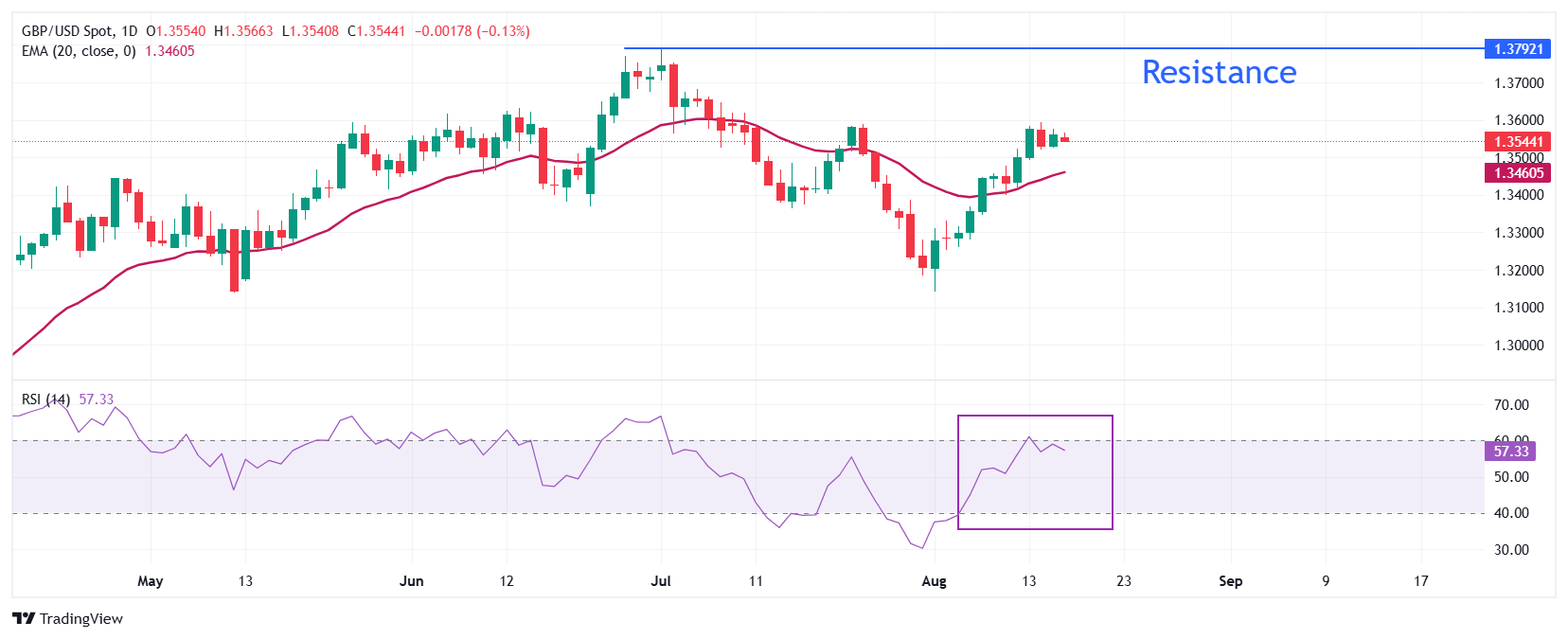
The Pound Sterling trades in a tight range around 1.3550 against the US Dollar on Monday. The near-term trend of the GBP/USD pair remains bullish as it holds above the 20-day Exponential Moving Average (EMA), which trades around 1.3460.
The 14-day Relative Strength Index (RSI) strives to break above 60.00. A fresh bullish momentum would emerge if the RSI breaks above that level.
Looking down, the August 11 low of 1.3400 will act as a key support zone. On the upside, the July 1 high near 1.3790 will act as a key barrier.
Risk sentiment FAQs
In the world of financial jargon the two widely used terms “risk-on” and “risk off'' refer to the level of risk that investors are willing to stomach during the period referenced. In a “risk-on” market, investors are optimistic about the future and more willing to buy risky assets. In a “risk-off” market investors start to ‘play it safe’ because they are worried about the future, and therefore buy less risky assets that are more certain of bringing a return, even if it is relatively modest.
Typically, during periods of “risk-on”, stock markets will rise, most commodities – except Gold – will also gain in value, since they benefit from a positive growth outlook. The currencies of nations that are heavy commodity exporters strengthen because of increased demand, and Cryptocurrencies rise. In a “risk-off” market, Bonds go up – especially major government Bonds – Gold shines, and safe-haven currencies such as the Japanese Yen, Swiss Franc and US Dollar all benefit.
The Australian Dollar (AUD), the Canadian Dollar (CAD), the New Zealand Dollar (NZD) and minor FX like the Ruble (RUB) and the South African Rand (ZAR), all tend to rise in markets that are “risk-on”. This is because the economies of these currencies are heavily reliant on commodity exports for growth, and commodities tend to rise in price during risk-on periods. This is because investors foresee greater demand for raw materials in the future due to heightened economic activity.
The major currencies that tend to rise during periods of “risk-off” are the US Dollar (USD), the Japanese Yen (JPY) and the Swiss Franc (CHF). The US Dollar, because it is the world’s reserve currency, and because in times of crisis investors buy US government debt, which is seen as safe because the largest economy in the world is unlikely to default. The Yen, from increased demand for Japanese government bonds, because a high proportion are held by domestic investors who are unlikely to dump them – even in a crisis. The Swiss Franc, because strict Swiss banking laws offer investors enhanced capital protection.
Author

Sagar Dua
FXStreet
Sagar Dua is associated with the financial markets from his college days. Along with pursuing post-graduation in Commerce in 2014, he started his markets training with chart analysis.
















