Pound Sterling edges lower against USD as US House passes Trump's tax cut bill
- The Pound Sterling gains against its peers, except the US Dollar, even though BoE’s Dhingra sees more than four interest rate cuts this year.
- US Treasury yields bounce back as the US administration clears the $4.5 trillion tax cut plan.
- Investors await the US PCE inflation data for January, scheduled for Friday.

The Pound Sterling (GBP) ticks lower to near 1.2660 against the USD in North American trading hours on Wednesday. The GBP/USD pair faces slight pressure as the US Dollar Index (DXY), which tracks the Greenback’s value against six major currencies, has shown a strong recovery move after sliding to near the 11-week low of 106.10 earlier in the day.
The Greenback bounces back strongly as bond yields gain ground after a five-day losing streak. 10-year US Treasury yields recover to near 4.33% after posting a fresh more than two-month low near 4.28% during the Asian session.
US bond yields find buyers’ interest after Republicans-controlled House of Representatives advances $4.5 trillion tax cut plan, which would also fund the deportation of migrants living in the US illegally, tighten border security, energy deregulation, and military spending, Reuters report. The injection of significant liquidity would boost inflationary pressures and force the Federal Reserve (Fed) to keep interest rates at their current levels for a prolonged period.
Meanwhile, traders have raised Fed dovish bets after weak flash United States (US) S&P Global PMI data for February showed on Friday that service sector activity contracted for the first time in over two years. According to the CME FedWatch tool, the possibility of the Fed cutting interest rates in June has increased to 65% from 47% a week ago. In the March and May policy meetings, the Fed is almost certain to keep borrowing rates steady in the range of 4.25%-4.50%.
Going forward, investors will focus on the US Durable Goods Orders and the Personal Consumption Expenditures Price Index (PCE) data for January, which will be released on Thursday and Friday, respectively. Investors will pay close attention to the US PCE inflation data as it will influence market speculation about the Fed’s monetary policy outlook.
US Dollar PRICE Today
The table below shows the percentage change of the US Dollar (USD) against listed major currencies today. The US Dollar was the strongest against the Australian Dollar.
| USD | EUR | GBP | JPY | CAD | AUD | NZD | CHF | |
|---|---|---|---|---|---|---|---|---|
| USD | 0.29% | 0.11% | 0.37% | 0.26% | 0.52% | 0.49% | 0.25% | |
| EUR | -0.29% | -0.17% | 0.06% | -0.02% | 0.24% | 0.20% | -0.03% | |
| GBP | -0.11% | 0.17% | 0.23% | 0.15% | 0.41% | 0.39% | 0.14% | |
| JPY | -0.37% | -0.06% | -0.23% | -0.08% | 0.17% | 0.13% | -0.11% | |
| CAD | -0.26% | 0.02% | -0.15% | 0.08% | 0.26% | 0.23% | -0.01% | |
| AUD | -0.52% | -0.24% | -0.41% | -0.17% | -0.26% | -0.03% | -0.27% | |
| NZD | -0.49% | -0.20% | -0.39% | -0.13% | -0.23% | 0.03% | -0.24% | |
| CHF | -0.25% | 0.03% | -0.14% | 0.11% | 0.01% | 0.27% | 0.24% |
The heat map shows percentage changes of major currencies against each other. The base currency is picked from the left column, while the quote currency is picked from the top row. For example, if you pick the US Dollar from the left column and move along the horizontal line to the Japanese Yen, the percentage change displayed in the box will represent USD (base)/JPY (quote).
Daily digest market movers: Pound Sterling gains as investors ignore BoE Dhingra's dovish guidance
- The Pound Sterling trades higher against its major peers, except the US Dollar (USD), on Wednesday as investors digest dovish guidance from Bank of England (BoE) Monetary Policy Committee (MPC) member Swati Dhingra in her speech at Birkbeck on Monday. Dhingra warned about “weakness in consumption” and didn’t see it going away sooner, which is why she favored the unwinding of “monetary policy restriction”.
- Traders have fully priced in two interest rate cuts by the BoE for the year. On the contrary, the commentary from Dhingra indicated that she favors more than four. "I know 'gradual' has been interpreted in the media as 25 basis points (bps) per quarter, but cutting interest rates at this pace for the remainder of 2025 would still leave monetary policy in an undesirable restrictive position at the end of the year,” Dhingra said.
- In the policy meeting earlier this month, the BoE reduced borrowing rates by 25 bps to 4.5% and guided a gradual policy easing. The BoE also halved its Gross Domestic Product (GDP) forecast for the year to 0.75% and warned that price pressures could temporarily increase in the third quarter due to higher energy prices.
- The outlook for the UK economy is uncertain due to potential tariffs from US President Donald Trump. Until now, Trump has imposed 10% tariffs on China and 25% on all steel and aluminum imports. He has also threatened to introduce reciprocal tariffs and 25% levies on all imports from Canada and Mexico, and he has proposed the same level of import duties on foreign cars, semiconductors, pharmaceuticals, and lumber and forest products.
Technical Analysis: Pound Sterling aims to revisit 1.2700
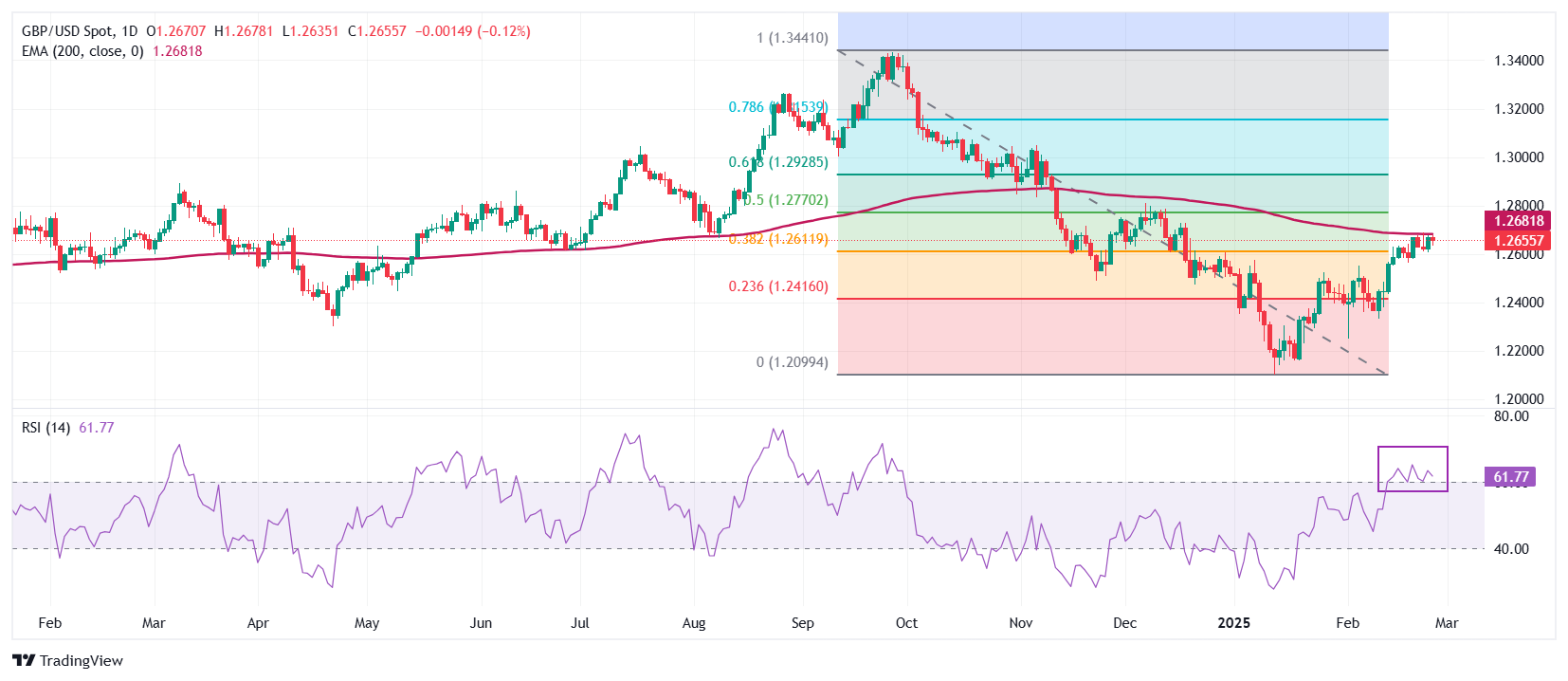
The Pound Sterling slides to near 1.2640 against the US Dollar in Wednesday’s European session. The GBP/USD pair continues to face pressure near the 200-day Exponential Moving Average (EMA), which stands at around 1.2680. The Cable holds above the 38.2% Fibonacci retracement from the end-September high to the mid-January low downtrend around 1.2620.
The 14-day Relative Strength Index (RSI) oscillates above 60.00. The bullish momentum remains intact if the RSI (14) holds above that level.
Looking down, the February 11 low of 1.2333 will act as a key support zone for the pair. On the upside, the 50% and 61.8% Fibonacci retracement at 1.2767 and 1.2927, respectively, will act as key resistance zones.
Economic Indicator
Core Personal Consumption Expenditures - Price Index (YoY)
The Core Personal Consumption Expenditures (PCE), released by the US Bureau of Economic Analysis on a monthly basis, measures the changes in the prices of goods and services purchased by consumers in the United States (US). The PCE Price Index is also the Federal Reserve’s (Fed) preferred gauge of inflation. The YoY reading compares the prices of goods in the reference month to the same month a year earlier. The core reading excludes the so-called more volatile food and energy components to give a more accurate measurement of price pressures." Generally, a high reading is bullish for the US Dollar (USD), while a low reading is bearish.
Read more.Next release: Fri Feb 28, 2025 13:30
Frequency: Monthly
Consensus: 2.6%
Previous: 2.8%
Source: US Bureau of Economic Analysis
After publishing the GDP report, the US Bureau of Economic Analysis releases the Personal Consumption Expenditures (PCE) Price Index data alongside the monthly changes in Personal Spending and Personal Income. FOMC policymakers use the annual Core PCE Price Index, which excludes volatile food and energy prices, as their primary gauge of inflation. A stronger-than-expected reading could help the USD outperform its rivals as it would hint at a possible hawkish shift in the Fed’s forward guidance and vice versa.
Author

Sagar Dua
FXStreet
Sagar Dua is associated with the financial markets from his college days. Along with pursuing post-graduation in Commerce in 2014, he started his markets training with chart analysis.