Pound Sterling declines against US Dollar ahead of US tariff deadline
- The Pound Sterling slides below 1.3600 against the US Dollar as markets focus on any trade deals ahead of the July 9 deadline for US tariffs.
- Trump prepares to send letters to those nations that have failed to ink a trade pact, specifying tariff rates.
- Higher UK welfare spending bill will need tax raise or spending cuts going forward.

The Pound Sterling (GBP) slumps to near 1.3580 against the US Dollar (USD) during European trading hours on Monday. The GBP/USD pair declines as the US Dollar trades calmly, with investors awaiting trade-related headlines in the countdown to the United States (US) tariff deadline on July 9.
The US Dollar Index (DXY), which tracks the Greenback’s value against six major currencies, trades 0.35% higher at near 97.45.
US Treasury Secretary Scott Bessent expressed confidence in an interview with CNN over the weekend that Washington will announce several deals in a couple of days, New York Times reported. “There’s a lot of foot dragging on the other side, and so I would expect to see several big announcements over the next couple of days,” Mr. Bessent said. “We’re going to be very busy over the next 72 hours,” he added.
So far, Washington has announced bilateral agreements with the United Kingdom (UK) and Vietnam and a limited trade pact with China. On July 2, the US expressed confidence that it would close a deal with India in 48 hours, but such an agreement has not been confirmed yet.
Meanwhile, investors should brace for volatility as the US is prepared to send letters to those nations that have not signed a deal with Washington during the 90-day tariff extension.
Over the weekend, Trump said the first batch of letters outlining the tariff levels they would face on exports to the United States would be sent to 12 countries on Monday, Reuters reported.
Daily digest market movers: Pound Sterling falls on mounting UK fiscal risks
- The Pound Sterling trades lower against its major peers, except antipodeans, at the start of the week. The British currency remains under pressure due to the fresh escalation in United Kingdom (UK) fiscal risks. The increase in the welfare spending bill by the administration has raised the likelihood of an announcement of a tax increase in the Autumn Budget.
- Last week, UK Chancellor of the Exchequer Rachel Reeves broke her self-imposed fiscal rules and increased the standard allowance to the Universal Credit, a move that is expected to accelerate the financial burden by £4.8 billion by fiscal year 2029-2030.
- According to a report from Barclays, the UK administration will likely necessitate tax increases in the Autumn Budget in the face of mounting fiscal challenges.
- On Thursday, Chancellor Reeves said in an interview with BBC that the administration will have to bear the cost of the increase in welfare spending. However, she didn’t clarify whether the government will raise taxes or cut spending. “Of course, there is a cost to the welfare changes that Parliament voted through this week and that will be reflected in the Budget," Reeves said.
- On the economic front, investors will focus on the monthly Gross Domestic Product (GDP) and factory data for May, which will published on Friday.
- Before that, Bank of England (BoE) Deputy Governor for Financial Stability Sarah Breeden is scheduled to speak at the Annual Chapman-Barrigan lecture series on Thursday. However, she is unlikely to speak on the monetary policy outlook and inflation.
- The next monetary policy announcement by the BoE is on August 7, with markets expecting another 25 basis points interest-rate cut to 4%, according to analysts at Deutsche Bank. The bank also expects the BoE to deliver two more interest rate cuts in November and December.
Technical Analysis: Pound Sterling struggles to hold 20-day EMA
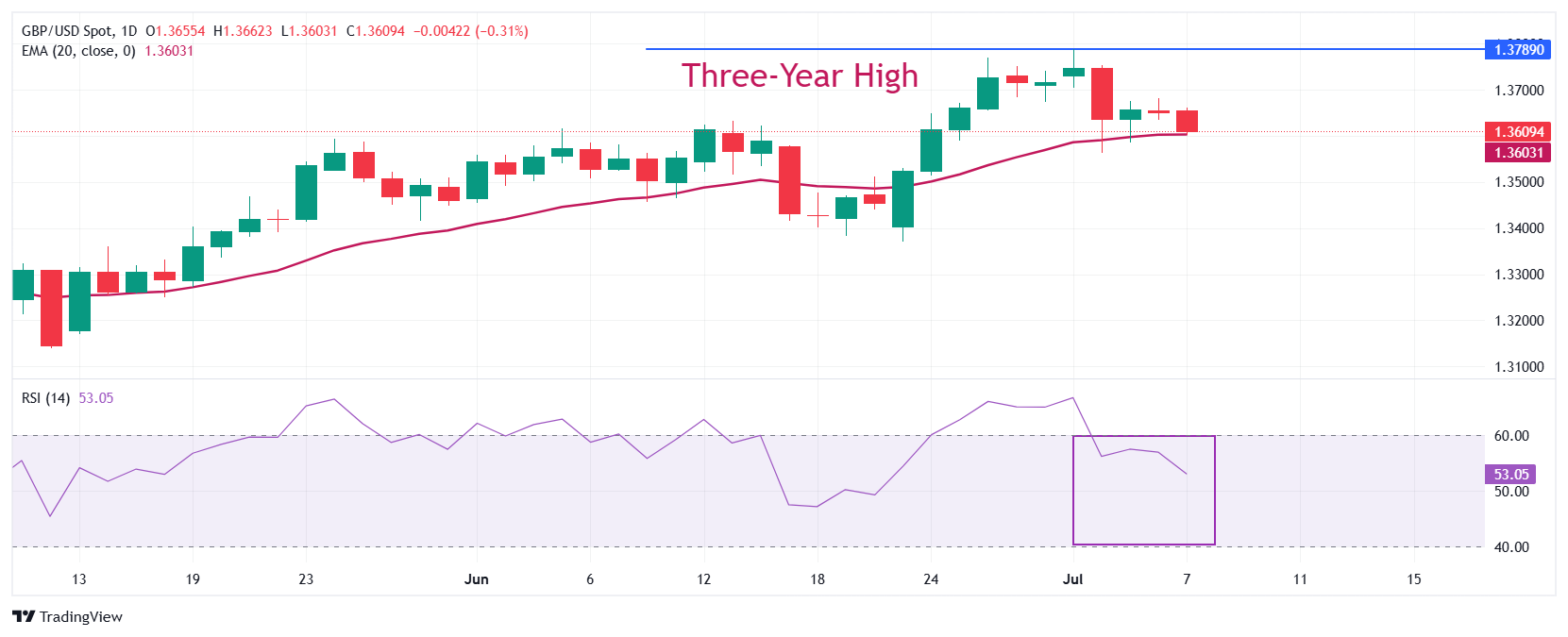
The Pound Sterling skids below the round level of 1.3600 against the US Dollar on Monday, which coincides with the 20-day Exponential Moving Average (EMA).
The 14-day Relative Strength Index (RSI) falls to near 50.00, suggesting that the bullish momentum has faded.
Looking down, the psychological level of 1.3500 will act as a key support zone. On the upside, the three-and-a-half-year high around 1.3800 will act as a key barrier.
Tariffs FAQs
Tariffs are customs duties levied on certain merchandise imports or a category of products. Tariffs are designed to help local producers and manufacturers be more competitive in the market by providing a price advantage over similar goods that can be imported. Tariffs are widely used as tools of protectionism, along with trade barriers and import quotas.
Although tariffs and taxes both generate government revenue to fund public goods and services, they have several distinctions. Tariffs are prepaid at the port of entry, while taxes are paid at the time of purchase. Taxes are imposed on individual taxpayers and businesses, while tariffs are paid by importers.
There are two schools of thought among economists regarding the usage of tariffs. While some argue that tariffs are necessary to protect domestic industries and address trade imbalances, others see them as a harmful tool that could potentially drive prices higher over the long term and lead to a damaging trade war by encouraging tit-for-tat tariffs.
During the run-up to the presidential election in November 2024, Donald Trump made it clear that he intends to use tariffs to support the US economy and American producers. In 2024, Mexico, China and Canada accounted for 42% of total US imports. In this period, Mexico stood out as the top exporter with $466.6 billion, according to the US Census Bureau. Hence, Trump wants to focus on these three nations when imposing tariffs. He also plans to use the revenue generated through tariffs to lower personal income taxes.
Author

Sagar Dua
FXStreet
Sagar Dua is associated with the financial markets from his college days. Along with pursuing post-graduation in Commerce in 2014, he started his markets training with chart analysis.

















