Pound Sterling falls against US Dollar amid Middle East tensions
- The Pound Sterling drops to near 1.3545 against the US Dollar, with investors seeking fresh cues on the Israel-Iran war outlook.
- Investors expect the Fed and the BoE to leave interest rates steady this week.
- The UK inflation is expected to have grown moderately in May.

The Pound Sterling (GBP) underperforms its peers on Tuesday amid conflict between Israel and Iran. Escalating tensions in the Middle Eash have dampened the risk appetite of investors, resulting in an increase in demand for safe-haven assets.
The tussle between Iran and Israel enters its fifth day. The Israeli military said during late Asian hours on Tuesday that they had identified missiles launched from Iran toward Israel, according to the BBC News.
Earlier in the day, a report from Reuters showed that Iran sought after its Middle East peers to urge United States (US) President Donald Trump to push Israeli Prime Minister Benjamin Netanyahu for an immediate ceasefire.
Following Tehran’s urge, Trump has asked US Vice President JD Vance and the Middle East envoy to push for meeting with the Iranians this week at the sidelines of the G7 meeting, The New York Times reported.
At the time of writing, the US Dollar Index (DXY), which tracks the Greenback’s value against six major currencies, wobbles around 98.15. Theoretcically, the demand for the US Dollar should have increasd amid heightening geopolitical tensions, given its safe-haven appeal. However, it is struggling to gain strength, with investors awaiting the Federal Reserve's (Fed) monetary policy announcement on Wednesday.
Daily digest market movers: Pound Sterling ticks down againt US Dollar
- The Pound Sterling drops to near 1.3545 against the US Dollar (USD) during European trading hours. The GBP/USD pair falls ahead of upcoming monetary policy announcements by the Fed and the Bank of England (BoE), which are scheduled for Wednesday and Thursday, respectively.
- According to the CME FedWatch tool, the Fed is almost certain to leave interest rates steady in the range of 4.25%-4.50% this time. Traders are increasingly confident that the central bank will keep borrowing rates on hold as officials have stated that monetary policy adjustments are inappropriate until they get clarity on how much new economic policies will impact inflation and affect the outlook.
- The major highlight of the Fed’s policy will be the dot plot, which shows where officials see interest rates heading in the near and long term. In the last release of the dot plot in March, officials anticipated at least two interest rate cuts by the year-end. Apart from that, investors will also focus on the monetary policy statement and Fed Chair Jerome Powell’s press conference to know when the central bank could start reducing interest rates.
- In Wednesday’s monetary policy announcement, the Fed will also show forecasts on inflation and economic growth. It will be interesting to watch the degree of change in these key economic triggers amid the implementation of new policies by US President Trump.
- In the United Kingdom (UK), the Bank of England (BoE) is also expected to keep interest rates steady at 4.25% as officials guided a “gradual and cautious” monetary easing approach in thMay’s policy meeting, following an interest rate reduction by 25 basis points (bps).
- However, market participants expect that the BoE could reassess its monetary policy guidance, given recent cracks in the UK labor market. Latest employment data showed an increase in the Unemployment Rate and slower job growth as business owners reduced labor force to offset the impact of an increase in employers’ contribution to social security schemes.
- Ahead of the BoE monetary policy announcement, investors will focus on the UK Consumer Price Index (CPI) data for May, which will be released on Wednesday. The inflation data is expected to show that price pressures have cooled down.
Technical Analysis: Pound Sterling drops to near 1.3540
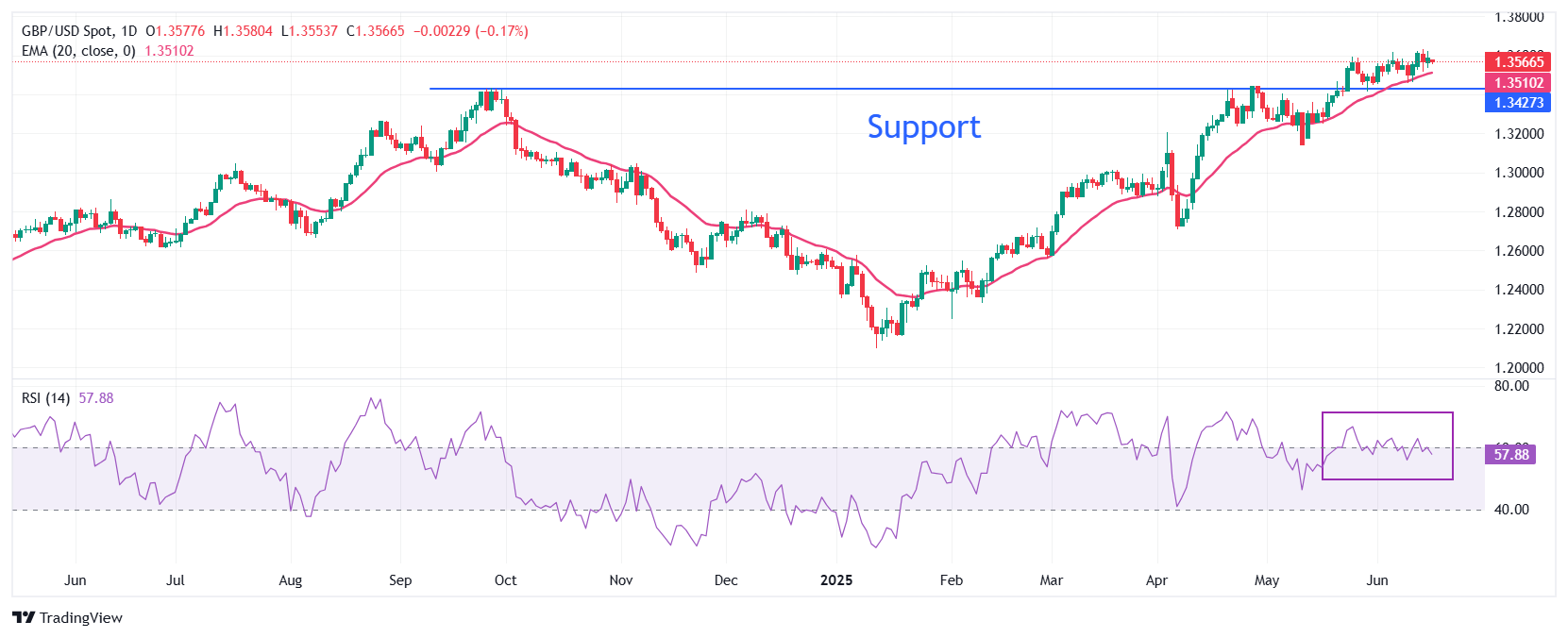
The Pound Sterling wobbles inside Monday’s trading range around 1.3565 against the US Dollar on Tuesday. The GBP/USD pair struggles to revisit the three-year high around 1.3630. The near-term trend of the Cable remains bullish as the 20-day Exponential Moving Average (EMA) slopes higher around 1.3508.
The 14-day Relative Strength Index (RSI) struggles to break decisively above 60.00. A fresh bullish momentum would emerge if the RSI holds above that level.
On the upside, the 13 January 2022 high of 1.3750 will be a key hurdle for the pair. Looking down, the horizontal line plotted from the September 26 high of 1.3434 will act as a key support zone.
US Dollar FAQs
The US Dollar (USD) is the official currency of the United States of America, and the ‘de facto’ currency of a significant number of other countries where it is found in circulation alongside local notes. It is the most heavily traded currency in the world, accounting for over 88% of all global foreign exchange turnover, or an average of $6.6 trillion in transactions per day, according to data from 2022. Following the second world war, the USD took over from the British Pound as the world’s reserve currency. For most of its history, the US Dollar was backed by Gold, until the Bretton Woods Agreement in 1971 when the Gold Standard went away.
The most important single factor impacting on the value of the US Dollar is monetary policy, which is shaped by the Federal Reserve (Fed). The Fed has two mandates: to achieve price stability (control inflation) and foster full employment. Its primary tool to achieve these two goals is by adjusting interest rates. When prices are rising too quickly and inflation is above the Fed’s 2% target, the Fed will raise rates, which helps the USD value. When inflation falls below 2% or the Unemployment Rate is too high, the Fed may lower interest rates, which weighs on the Greenback.
In extreme situations, the Federal Reserve can also print more Dollars and enact quantitative easing (QE). QE is the process by which the Fed substantially increases the flow of credit in a stuck financial system. It is a non-standard policy measure used when credit has dried up because banks will not lend to each other (out of the fear of counterparty default). It is a last resort when simply lowering interest rates is unlikely to achieve the necessary result. It was the Fed’s weapon of choice to combat the credit crunch that occurred during the Great Financial Crisis in 2008. It involves the Fed printing more Dollars and using them to buy US government bonds predominantly from financial institutions. QE usually leads to a weaker US Dollar.
Quantitative tightening (QT) is the reverse process whereby the Federal Reserve stops buying bonds from financial institutions and does not reinvest the principal from the bonds it holds maturing in new purchases. It is usually positive for the US Dollar.
Author

Sagar Dua
FXStreet
Sagar Dua is associated with the financial markets from his college days. Along with pursuing post-graduation in Commerce in 2014, he started his markets training with chart analysis.