Pound Sterling recovers as steady UK wage growth deepens BoE rate-cut uncertainty
- The Pound Sterling recovers sharply from 1.2500 due to steady UK wage growth.
- UK employers laid off workers for the third time in a row but wage growth remains steady.
- The US Dollar comes under pressure despite the US monthly PPI growing strongly in April.


The Pound Sterling (GBP) discovers strong buying interest near the psychological support of 1.2500 against the US Dollar in Tuesday’s New York session. The GBP/USD pair rebounds as the impact of weak United Kingdom (UK) Employment data for three months ending in March was offset by steady wage growth. Also, a decline in the US Dollar despite hot United States Producer Price Index (PPI) has boosted demand for the Cable.
The United Kingdom (UK) Office for National Statistics (ONS) has reported that labor market has witnessed a drawdown for the third time in a row while wage growth momentum remains steady at relatively high levels.
After the labor market data, BoE Chief Economist commented, "Rates of pay growth remain quite well above what would be consistent for meeting the 2% inflation target sustainably." Pill emphasized maintaining a restrictive stance on monetary policy that continues to build downside pressure on domestic inflation persistence. Over rate cuts, Pill commented that it is reasonable to believe that over the summer, we will see enough confidence to consider lowering interest rates.
Daily digest market movers: Pound Sterling holds gains as US Dollar fails to capitalizes on stubborn US PPI data
- The Pound Sterling finds strong buying interest near 1.2500 against the US Dollar. The GBP/USD pair rises even though UK employers laid off 177K workers, which was higher than the firing of 156K employees in the December-February period. The ILO Unemployment Rate rises to 4.3% as expected from the former reading of 4.2%. The labor market data clearly indicates that the economy is struggling to bear the consequences of the Bank of England's (BoE) higher interest rates.
- In the current scenario, the situation seems favorable for the BoE to begin reducing interest rates, as price pressures are also consistently softening. However, strong wage growth that is feeding service inflation will continue to remain a major concern for BoE policymakers. Annual Average Earnings (both excluding and including bonuses) grew steadily by 6.0% and 5.7%, respectively, for the three months to March period. Investors anticipated Average Earnings, including bonuses, to decelerate to 5.3%.
- On the US front, the US Dollar Index (DXY), which tracks the US Dollar’s value against six major currencies, falls to the weekly low at around 105.00 despite PPI grew in line with estimates. Annual headline and the core PPI, which strips off volatile food and energy prices, grew expectedly by 2.2% and 2.4%, respectively. Monthly headline and core PPI grew strongly by 0.5% from expectations of 0.3% and 0.2%, respectively.
- This week, the US economic calendar is filled with top-tier data. The next move in the US Dollar will be majorly driven by the Consumer Price Index (CPI) and Retail Sales data for April, which will be published on Wednesday. The consumer inflation data will influence speculation about the Federal Reserve (Fed) returning to policy normalisation from the September meeting.
Technical Analysis: Pound Sterling holds above 20-day EMA
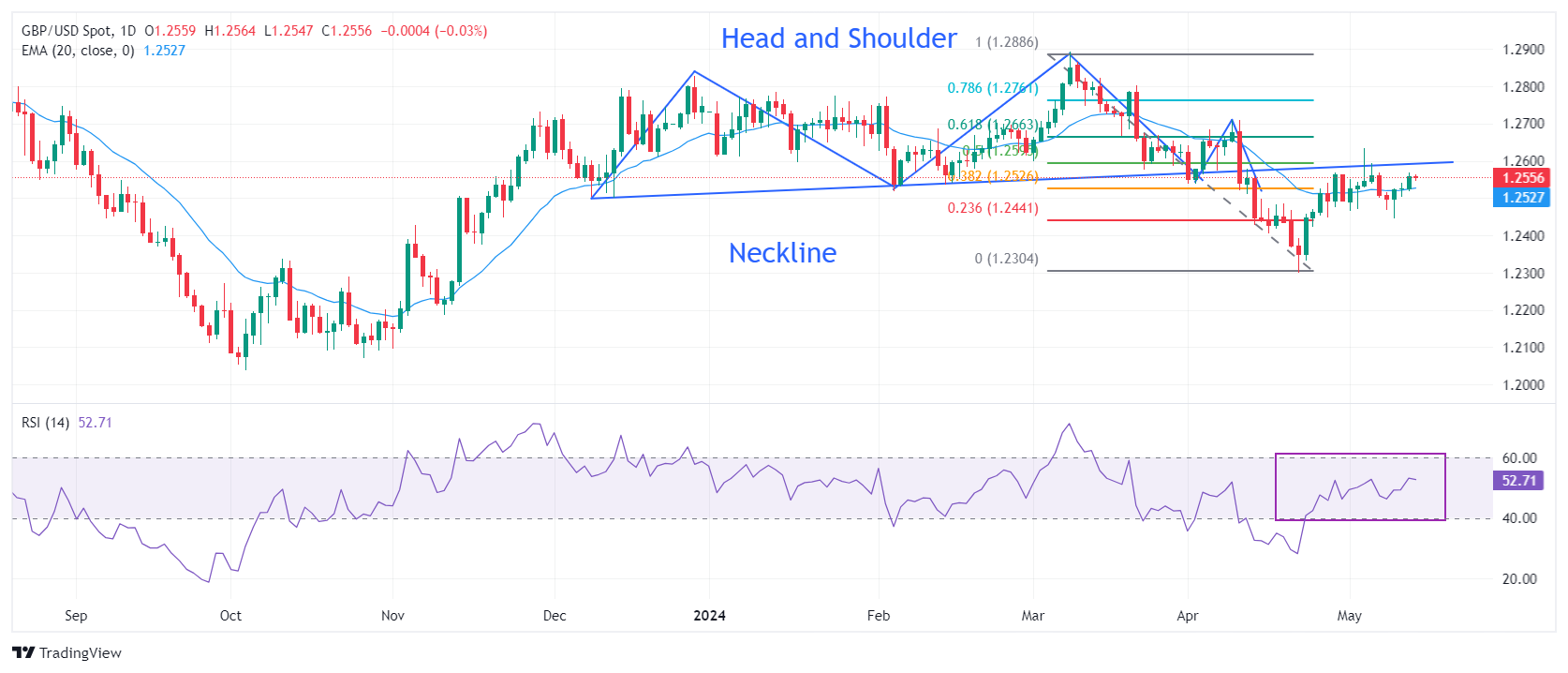
The Pound Sterling exhibits strength near 1.2560 due to a strong near-term outlook. The GBP/USD pair remains comfortably established above the 20-day Exponential Moving Average (EMA), which trades around 1.2530. The pair has retraced 38.2% losses recorded from a 10-month high around 1.2900.
The Cable continues to face pressure near the neckline of the Head and Shoulder (H&S) chart pattern formed on a daily timeframe. On April 12, the pair fell sharply after breaking below the neckline of the H&S pattern plotted from December 8 low around 1.2500.
The 14-period Relative Strength Index (RSI) oscillates in the 40.00-60.00 range, suggesting indecisiveness among market participants.
Economic Indicator
Producer Price Index ex Food & Energy (YoY)
The Producer Price Index ex Food & energy released by the Bureau of Labor statistics, Department of Labor measures the average changes in prices in primary markets of the US by producers of commodities in all states of processing. Those volatile products such as food and energy are excluded in order to capture an accurate calculation. Generally speaking, a high reading is seen as positive (or bullish) for the USD, whereas a low reading is seen as negative (or bearish).
Read more.Last release: Tue May 14, 2024 12:30
Frequency: Monthly
Actual: 2.4%
Consensus: 2.4%
Previous: 2.4%
Source: US Bureau of Labor Statistics
Author
Sagar Dua
FXStreet
Sagar Dua is associated with the financial markets from his college days. Along with pursuing post-graduation in Commerce in 2014, he started his markets training with chart analysis.