Pound Sterling weakens as Chancellor Reeves' welfare bill unleashes fiscal risks
- The Pound Sterling drops even as UK Chancellor Reeves rules out speculation that she is stepping down.
- UK’s new welfare bill is expected to lead to an increase in taxes or spending cuts.
- The US Dollar underperforms as Trump’s tariff deadline expires on July 9.

The Pound Sterling (GBP) faces selling pressure against its peers on Friday despite United Kingdom (UK) Chancellor of the Exchequer Rachel Reeves committing to remain in her role till the next elections.
On Thursday, Reeves confirmed while speaking to reporters that she will remain in office despite fiscal headwinds, till her term. The same day, a spokesperson also confirmed on behalf of UK Prime Minister Keir Starmer that “She [Reeves] is going nowhere”.
The speculation of Chancellor Reeves' stepping down stemmed after she was seen in tears at the House of Commons earlier this week, while revealing the new welfare bill. However, Reeves clarified that she was upset due to some personal reasons.
Chancellor Reeves announced an increase in the standard allowance for Universal Credit (UC) in the new welfare bill, a move that has raised questions over the credibility of her self-imposed fiscal rules.
Investors worry that new adjustment in the welfae scheme will increase fiscal risks for the UK economy. To offset the cost of the same, she would need to cut spending or raise taxes. “Of course, there is a cost to the welfare changes that Parliament voted through this week and that will be reflected in the Budget," Reeves said, BBC reported.
In the last Autumn Budget, Reeves promised not to borrow to fund day-to-day public spending; and to get debt falling as a share of the UK economic output by 2029/30. New welfare reforms are expected to wipe out governments’ plans to save £5.5 billion by 2029-30, according to data from UK Institute for Fiscal Studies (IFS).
British Pound PRICE This week
The table below shows the percentage change of British Pound (GBP) against listed major currencies this week. British Pound was the weakest against the Canadian Dollar.
| USD | EUR | GBP | JPY | CAD | AUD | NZD | CHF | |
|---|---|---|---|---|---|---|---|---|
| USD | -0.31% | 0.49% | 0.03% | -0.73% | -0.28% | -0.12% | -0.55% | |
| EUR | 0.31% | 0.76% | 0.36% | -0.43% | 0.00% | 0.20% | -0.25% | |
| GBP | -0.49% | -0.76% | -0.61% | -1.18% | -0.75% | -0.58% | -1.01% | |
| JPY | -0.03% | -0.36% | 0.61% | -0.76% | -0.27% | -0.11% | -0.53% | |
| CAD | 0.73% | 0.43% | 1.18% | 0.76% | 0.40% | 0.61% | 0.18% | |
| AUD | 0.28% | -0.00% | 0.75% | 0.27% | -0.40% | 0.17% | -0.26% | |
| NZD | 0.12% | -0.20% | 0.58% | 0.11% | -0.61% | -0.17% | -0.43% | |
| CHF | 0.55% | 0.25% | 1.01% | 0.53% | -0.18% | 0.26% | 0.43% |
The heat map shows percentage changes of major currencies against each other. The base currency is picked from the left column, while the quote currency is picked from the top row. For example, if you pick the British Pound from the left column and move along the horizontal line to the US Dollar, the percentage change displayed in the box will represent GBP (base)/USD (quote).
Pound Sterling falls against US Dollar despite uncertainty surrounding US tariff policy
- The Pound Sterling ticks down to near 1.3640 against the US Dollar (USD) on Friday, in a holiday mood due to Independence Day in the United States (US). The GBP/USD pair edges lower evem as the US Dollar underperforms its peers, with the July 9 tariff deadline looming large. The US Dollar Index (DXY) slides below 97.00 at the time of writing in the European session.
- The US Dollar underperforms as US President Donald Trump stated that he will send letters to those nations with whom a trade agreement has not been finalized, outlining tariff rates. So far, Washington has announced trade agreements with the UK and Vietnam, and a framework with China. Trump has also expressed confidence that he will strike a deal with India before the tariff deadline.
- The imposition of reciprocal tariffs by the US on its major trading partners, such as the Eurozone, Japan, Canada and Mexico, will dampen global trade stability.
- Meanwhile, the clearance for imposing Trump’s “Big Beautiful Bill” after it was narrowly approved by the Republican-controlled House of Representatives has increased US fiscal risks. Market experts believe that his signature bill will increase the national debt by $3–3.4 trillion over the next decade. Such scenario will increase interest obligations for the administration and will be inflationary for the economy.
- Another reason behind US Dollar weakness is slowing private sector hiring. The US Nonfarm Payrolls (NFP) report showed on Thursday that strong public sector hiring contributed significantly to robust employment data. Overall, workers added in June were 147K, of which 74K were private employees and others from the government.
- Private sector hiring was almost half of 137K recorded in May and way below if compared to the three-month average of 115K, pointing to hesitancy amid uncertainty surrounding the tariff policy.
- Soft hiring by private employers will likely force Federal Reserve (Fed) officials to consider interest rate cuts sooner.
Technical Analysis: Pound Sterling aims to hold 1.3600
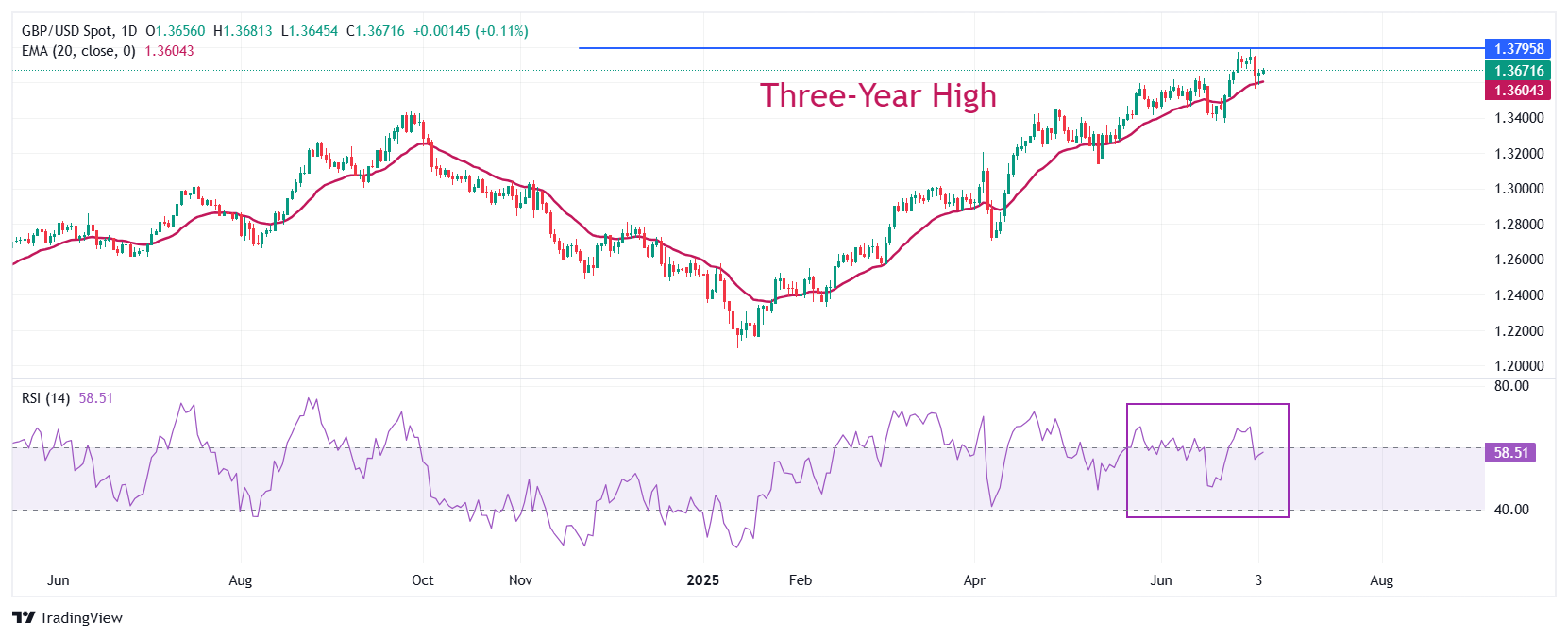
The Pound Sterling trades slightly higher, near 1.3675 against the US Dollar on Friday. The 20-day Exponential Moving Average (EMA) close to 1.3600 continues to act as a major support zone for the GBP/USD pair.
The 14-day Relative Strength Index (RSI) falls below 60, suggesting that the bullish momentum has faded. However, the bullish bias is still intact.
Looking down, the psychological level of 1.3500 will act as a key support zone. On the upside, the three-and-a-half-year high around 1.3800 will act as a key barrier.
Pound Sterling FAQs
The Pound Sterling (GBP) is the oldest currency in the world (886 AD) and the official currency of the United Kingdom. It is the fourth most traded unit for foreign exchange (FX) in the world, accounting for 12% of all transactions, averaging $630 billion a day, according to 2022 data. Its key trading pairs are GBP/USD, also known as ‘Cable’, which accounts for 11% of FX, GBP/JPY, or the ‘Dragon’ as it is known by traders (3%), and EUR/GBP (2%). The Pound Sterling is issued by the Bank of England (BoE).
The single most important factor influencing the value of the Pound Sterling is monetary policy decided by the Bank of England. The BoE bases its decisions on whether it has achieved its primary goal of “price stability” – a steady inflation rate of around 2%. Its primary tool for achieving this is the adjustment of interest rates. When inflation is too high, the BoE will try to rein it in by raising interest rates, making it more expensive for people and businesses to access credit. This is generally positive for GBP, as higher interest rates make the UK a more attractive place for global investors to park their money. When inflation falls too low it is a sign economic growth is slowing. In this scenario, the BoE will consider lowering interest rates to cheapen credit so businesses will borrow more to invest in growth-generating projects.
Data releases gauge the health of the economy and can impact the value of the Pound Sterling. Indicators such as GDP, Manufacturing and Services PMIs, and employment can all influence the direction of the GBP. A strong economy is good for Sterling. Not only does it attract more foreign investment but it may encourage the BoE to put up interest rates, which will directly strengthen GBP. Otherwise, if economic data is weak, the Pound Sterling is likely to fall.
Another significant data release for the Pound Sterling is the Trade Balance. This indicator measures the difference between what a country earns from its exports and what it spends on imports over a given period. If a country produces highly sought-after exports, its currency will benefit purely from the extra demand created from foreign buyers seeking to purchase these goods. Therefore, a positive net Trade Balance strengthens a currency and vice versa for a negative balance.
Author

Sagar Dua
FXStreet
Sagar Dua is associated with the financial markets from his college days. Along with pursuing post-graduation in Commerce in 2014, he started his markets training with chart analysis.

















