Pound Sterling advances against US Dollar amid uncertainty over Trump's tariff policy
- The Pound Sterling faces a sharp selling pressure as the UK economy declined at a faster-than-projected pace in April.
- Slower labor demand and economic contraction might encourage BoE officials to consider more interest rate cuts.
- US President Donald Trump confirms the import of rare earth from China.

The Pound Sterling (GBP) jumps to near 1.3600 against the US Dollar during European trading hours on Thursday. The GBP/USD pair trades firmly as the US Dollar underperforms its peers due to uncertainty surrounding the tariff policy. The US Dollar Index (DXY), which tracks the Greenback's value against six major currencies, posts a fresh three-year low near 97.80.
On Wednesday, United States (US) President Trump threatened to send letters to those trading partners from whom Washington has not received any proposal or those who are not negotiating in good faith, stating trade terms and tariff rates.
“At a certain point, we’re just going to send letters out. And I think you understand that, saying this is the deal, you can take it or you can leave it,” Trump said to reporters on Wednesday at Kennedy Centre and added, “We’re going to be sending letters out in a week and a half to two weeks, telling them what the deal is.”
On the US-China trade front, Trump expressed confidence through a post on Truth.Social that Beijing has agreed to supply rare earths to Washington after the two-day meeting in London earlier this week. “Full magnets, and any necessary rare earths, will be supplied, up front, by China. Likewise, we will provide to China what was agreed to, including Chinese students using our colleges and universities (which has always been good with me!)," Trump wrote. He further added, "We are getting a total of 55% tariffs, China is getting 10%. Relationship is excellent!”
On the economic calendar front, investors await the US Producer Price Index (PPI) data for May, which will be published at 12:30 GMT. The PPI report is expected to show that the producer inflation grew at a faster pace.
Daily digest market movers: Pound Sterling weakens as UK economy contracts in April
- The Pound Sterling faces selling pressure against its major peers on Thursday, except the US Dollar, as the United Kingdom (UK) Office for National Statistics (ONS) reported that the economy shrank at a faster-than-expected pace in April.
- According to the report, the UK Gross Domestic Product (GDP) declined by 0.3% month-over-month in April, faster than expectations of 0.1%. In March, the GDP growth rate was 0.2%. The ONS reported that the economy contracted due to a sharp decrease in exports to the US amid the imposition of the tariff policy. "After increasing for each of the four preceding months, April saw the largest monthly fall on record in goods exports to the United States with decreases seen across most types of goods, following the recent introduction of tariffs," the ONS reported.
- This higher-than-projected decline in the country’s economy is expected to force the Bank of England (BoE) officials to reassess their “gradual and careful” monetary expansion guidance, which they delivered in May after slashing interest rates by 25 basis points (bps) to 4.25%.
- Meanwhile, the factory data has also declined at a faster-than-projected pace in April. On month, the Industrial and Manufacturing Production contracted by 0.6% and 0.9%, respectively.
- On Tuesday, the employment data for the three months ending in April also indicated cracks in the labor market. UK business owners laid off a significant number of employees and recruited fewer workers than seen in the quarter ending in March on the back of an increase in employers’ contributions to social security schemes.
- Signs of economic shockwaves and softer labor demand are expected to boost market expectations that the BoE will cut interest rates more times than projected last week.
- Going forward, the major trigger for the Pound Sterling will be the UK Consumer Price Index (CPI) data for May and the BoE’s monetary policy meeting, both scheduled for next week.
British Pound PRICE Today
The table below shows the percentage change of British Pound (GBP) against listed major currencies today. British Pound was the weakest against the Swiss Franc.
| USD | EUR | GBP | JPY | CAD | AUD | NZD | CHF | |
|---|---|---|---|---|---|---|---|---|
| USD | -0.88% | -0.26% | -0.59% | -0.27% | -0.18% | -0.41% | -0.96% | |
| EUR | 0.88% | 0.62% | 0.32% | 0.61% | 0.69% | 0.47% | -0.06% | |
| GBP | 0.26% | -0.62% | -0.33% | -0.01% | 0.05% | -0.17% | -0.71% | |
| JPY | 0.59% | -0.32% | 0.33% | 0.33% | 0.39% | 0.12% | -0.37% | |
| CAD | 0.27% | -0.61% | 0.01% | -0.33% | 0.09% | -0.16% | -0.69% | |
| AUD | 0.18% | -0.69% | -0.05% | -0.39% | -0.09% | -0.22% | -0.75% | |
| NZD | 0.41% | -0.47% | 0.17% | -0.12% | 0.16% | 0.22% | -0.54% | |
| CHF | 0.96% | 0.06% | 0.71% | 0.37% | 0.69% | 0.75% | 0.54% |
The heat map shows percentage changes of major currencies against each other. The base currency is picked from the left column, while the quote currency is picked from the top row. For example, if you pick the British Pound from the left column and move along the horizontal line to the US Dollar, the percentage change displayed in the box will represent GBP (base)/USD (quote).
Technical Analysis: Pound Sterling approaches three-year high above 1.3600
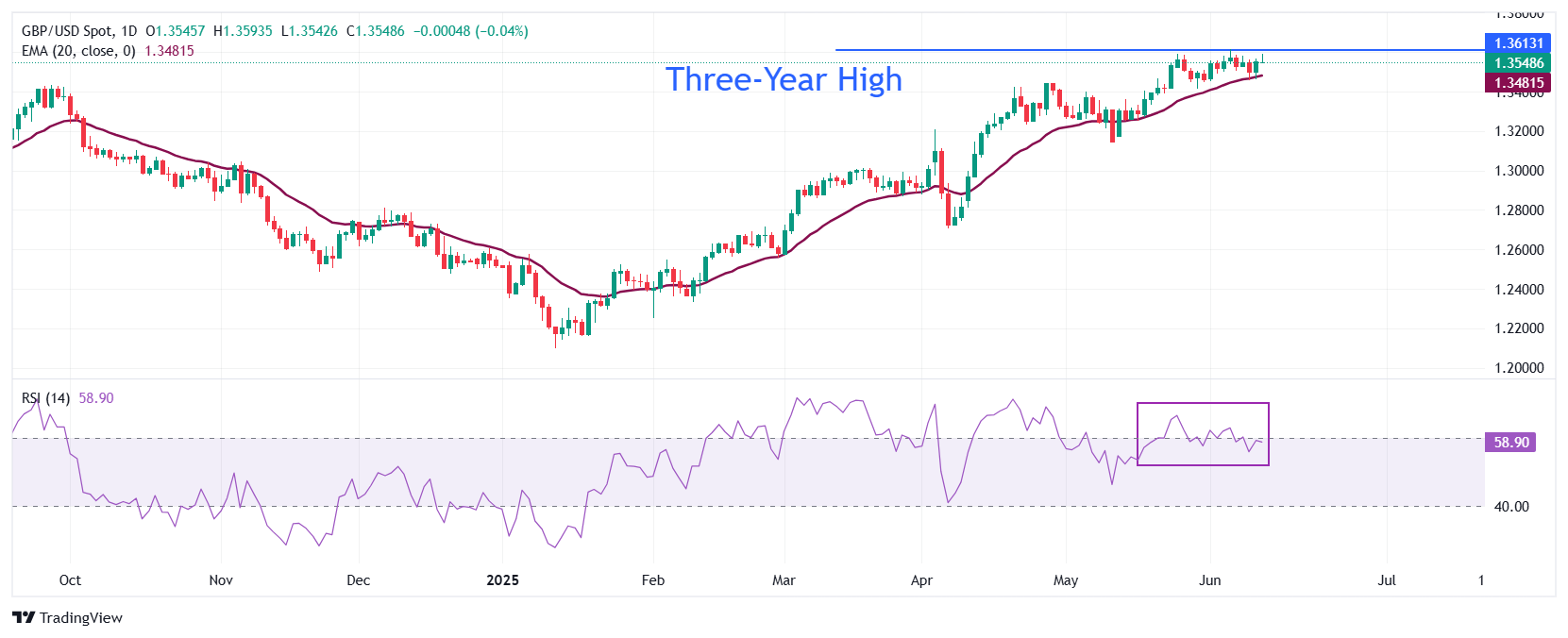
The Pound Sterling aims to revisit the over three-year high of 1.3617 against the US Dollar, which was touched on June 5. The GBP/USD pair continues to hold the 20-day Exponential Moving Average (EMA) around 1.3480, suggesting that the near-term trend remains bullish.
The 14-day Relative Strength Index (RSI) strives to break 60.00. A fresh bullish momentum would emerge if the RSI breaks decisively above that level.
On the upside, the three-year high of 1.3617 will be a key hurdle for the pair. Looking down, the May 15 low of 1.3258 will act as a key support zone.
US Dollar FAQs
The US Dollar (USD) is the official currency of the United States of America, and the ‘de facto’ currency of a significant number of other countries where it is found in circulation alongside local notes. It is the most heavily traded currency in the world, accounting for over 88% of all global foreign exchange turnover, or an average of $6.6 trillion in transactions per day, according to data from 2022. Following the second world war, the USD took over from the British Pound as the world’s reserve currency. For most of its history, the US Dollar was backed by Gold, until the Bretton Woods Agreement in 1971 when the Gold Standard went away.
The most important single factor impacting on the value of the US Dollar is monetary policy, which is shaped by the Federal Reserve (Fed). The Fed has two mandates: to achieve price stability (control inflation) and foster full employment. Its primary tool to achieve these two goals is by adjusting interest rates. When prices are rising too quickly and inflation is above the Fed’s 2% target, the Fed will raise rates, which helps the USD value. When inflation falls below 2% or the Unemployment Rate is too high, the Fed may lower interest rates, which weighs on the Greenback.
In extreme situations, the Federal Reserve can also print more Dollars and enact quantitative easing (QE). QE is the process by which the Fed substantially increases the flow of credit in a stuck financial system. It is a non-standard policy measure used when credit has dried up because banks will not lend to each other (out of the fear of counterparty default). It is a last resort when simply lowering interest rates is unlikely to achieve the necessary result. It was the Fed’s weapon of choice to combat the credit crunch that occurred during the Great Financial Crisis in 2008. It involves the Fed printing more Dollars and using them to buy US government bonds predominantly from financial institutions. QE usually leads to a weaker US Dollar.
Quantitative tightening (QT) is the reverse process whereby the Federal Reserve stops buying bonds from financial institutions and does not reinvest the principal from the bonds it holds maturing in new purchases. It is usually positive for the US Dollar.
Author

Sagar Dua
FXStreet
Sagar Dua is associated with the financial markets from his college days. Along with pursuing post-graduation in Commerce in 2014, he started his markets training with chart analysis.