Pound Sterling corrects sharply against US Dollar amid Iran-Israel conflict
- The Pound Sterling falls sharply against its major peers as Israel’s attack on Iran dampened demand for risky assets.
- Both the Fed and the BoE are expected to maintain interest rates steady next week.
- Investors expect the BoE to reassess its “gradual and cautious” monetary expansion guidance due to recent weak economic data.

The Pound Sterling (GBP) underperforms against its major peers on Friday, except for antipodean currencies, as market sentiment turns risk-averse amid escalating geopolitical tensions in the Middle East.
Israel has announced a war against Iran after striking dozens of targets in the northeast region of Tehran, including nuclear facilities and military bases. Israeli Prime Minister Benjamin Netanyahu has clarified that their military has started the “Operation Rising Lion” to stop Iran from building nuclear warheads, citing that the operation aims to “roll back the Iranian threat to Israel’s very survival”.
US President Donald Trump also said earlier in the day that Iran “cannot have a nuclear bomb”, partly endorsing Israel’s attack
Escalating tensions between Tel Aviv and Tehran have led investors to turn to safe-haven assets such as the US Dollar (USD). The US Dollar Index (DXY), which tracks the Greenback’s value against six major currencies, is up 0.45% to near 98.30, recovering sharply from the three-year low of 97.60 posted on Thursday.
Apart from geopolitical headlines, the next triggers for the GBP/USD pair will be the monetary policy announcements by both the Federal Reserve (Fed) and the Bank of England (BoE) next week. Both central banks are expected to hold interest rates steady.
Daily digest market movers: Pound Sterling falls back against US Dollar
- The Pound Sterling retraces sharply to near 1.3520 against the US Dollar during European trading hours on Friday after posting a fresh three-year high near 1.3630 the previous day. The GBP/USD pair faces sharp selling pressure as investors turn risk-averse amid escalating Middle East tensions.
- Earlier in the day, the US clarified that they have no involvement in the Israel-Iran conflict and assured that Washington would seek talks with Tehran to end tensions peacefully. However, Tehran has refused to join the US at the table. Senior Iranian lawmaker Boroujerdi said that the sixth round of talks with the US “will not be held following the Israeli attacks”, according to Iran International.
- Meanwhile, US President Trump has urged Iran to make a deal before it is too late in a post on Truth.Social. "I gave Iran chance after chance to make a deal," Trump wrote and added, "Iran must make a deal, before there is nothing left, and save what was once known as the Iranian Empire. No more death, no more destruction, JUST DO IT, BEFORE IT IS TOO LATE."
- Next week, the US Dollar’s valuation will be influenced by the outcome of the Fed’s policy meeting on Wednesday. According to the CME FedWatch tool, the Fed is expected to leave interest rates steady in the current range of 4.25%-4.50%.
- Traders are increasingly confident that the Fed will avoid any monetary policy adjustments as policymakers have guided that interest rates should remain at their current levels until they get clarity about how the new economic policies announced by US President Trump will impact inflation and the economic outlook.
- Investors will closely monitor the Fed’s dot plot, which shows where officials expect interest rates to head in the near and longer term. The CME FedWatch tool shows that the Fed will reduce interest rates in the September meeting. Traders are currently expecting the Federal Reserve to cut rates by 55 basis points by the year-end, which means around two 25-basis-point cuts, Reuters reported.
- In the United Kingdom (UK), the BoE is also anticipated to leave interest rates unchanged at 4.25% on Thursday. However, market participants expect the central bank to reassess its “gradual and careful” policy easing guidance amid slowing labor demand and an economic contraction in the monthly Gross Domestic Product data for April.
- This week, the Office for National Statistics (ONS) reported that the Unemployment Rate rose to 4.6% in the three months ending April, the highest level seen since July 2021, and employers added fewer jobs in the same period. Cracks emerged in the labor market after employers’ contribution to the National Insurance (NI) increased to 15% from 13.8% in April.
- Meanwhile, the UK economy declined at a faster-than-projected pace of 0.3% in April, and the factory data contracted sharply.
- Ahead of the BoE’s monetary policy announcement, investors will focus on the UK Consumer Price Index (CPI) data for May, which is scheduled to be released on Wednesday.
Technical Analysis: Pound Sterling still holds 20-day EMA
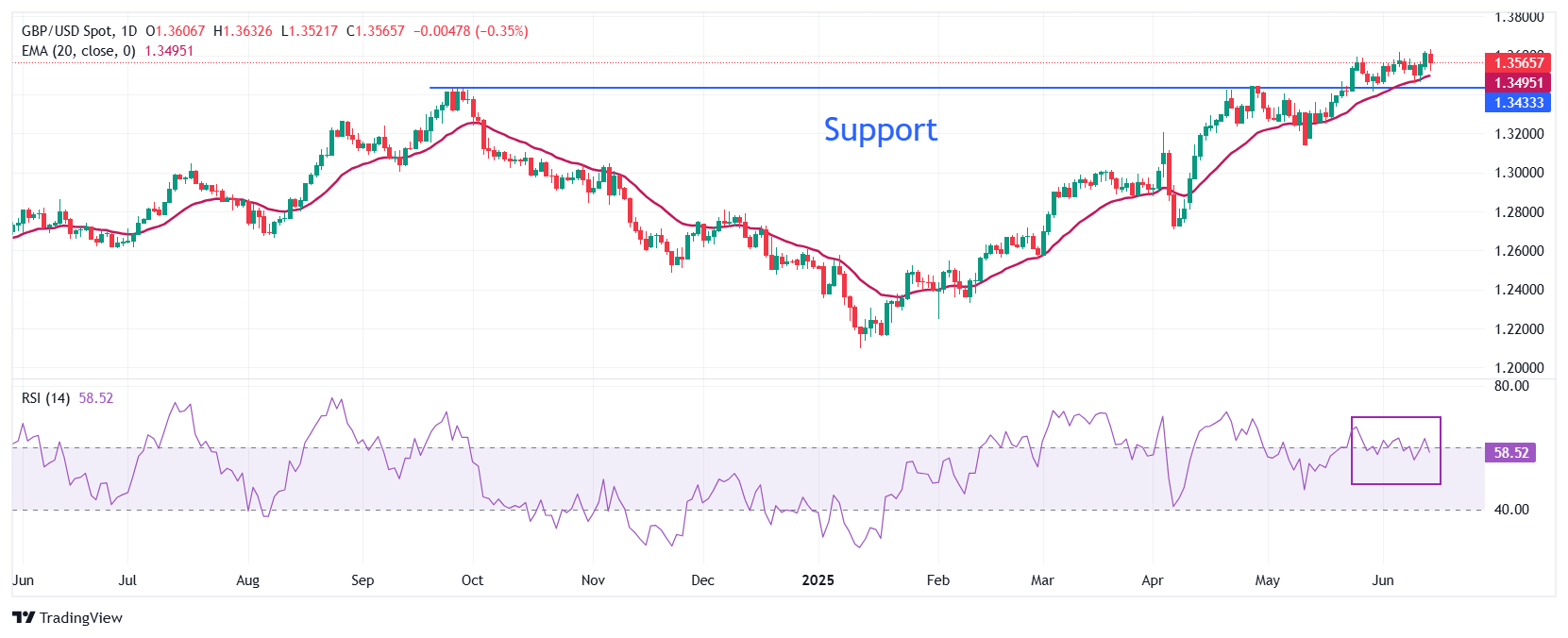
The Pound Sterling falls sharply to near 1.3530 against the US Dollar after facing selling pressure near the three-year high around 1.3630. Despite the pullback, the near-term trend of the GBP/USD pair remains bullish as the 20-day Exponential Moving Average (EMA) slopes higher around 1.3490.
The 14-day Relative Strength Index (RSI) falls below 60.00 and points downwards, signaling a quick loss of bullish momentum. Still, this could resume if the RSI is able to retake the 60 level.
On the upside, the January 13, 2022, high of 1.3750 will be a key hurdle for the pair. Looking down, the horizontal line plotted from the September 26 high of 1.3434 will act as a key support zone.
Economic Indicator
BoE Interest Rate Decision
The Bank of England (BoE) announces its interest rate decision at the end of its eight scheduled meetings per year. If the BoE is hawkish about the inflationary outlook of the economy and raises interest rates it is usually bullish for the Pound Sterling (GBP). Likewise, if the BoE adopts a dovish view on the UK economy and keeps interest rates unchanged, or cuts them, it is seen as bearish for GBP.
Read more.Next release: Thu Jun 19, 2025 11:00
Frequency: Irregular
Consensus: 4.25%
Previous: 4.25%
Source: Bank of England
Author

Sagar Dua
FXStreet
Sagar Dua is associated with the financial markets from his college days. Along with pursuing post-graduation in Commerce in 2014, he started his markets training with chart analysis.

















