Pound Sterling rebounds ahead of US Retail Sales, Trump-Putin meet
- The Pound Sterling edges up slightly against the US Dollar, after the recent rally halted around 1.3600 due to hot US PPI data.
- Tariffs led US producer inflation to grow at the fastest pace in three years, supporting the US Dollar.
- Investors await the US Retail Sales data and the Trump-Putin meeting.

The Pound Sterling (GBP) recovers to near 1.3560 against the US Dollar (USD) on Friday, paring back some of the losses seen on Thursday, when the US Dollar (USD) bounced back strongly after the United States (US) Producer Price Index (PPI) report for July showed that wholesale prices rose at the strongest pace in three years.
During the press time, the US Dollar Index (DXY), which tracks the Greenback’s value against six major currencies, falls back to near 97.70 after a recovery move on Thursday to near 98.30.
Headline and the core PPI – which excludes volatile food and energy items – rose by 0.9% on a month, after remaining flat in June. Hot US PPI data indicate that business owners are reluctant to absorb the impact of tariffs and are passing it on to consumers.
Escalating producer inflation has raised doubts among market experts about whether the Federal Reserve (Fed) will reduce interest rates in September.
“This report is a strong validation of the Fed’s wait-and-see stance on policy changes," analysts at High Frequency Economics said.
According to the CME FedWatch Tool, traders still see it likely that the Fed will cut interest rates in September. Market expectations for Fed interest rate cuts were intensified by cooling labor market conditions and the absence of signs supporting the flow of tariff effects into prices in the Consumer Price Index (CPI) report of July, released on Tuesday.
Market experts believe that consumer prices rose moderately since the tariff announcement because importers shielded consumers from higher prices by stocking higher inventory before the announcement of reciprocal duties on the so-called “Liberation Day”.
“We anticipate broader signs of tariff-driven inflation in the data over time as inventories roll over and firms adjust pricing under margin pressure,” analysts at Oxford Economics said, CBS News reported.
Daily digest market movers: Pound Sterling trades stably with US CPI in focus
- The Pound Sterling trades calmly, with investors awaiting fresh cues about the likely monetary policy action by the Bank of England (BoE) in the remainder of the year. Financial market participants expect the BoE to hold interest rates at their current levels as price pressures in the United Kingdom (UK) have remained elevated. Additionally, better-than-projected Q2 Gross Domestic Product (GDP) data has come in as relief for policymakers.
- On Thursday, the Office for National Statistics (ONS) reported that the economy rose at a faster pace of 0.3% in the second quarter of the year, stronger than expectations of 0.1%, but slower than the prior release of 0.7%.
- In the near term, economists believe that global trade risks, weak labor demand, and a likely increase in taxes by UK Chancellor of the Exchequer Rachel Reeves in the Autumn Budget could be major drags on economic growth. "We don’t expect growth to pick up much from here as continued consumer caution, weaker global demand, and tax increases all continue to drag," economists at accountants RSM UK said, Reuters reported. The probability of Reeves raising taxes is high as the Chancellor needs to offset the impact of higher welfare spending, announced in early July, to meet her fiscal target.
- Going forward, investors will focus on the UK Consumer Price Index (CPI) data for July, which is scheduled to be released on Wednesday.
- In Friday’s session, investors will focus on the US Retail Sales data for July, which will be published at 12:30 GMT. Economists expect Retail Sales to have grown by 0.5% on a month, slower than the prior reading of 0.6%.
- On the global front, financial market participants will pay close attention to the meeting between US President Donald Trump and Russian leader Vladimir Putin in Alaska on Friday. US President Trump has called Russian leader Putin to discuss ending the war in Ukraine. According to a report from Reuters, Trump said on Thursday that he believes Putin is ready to end the conflict, but peace would likely require at least a second meeting involving Ukraine’s leader.
Technical Analysis: Pound Sterling aims to extend upside above 1.3600
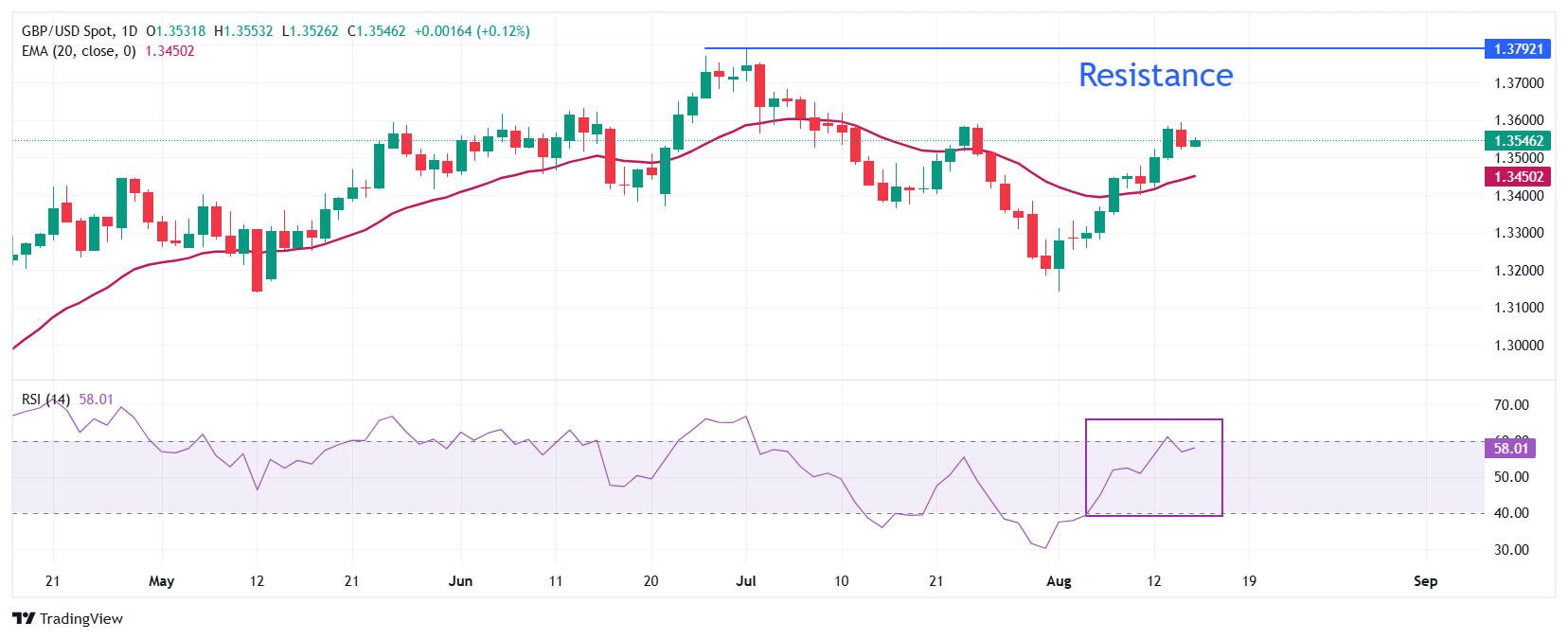
The Pound Sterling bounces back to near 1.3560 during the European trading session on Friday, and aims to reclaim the two-month high of 1.3600 posted on Thursday. The near-term trend of the GBP/USD pair remains bullish as it holds the 20-day Exponential Moving Average (EMA), which trades around 1.3450.
The 14-day Relative Strength Index (RSI) strives to break above 60.00. A fresh bullish momentum would emerge if the RSI breaks above that level.
Looking down, the August 11 low of 1.3400 will act as a key support zone. On the upside, the July 1 high near 1.3790 will act as a key barrier.
Inflation FAQs
Inflation measures the rise in the price of a representative basket of goods and services. Headline inflation is usually expressed as a percentage change on a month-on-month (MoM) and year-on-year (YoY) basis. Core inflation excludes more volatile elements such as food and fuel which can fluctuate because of geopolitical and seasonal factors. Core inflation is the figure economists focus on and is the level targeted by central banks, which are mandated to keep inflation at a manageable level, usually around 2%.
The Consumer Price Index (CPI) measures the change in prices of a basket of goods and services over a period of time. It is usually expressed as a percentage change on a month-on-month (MoM) and year-on-year (YoY) basis. Core CPI is the figure targeted by central banks as it excludes volatile food and fuel inputs. When Core CPI rises above 2% it usually results in higher interest rates and vice versa when it falls below 2%. Since higher interest rates are positive for a currency, higher inflation usually results in a stronger currency. The opposite is true when inflation falls.
Although it may seem counter-intuitive, high inflation in a country pushes up the value of its currency and vice versa for lower inflation. This is because the central bank will normally raise interest rates to combat the higher inflation, which attract more global capital inflows from investors looking for a lucrative place to park their money.
Formerly, Gold was the asset investors turned to in times of high inflation because it preserved its value, and whilst investors will often still buy Gold for its safe-haven properties in times of extreme market turmoil, this is not the case most of the time. This is because when inflation is high, central banks will put up interest rates to combat it. Higher interest rates are negative for Gold because they increase the opportunity-cost of holding Gold vis-a-vis an interest-bearing asset or placing the money in a cash deposit account. On the flipside, lower inflation tends to be positive for Gold as it brings interest rates down, making the bright metal a more viable investment alternative.
Author

Sagar Dua
FXStreet
Sagar Dua is associated with the financial markets from his college days. Along with pursuing post-graduation in Commerce in 2014, he started his markets training with chart analysis.