Pound Sterling rises swiftly as BoE Bailey refuses to provide timing for rate cuts
- Pound Sterling rebounds as BoE reiterates the need for price pressures easing for months.
- The stubbornness of the UK inflation outlook has deepened amid robust household spending.
- The market mood has turned upbeat ahead of the FOMC minutes.

The Pound Sterling (GBP) rises against the US Dollar in Tuesday’s European session as the market sentiment turned upbeat ahead of the release of the Federal Reserve Open Market Committee (FOMC) minutes, providing a fresh outlook on interest rates.
Apart from that, fresh guidance on interest rates from Bank of England (BoE) Governor Andrew Bailey and other policymakers in their testimony before the United Kingdom Parliament has provided an interim cushion the Pound Sterling.
BoE Deputy Governor Ben Broadbent said wage growth and services inflation are double the rate, consistent with sustainable inflation at 2%. However, easing labor market tightness indicates that the current monetary policy is sufficiently restrictive. Broadbent added that the central bank's focus has shifted from the degree of restrictive monetary policy to its duration, but evidence doesn't support rate cuts at the current stage. When asked about the timing of the rate cut, Broadbent said any adjustment largely depends upon an actual evolution of economic data. Also, policymaker Megan Greene sees upside risks to wage growth.
Meanwhile, Andrew Bailey said there are encouraging signs that price pressures are easing. Market expectations of rate cuts this year are not unreasonable. Bailey added that rate cuts could be eased before inflation reaches the 2% target. Bailey further
BoE policymaker Swati Dhingra, who voted for a rate cut in the last meeting, warned about significant downside risks to the United Kingdom economy due to tight monetary policy.
Daily Digest Market Movers: Pound Sterling jumps higher on improved market sentiment
- Pound Sterling rises as BoE policymakers don't explicitly provide timing for rate cuts in the testimony before the UK Parliament.
- Bank of England Governor Andrew Bailey and other Monetary Policy Committee (MPC) members have admitted that the current interest rates are sufficiently restrictive but are not ready to bring them down until getting convinced that inflation will return to the 2% target.
- The robust Retail Sales data for January have indicated that the impact of hawkish stance on interest rates by the BoE is fading away, providing support the United Kingdom economy in coming out from a recession.
- Last week, BoE Chief Economist Huw Pill advised to remain patient for rate cuts as current inflation data is insufficient to convince us that inflation will sustainably decline to the 2% target.
- Meanwhile, the near-term outlook for the Pound Sterling has strengthened. The weekly data from the Commodity Futures Trading Commission (CFTC) shows that speculators lifted their bullish sterling position to $3.971 billion in the week to Feb 13, just shy of last July's nine-year high, Reuters reported.
- This week, the GBP/USD pair will be guided by the preliminary S&P/CIPS Global Manufacturing and Services PMI for February, which will be published on Thursday. . Expectations are for the Manufacturing PMI to rise to 47.5 from 47.0, while Services PMI to drop to 54.1 from 54.3 in December.
- On the United States front, the US Dollar Index, which gauges the Greenback’s value against six rival currencies, fell to near 104.00 amid uncertainty ahead of FOMC minutes for the January policy meeting, which will be released on Wednesday.
- The USD Index refreshes weekly low near 104.00 as Federal Reserve policymakers are confident that inflation is moving in the right direction despite hotter-than-anticipated consumer price inflation and the Producer Price Index (PPI) data for January.
Technical Analysis: Pound Sterling rebounds above 1.2600
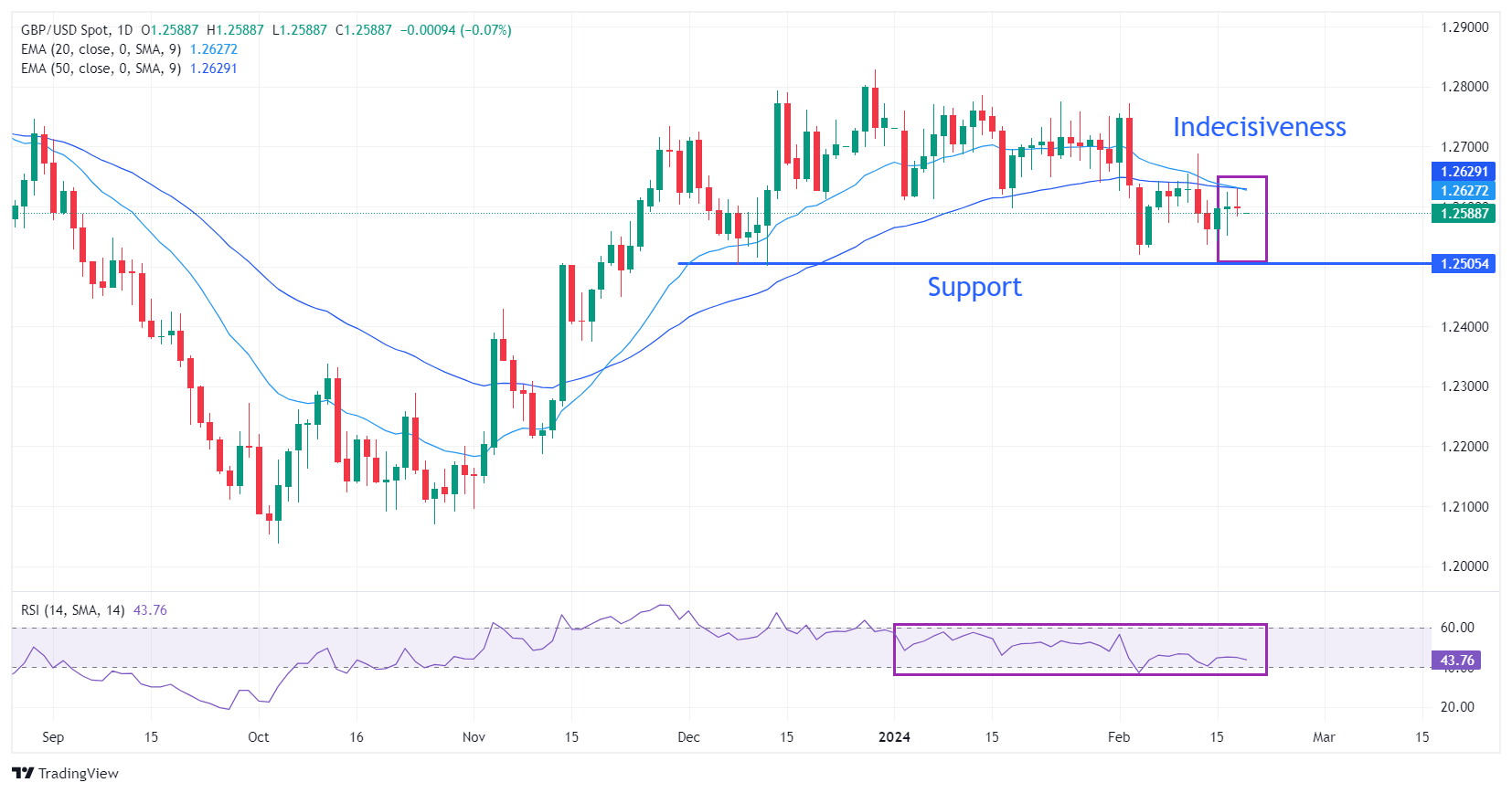
Pound Sterling delivers a sharp recovery after remaining stuck in a tight range below 1.2600 post-indecisive closing in the last two trading sessions. The broader appeal is expected to remain uncertain as the 20 and 50-day Exponential Moving Averages (EMAs) are on the verge of delivering a bearish crossover. The psychological support at 1.2500 remains a major cushion for the Pound Sterling bulls.
The 14-period Relative Strength Index (RSI) oscillates in the 40.00-60.00 range, indicating a sharp volatility contraction.
BoE FAQs
What does the Bank of England do and how does it impact the Pound?
The Bank of England (BoE) decides monetary policy for the United Kingdom. Its primary goal is to achieve ‘price stability’, or a steady inflation rate of 2%. Its tool for achieving this is via the adjustment of base lending rates. The BoE sets the rate at which it lends to commercial banks and banks lend to each other, determining the level of interest rates in the economy overall. This also impacts the value of the Pound Sterling (GBP).
How does the Bank of England’s monetary policy influence Sterling?
When inflation is above the Bank of England’s target it responds by raising interest rates, making it more expensive for people and businesses to access credit. This is positive for the Pound Sterling because higher interest rates make the UK a more attractive place for global investors to park their money. When inflation falls below target, it is a sign economic growth is slowing, and the BoE will consider lowering interest rates to cheapen credit in the hope businesses will borrow to invest in growth-generating projects – a negative for the Pound Sterling.
What is Quantitative Easing (QE) and how does it affect the Pound?
In extreme situations, the Bank of England can enact a policy called Quantitative Easing (QE). QE is the process by which the BoE substantially increases the flow of credit in a stuck financial system. QE is a last resort policy when lowering interest rates will not achieve the necessary result. The process of QE involves the BoE printing money to buy assets – usually government or AAA-rated corporate bonds – from banks and other financial institutions. QE usually results in a weaker Pound Sterling.
What is Quantitative tightening (QT) and how does it affect the Pound Sterling?
Quantitative tightening (QT) is the reverse of QE, enacted when the economy is strengthening and inflation starts rising. Whilst in QE the Bank of England (BoE) purchases government and corporate bonds from financial institutions to encourage them to lend; in QT, the BoE stops buying more bonds, and stops reinvesting the principal maturing on the bonds it already holds. It is usually positive for the Pound Sterling.
Author

Sagar Dua
FXStreet
Sagar Dua is associated with the financial markets from his college days. Along with pursuing post-graduation in Commerce in 2014, he started his markets training with chart analysis.