Pound Sterling strugges to extend upside against USD with Fed-BoE policy in focus
- The Pound Sterling drops from 1.3000 against the US Dollar as the DXY Index finds bids near the five-month.
- Fed officials could project a higher number of interest rate cuts this year.
- The Fed and the BoE are expected to keep interest rates steady on Wednesday and Thursday, respectively.

The Pound Sterling (GBP) faces slight selling pressure near the psychological figure of 1.3000 against the US Dollar (USD) in North American trading hours on Tuesday. The GBP/USD pair struggles to extend its upside as the US Dollar Index (DXY), which tracks the Greenback’s value against six major currencies, finds buying interest near the five-month low of 103.20.
The Greenback rebounds investors turn cautious ahead of the Federal Reserve (Fed) monetary policy outcome on Wednesday. Investors will pay close attention to Fed's dot plot, which shows where officials see Federal Fund rates heading in the near and longer term, as the central bank is certain to keep interest rates steady in the range of 4.25%-4.50% for the second time in a row.
Fed could guide more interest rate cuts this year when they end the March policy meeting on Wednesday. In December, Fed officials collectively guided two interest rate cuts in 2025. Market expectations that the central bank could turn slightly dovish on the monetary policy outlook are based on easing inflationary pressures and deteriorating consumer confidence.
The United States (US) Consumer Price Index (CPI) data for February showed that the core inflation – which excludes volatile food and energy prices – rose by 3.1%, the lowest level seen since April 2021. Meanwhile, the preliminary Michigan Consumer Sentiment Index fell significantly lower at 57.9 in March against estimates of 63.1 and the former reading of 64.7.
British Pound PRICE Today
The table below shows the percentage change of British Pound (GBP) against listed major currencies today. British Pound was the strongest against the Australian Dollar.
| USD | EUR | GBP | JPY | CAD | AUD | NZD | CHF | |
|---|---|---|---|---|---|---|---|---|
| USD | 0.06% | 0.16% | 0.25% | 0.01% | 0.44% | 0.20% | -0.19% | |
| EUR | -0.06% | 0.08% | 0.18% | -0.06% | 0.36% | 0.13% | -0.26% | |
| GBP | -0.16% | -0.08% | 0.12% | -0.14% | 0.29% | 0.05% | -0.34% | |
| JPY | -0.25% | -0.18% | -0.12% | -0.27% | 0.17% | -0.09% | -0.46% | |
| CAD | -0.01% | 0.06% | 0.14% | 0.27% | 0.44% | 0.20% | -0.20% | |
| AUD | -0.44% | -0.36% | -0.29% | -0.17% | -0.44% | -0.24% | -0.63% | |
| NZD | -0.20% | -0.13% | -0.05% | 0.09% | -0.20% | 0.24% | -0.39% | |
| CHF | 0.19% | 0.26% | 0.34% | 0.46% | 0.20% | 0.63% | 0.39% |
The heat map shows percentage changes of major currencies against each other. The base currency is picked from the left column, while the quote currency is picked from the top row. For example, if you pick the British Pound from the left column and move along the horizontal line to the US Dollar, the percentage change displayed in the box will represent GBP (base)/USD (quote).
Daily digest market movers: Pound Sterling trades cautiously against its peers, BoE policy takes centre stage
- The Pound Sterling trades with caution against its major peers, with investors focusing on the Bank of England’s (BoE) interest rate decision on Thursday. Traders are increasingly confident that the BoE will keep borrowing rates steady at 4.5%, with a 7-2 vote split.
- BoE Monetary Policy Committee (MPC) members Catherine Mann and Swati Dhingra are expected to support an interest rate cut. Both officials voted for a larger-than-usual interest rate reduction of 50 basis points (bps) in the February policy meeting, while others favored a usual cut of 25 bps.
- Investors will also focus on BoE’s guidance on the monetary policy and how much US President Donald Trump-led tariff war could impact the United Kingdom’s (UK) economic outlook. Traders expect the BoE to cut interest rates two times more this year as the central bank halved its Gross Domestic Product (GDP) growth forecast for the year to 0.75% in the February policy meeting.
- On Monday, the Organisation for Economic Cooperation and Development (OECD) lowered its British growth forecast for this year to 1.4% from 1.7% projected in December amid global economic uncertainty due to US President Trump’s tariff agenda.
- On Thursday, investors will also focus on the UK labor market data for three months ending January before the BoE’s policy meeting.
Technical Analysis: Pound Sterling clings to gains above 1.2900
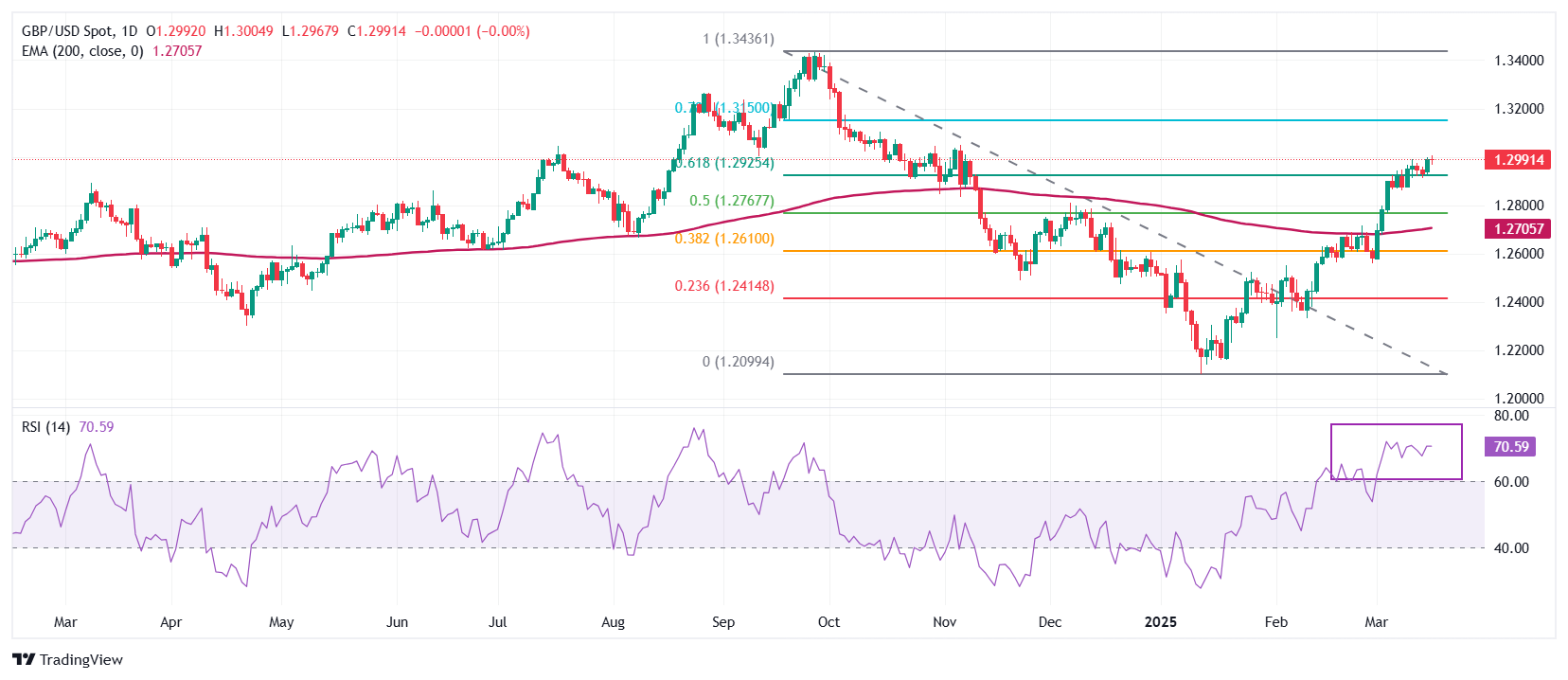
The Pound Sterling attracts some offers after posting a fresh four-month high around the psychological level of 1.3000 against the US Dollar on Tuesday. The pair established above the 61.8% Fibonacci retracement, plotted from the late September high to the mid-January low, at 1.2930.
The long-term outlook of the GBP/USD pair remains bullish as it holds above the 200-day Exponential Moving Average (EMA), which is around 1.2700.
The 14-day Relative Strength Index (RSI) holds above 60.00, indicating that a strong bullish momentum is intact.
Looking down, the 50% Fibo retracement at 1.2767 and the 38.2% Fibo retracement at 1.2608 will act as key support zones for the pair. On the upside, the October 15 high of 1.3100 will act as a key resistance zone.
BoE FAQs
The Bank of England (BoE) decides monetary policy for the United Kingdom. Its primary goal is to achieve ‘price stability’, or a steady inflation rate of 2%. Its tool for achieving this is via the adjustment of base lending rates. The BoE sets the rate at which it lends to commercial banks and banks lend to each other, determining the level of interest rates in the economy overall. This also impacts the value of the Pound Sterling (GBP).
When inflation is above the Bank of England’s target it responds by raising interest rates, making it more expensive for people and businesses to access credit. This is positive for the Pound Sterling because higher interest rates make the UK a more attractive place for global investors to park their money. When inflation falls below target, it is a sign economic growth is slowing, and the BoE will consider lowering interest rates to cheapen credit in the hope businesses will borrow to invest in growth-generating projects – a negative for the Pound Sterling.
In extreme situations, the Bank of England can enact a policy called Quantitative Easing (QE). QE is the process by which the BoE substantially increases the flow of credit in a stuck financial system. QE is a last resort policy when lowering interest rates will not achieve the necessary result. The process of QE involves the BoE printing money to buy assets – usually government or AAA-rated corporate bonds – from banks and other financial institutions. QE usually results in a weaker Pound Sterling.
Quantitative tightening (QT) is the reverse of QE, enacted when the economy is strengthening and inflation starts rising. Whilst in QE the Bank of England (BoE) purchases government and corporate bonds from financial institutions to encourage them to lend; in QT, the BoE stops buying more bonds, and stops reinvesting the principal maturing on the bonds it already holds. It is usually positive for the Pound Sterling.
Author

Sagar Dua
FXStreet
Sagar Dua is associated with the financial markets from his college days. Along with pursuing post-graduation in Commerce in 2014, he started his markets training with chart analysis.