Pound Sterling gains against US Dollar ahead of Fed-BoE policy outcome
- The Pound Sterling rises at the start of the week ahead of the Fed and BoE monetary policy announcements.
- Investors expect the Fed to cut interest rates, while the BoE is seen holding them steady.
- UK headline CPI is estimated at a faster pace of 3.9% in August.

The Pound Sterling (GBP) advances against the US Dollar (USD) at the start of the week during the European trading session. The GBP/USD pair jumps to near 1.3600as the US Dollar faces selling pressure, with investors awaiting monetary policy announcements by the Federal Reserve (Fed) and the Bank of England (BoE) on Wednesday and Thursday, respectively.
During the press time, the US Dollar Index (DXY), which tracks the Greenback’s value against six major currencies, trades marginally down near 97.50.
According to the CME FedWatch tool, traders see a 94,2% chance that the central bank will cut interest rates by 25 basis points (bps) to 4.00%-4.25% in the policy announcement on Wednesday. Fed dovish speculation has been intensified due to growing labor market concerns.
Meanwhile, the BoE is expected to hold interest rates steady at 4% as inflationary pressures in the United Kingdom (UK) economy are continuing to prove persistent.
US Dollar Price Today
The table below shows the percentage change of US Dollar (USD) against listed major currencies today. US Dollar was the weakest against the British Pound.
| USD | EUR | GBP | JPY | CAD | AUD | NZD | CHF | |
|---|---|---|---|---|---|---|---|---|
| USD | -0.17% | -0.37% | -0.21% | -0.09% | -0.22% | -0.09% | -0.19% | |
| EUR | 0.17% | -0.16% | -0.09% | 0.09% | 0.02% | 0.04% | -0.02% | |
| GBP | 0.37% | 0.16% | 0.14% | 0.25% | 0.16% | 0.20% | 0.03% | |
| JPY | 0.21% | 0.09% | -0.14% | 0.09% | 0.03% | 0.10% | 0.02% | |
| CAD | 0.09% | -0.09% | -0.25% | -0.09% | -0.03% | -0.05% | -0.23% | |
| AUD | 0.22% | -0.02% | -0.16% | -0.03% | 0.03% | 0.05% | -0.05% | |
| NZD | 0.09% | -0.04% | -0.20% | -0.10% | 0.05% | -0.05% | -0.17% | |
| CHF | 0.19% | 0.02% | -0.03% | -0.02% | 0.23% | 0.05% | 0.17% |
The heat map shows percentage changes of major currencies against each other. The base currency is picked from the left column, while the quote currency is picked from the top row. For example, if you pick the US Dollar from the left column and move along the horizontal line to the Japanese Yen, the percentage change displayed in the box will represent USD (base)/JPY (quote).
Pound Sterling will be influenced by UK employment and inflation data
- Investors brace for significant volatility in the Pound Sterling this week as the United Kingdom (UK) labor market data for the three months ending July and the Consumer Price Index (CPI) data for August are also scheduled to be released this week on Tuesday and Wednesday, respectively.
- The Office for National Statistics (ONS) is expected to show that the ILO Unemployment Rate remains steady at 4.7%. Average Earnings Excluding Bonuses, a key measure of wage growth, is estimated to have grown at an annual pace of 4.8%, slower than the prior reading of 5%. However, the wage growth measure including bonuses is expected to have risen at a faster pace of 4.7% from the former reading of 4.6%.
- Lately, BoE Governor Andrew Bailey has warned of downside labor market risks and stated that the monetary policy path will remain downwards.
- Meanwhile, the UK headline CPI is expected to have risen at a faster pace of 3.9%, the highest level in 19 months. BoE officials would need to perform a delicate balancing act if the inflation data shows signs of growth and the labor market faces a slowdown.
- In the US, investors await the Retail Sales figures for August, which will be published on Tuesday. The US Retail Sales data, a key measure of consumer spending, is expected to have grown at a moderate pace of 0.3% against 0.5% in July.
Technical Analysis: Pound Sterling stays above 20-day EMA
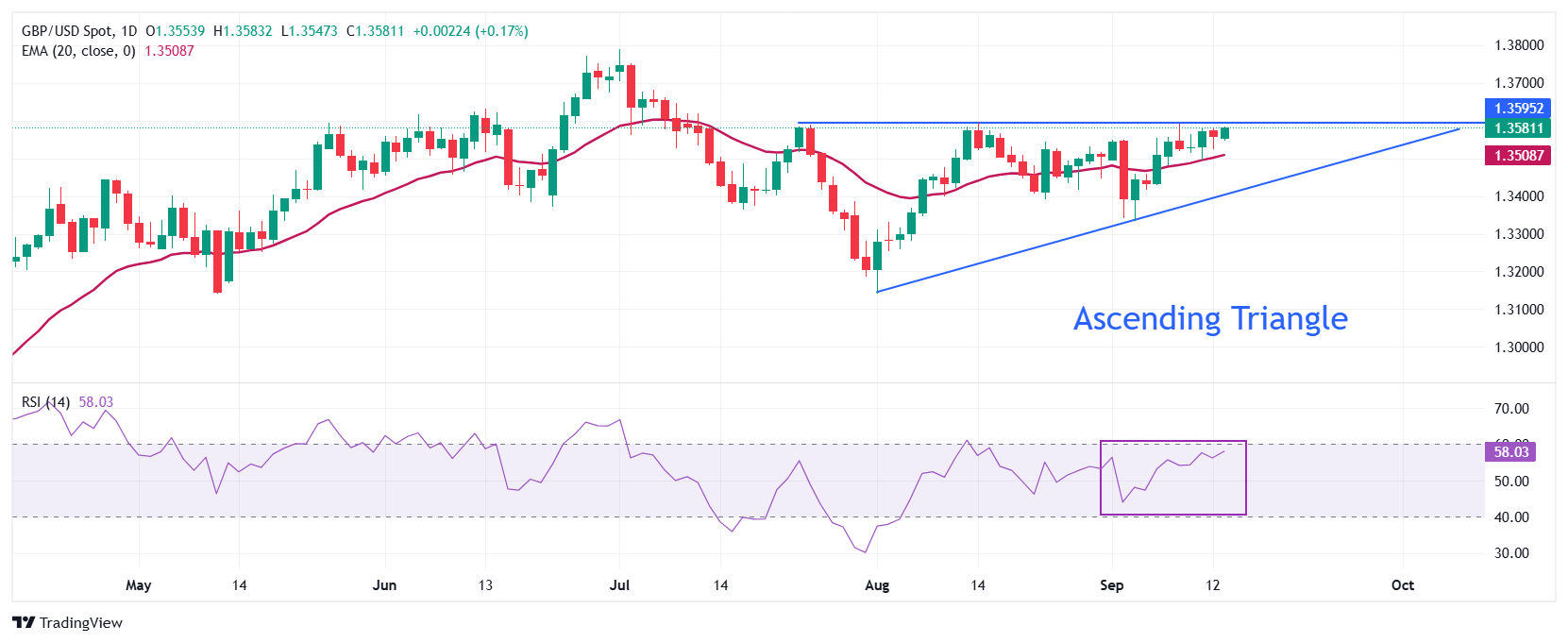
The Pound Sterling edges higher to near 1.3580 against the US Dollar on Monday. The near-term trend of the Cable remains sideways as it trades close to the 20-day Exponential Moving Average (EMA), which is around 1.3508.
The Cable trades inside the Ascending Triangle chart pattern, which indicates indecisiveness among investors. The horizontal resistance of the above-mentioned chart pattern is plotted from the July 23 high around 1.3585, while the upward-sloping border is placed from the August 1 low near 1.3140.
The 14-day Relative Strength Index (RSI) oscillates inside the 40.00-60.00 range, indicating a sideways trend.
Looking down, the August 1 low of 1.3140 will act as a key support zone. On the upside, the July 1 high near 1.3800 will act as a key barrier.
Author

Sagar Dua
FXStreet
Sagar Dua is associated with the financial markets from his college days. Along with pursuing post-graduation in Commerce in 2014, he started his markets training with chart analysis.

















