Gold attracts some buyers on Fed rate cut expectations, geopolitical uncertainties
- Gold price jumps in Wednesday’s early European session.
- Expectations of US interest rate cuts and ongoing geopolitical tensions boost the Gold price.
- Some profit-taking and portfolio rebalancing cannot be ruled out ahead of the New Year's holidays.
Gold price (XAU/USD) extends the rally above $4,350 during the early European trading hours on Wednesday. Gold's price has surged about 65% this year and is set to record its biggest annual gains since 1979. The rally in the precious metal is bolstered by the prospect of further US interest rate cuts in 2026. Lower interest rates could reduce the opportunity cost of holding Gold, supporting the non-yielding precious metal.
Furthermore, the persistent Israel-Iran conflict and the ongoing US-Venezuela tensions could boost the yellow metal. It’s worth noting that traders seek assets that can preserve value during periods of uncertainty, which supports a traditional safe-haven asset such as Gold.
On the other hand, increased margin requirements on gold and silver futures by the Chicago Mercantile Exchange (CME) Group could prompt widespread profit-taking and portfolio rebalancing, which might cap the upside for the yellow metal. Additionally, reported progress on a Ukraine peace deal might drag the Gold price lower.
Traders brace for the release of the US Initial Jobless Claims report later on Wednesday. Economists forecast a modest rise in new applications for the week ending December 27 to 220,000, compared to 214,000 in the previous week. Financial markets are expected to trade on thin volumes as traders prepare for the New Year holiday.
Daily Digest Market Movers: Gold heads for biggest annual price gains in over 40 years
- The US Federal Reserve (Fed) decided to cut the interest rate by 25 basis points (bps), bringing the federal funds rate to a target range of 3.50%–3.75%. Those in favor cited increased downside risks to employment and easing inflation pressures.
- Fed Governor Stephen Miran voted against the action in favor of a jumbo rate cut, while Chicago Fed President Austan Goolsbee and Kansas City’s Jeff Schmid dissented in favor of leaving rates unchanged.
- According to minutes from the Federal Open Market Committee (FOMC) at its December 9-10 meeting, most Fed officials saw further interest-rate reductions as appropriate so long as inflation declines over time, though they remained divided over when and how far to cut.
- Following the FOMC minutes’ release, the probability of a January cut based on federal funds futures contracts declined slightly to about 15%, according to the CME FedWatch tool.
- The Chicago Mercantile Exchange (CME) Group, one of the world’s largest trading floors for commodities, raised margin requirements for gold, silver, and other metals in a notice posted to the exchange's website last week. These notices require traders to put up more cash on their bets in order to insure against the possibility that the trader will default when they take delivery of the contract.
Gold keeps a positive view, with bullish RSI momentum
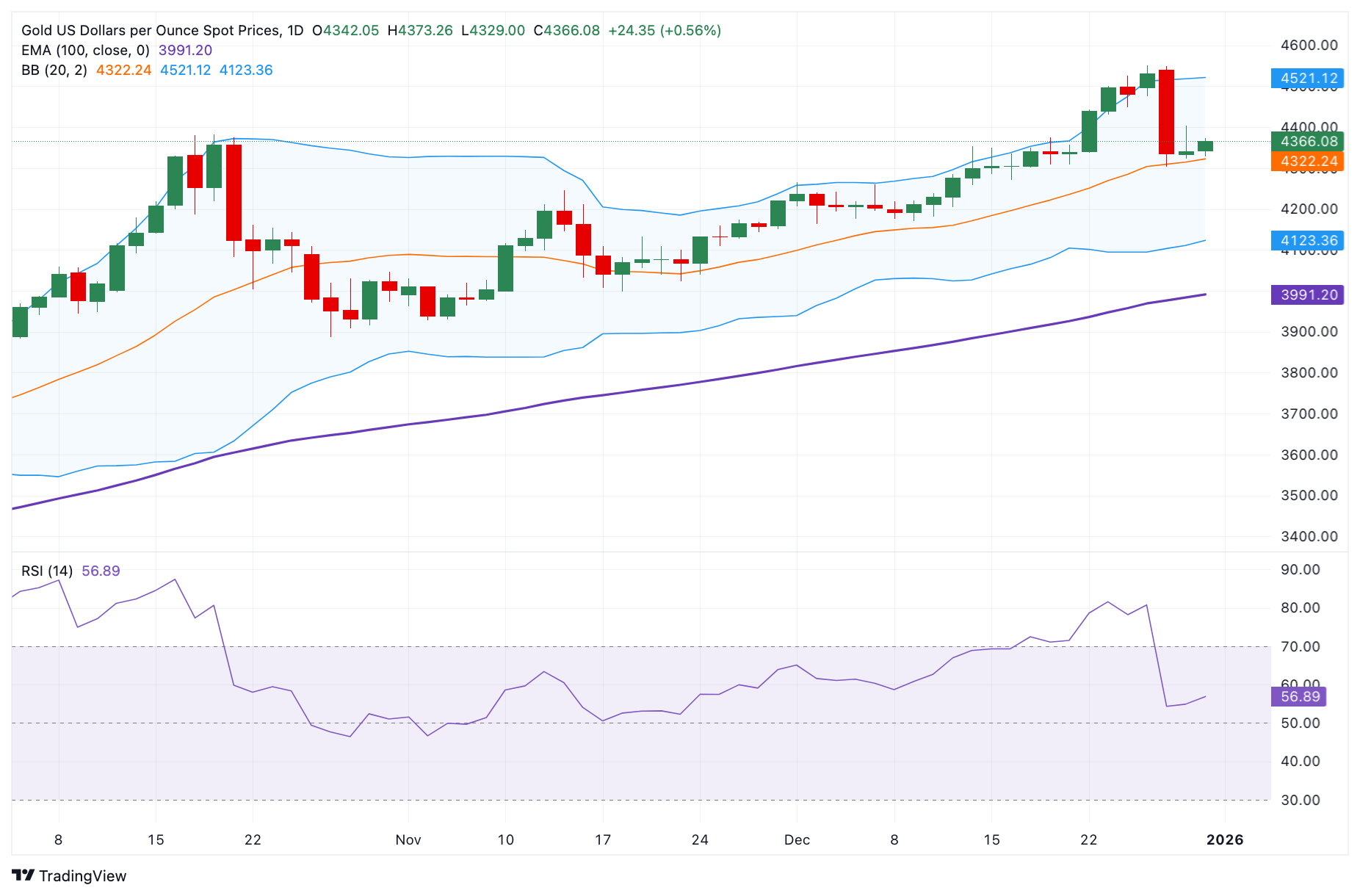
Gold trades in positive territory on the day. According to the daily chart, the bullish outlook of the precious metal remains intact as the price holds above the key 100-day Exponential Moving Average (EMA), while the Bollinger Bands widen. The path of least resistance is to the upside, with the 14-day Relative Strength Index (RSI) pointing higher above the midline. This displays the upward momentum in the near term.
The first upside barrier for XAU/USD is seen at the upper boundary of the Bollinger Band of $4,520. Green candlesticks and steady action above this level could set the price up for a run toward the all-time high of $4,550, en route to the $4,600 psychological mark.
On the other hand, the initial support level for Gold emerges in the $4,305-$4,300 region, representing the December 29 low and round figure. A stronger pullback could drag the yellow metal toward the December 16 low of $4,271.
Fed FAQs
Monetary policy in the US is shaped by the Federal Reserve (Fed). The Fed has two mandates: to achieve price stability and foster full employment. Its primary tool to achieve these goals is by adjusting interest rates. When prices are rising too quickly and inflation is above the Fed’s 2% target, it raises interest rates, increasing borrowing costs throughout the economy. This results in a stronger US Dollar (USD) as it makes the US a more attractive place for international investors to park their money. When inflation falls below 2% or the Unemployment Rate is too high, the Fed may lower interest rates to encourage borrowing, which weighs on the Greenback.
The Federal Reserve (Fed) holds eight policy meetings a year, where the Federal Open Market Committee (FOMC) assesses economic conditions and makes monetary policy decisions. The FOMC is attended by twelve Fed officials – the seven members of the Board of Governors, the president of the Federal Reserve Bank of New York, and four of the remaining eleven regional Reserve Bank presidents, who serve one-year terms on a rotating basis.
In extreme situations, the Federal Reserve may resort to a policy named Quantitative Easing (QE). QE is the process by which the Fed substantially increases the flow of credit in a stuck financial system. It is a non-standard policy measure used during crises or when inflation is extremely low. It was the Fed’s weapon of choice during the Great Financial Crisis in 2008. It involves the Fed printing more Dollars and using them to buy high grade bonds from financial institutions. QE usually weakens the US Dollar.
Quantitative tightening (QT) is the reverse process of QE, whereby the Federal Reserve stops buying bonds from financial institutions and does not reinvest the principal from the bonds it holds maturing, to purchase new bonds. It is usually positive for the value of the US Dollar.
Author

Lallalit Srijandorn
FXStreet
Lallalit Srijandorn is a Parisian at heart. She has lived in France since 2019 and now becomes a digital entrepreneur based in Paris and Bangkok.