Pound Sterling drops despite traders reassess BoE dovish bets
- The Pound Sterling extends correction to near 1.3460 against the US Dollar as the Greenback recovers on US-EU trade deal optimism.
- The improvement in US-China trade relations has boosted US Consumer Confidence.
- Markets don’t expect the BoE to cut interest rates in June.

The Pound Sterling (GBP) underperforms its peers during European trading hours on Wednesday. The British currency takes a breather after a sharp rally in the past few trading days as investors seek fresh cues on whether the Bank of England (BoE) will cut interest rates again at its June policy meeting.
The BoE reduced its borrowing rates by 25 basis points (bps) to 4.25% earlier this month, with a 7-2 vote split, and guided a “gradual and cautious” interest rate cut approach.
The latest strong United Kingdom (UK) Consumer Price Index (CPI) and Retail Sales data for April, along with the upbeat Q1 Gross Domestic Product (GDP) figures, are sufficient to discourage BoE officials from cutting interest rates further.
This month, the UK service inflation data, closely tracked by BoE policymakers, accelerated sharply to 5.4% year-over-year from 4.7% in March. Month-on-month, Retail Sales rose at a robust pace of 1.2%, compared to the 0.1% seen in March. UK economic growth came in at 0.7%, significantly higher than the 0.1% recorded in the last quarter of 2024.
The International Monetary Fund (IMF) has raised the UK GDP growth forecast for the current year to 1.2%, slightly higher than 1.1% anticipated earlier, on the back of an upbeat economic performance in the January-March period.
Daily digest market movers: Pound Sterling trades lower against US Dollar
- The Pound Sterling extends its correction to near 1.3460 against the US Dollar (USD) during North American trading hours on Wednesday. The GBP/USD pair faced selling pressure after refreshing the three-year high around 1.3600 on Monday as the US Dollar (USD) gains ground on hopes that the United States (US) and the European Union will reach a trade deal soon.
- The US Dollar Index (DXY), which tracks the Greenback’s value against six major currencies, rises to near 99.80, following Tuesday’s recovery move.
- During North American trading hours, EU officials stated that US trade negotiators Howard Lutnick and Jameison Greer have agreed to trade discussions every other day, indicating substantial efforts from the old continent to fast-track trade talks.
- On Tuesday, US President Donald Trump expressed confidence in a post on Truth.Social that the EU is increasing efforts to reach a bilateral trade deal. "I was extremely satisfied with the 50% Tariff allotment on the European Union, especially since they were ‘slow walking’. I have just been informed that the EU has called to quickly establish meeting dates. This is a positive event, and I hope that they will," Trump wrote.
- Increasing optimism over the US-EU trade deal has helped the US Dollar claw back almost the losses seen on Friday, when US President Trump threatened to impose a flat 50% tariff on imports from the EU.
- Another reason behind the recent strength in the US Dollar is the upbeat US Consumer Confidence data for May. The data, released on Tuesday, showed that Consumer Confidence increased substantially to 98.0 after deteriorating for five consecutive months. The commentary from the Conference Board indicated that de-escalation in US-China trade tensions significantly contributed to lifting households’ mood.
- This week, investors will focus on the Personal Consumption Expenditure Price Index (PCE) data for April, which will be released on Friday. The inflation data is unlikely to influence market expectations for the Federal Reserve’s (Fed) monetary policy outlook as officials are expected to remain on hold until they get clarity on new economic policies under Trump’s leadership and the scope of their consequences on the economy.
Technical Analysis: Pound Sterling falls to near 1.3460
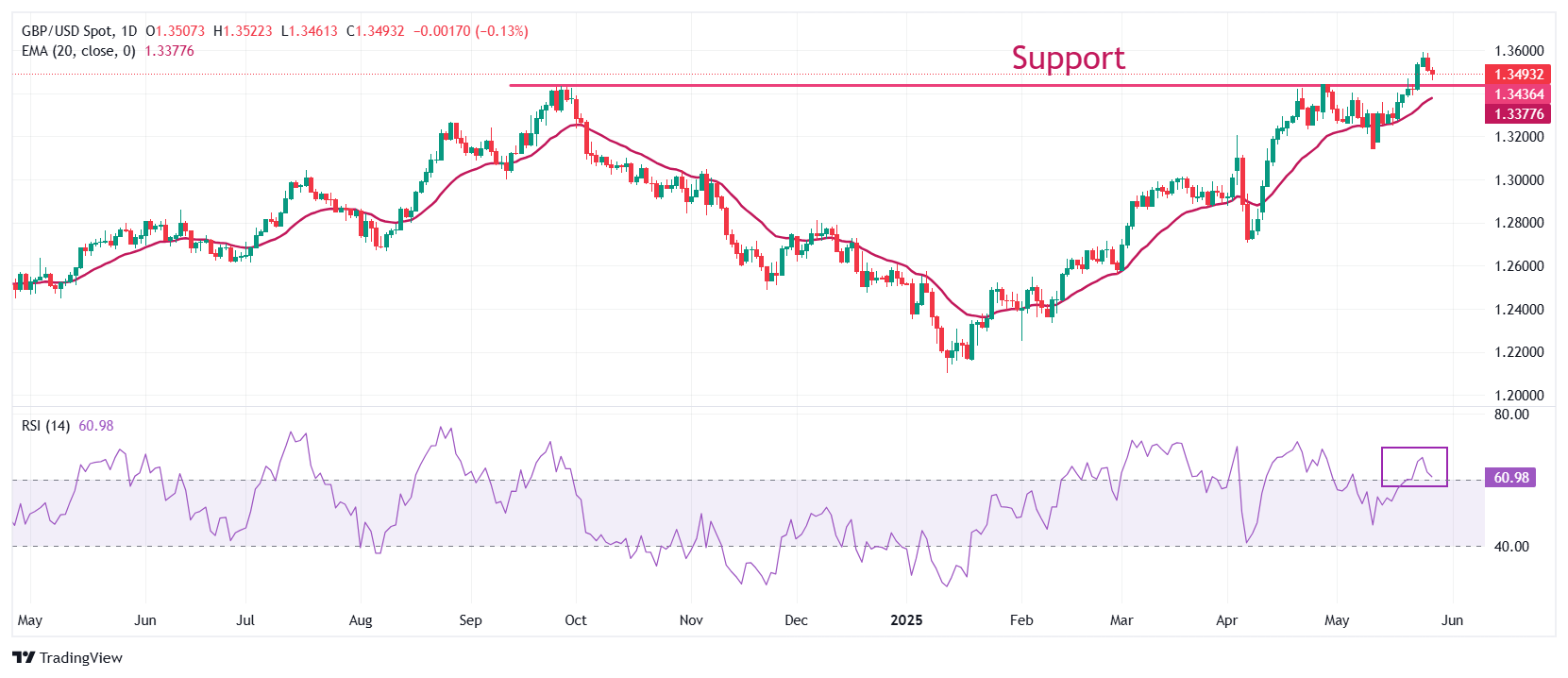
The Pound Sterling retraces to near 1.3460 against the US Dollar from the three-year high around 1.3600 on Monday. However, the outlook of the pair remains firm as the 20-day Exponential Moving Average (EMA) slopes higher around 1.3380.
The 14-day Relative Strength Index (RSI) holds above 60.00, suggesting that the bullish momentum is intact.
On the upside, the January 2022 high of 1.3750 will be a key hurdle for the pair. Looking down, the 20-day EMA will act as a major support area.
BoE FAQs
The Bank of England (BoE) decides monetary policy for the United Kingdom. Its primary goal is to achieve ‘price stability’, or a steady inflation rate of 2%. Its tool for achieving this is via the adjustment of base lending rates. The BoE sets the rate at which it lends to commercial banks and banks lend to each other, determining the level of interest rates in the economy overall. This also impacts the value of the Pound Sterling (GBP).
When inflation is above the Bank of England’s target it responds by raising interest rates, making it more expensive for people and businesses to access credit. This is positive for the Pound Sterling because higher interest rates make the UK a more attractive place for global investors to park their money. When inflation falls below target, it is a sign economic growth is slowing, and the BoE will consider lowering interest rates to cheapen credit in the hope businesses will borrow to invest in growth-generating projects – a negative for the Pound Sterling.
In extreme situations, the Bank of England can enact a policy called Quantitative Easing (QE). QE is the process by which the BoE substantially increases the flow of credit in a stuck financial system. QE is a last resort policy when lowering interest rates will not achieve the necessary result. The process of QE involves the BoE printing money to buy assets – usually government or AAA-rated corporate bonds – from banks and other financial institutions. QE usually results in a weaker Pound Sterling.
Quantitative tightening (QT) is the reverse of QE, enacted when the economy is strengthening and inflation starts rising. Whilst in QE the Bank of England (BoE) purchases government and corporate bonds from financial institutions to encourage them to lend; in QT, the BoE stops buying more bonds, and stops reinvesting the principal maturing on the bonds it already holds. It is usually positive for the Pound Sterling.
Author

Sagar Dua
FXStreet
Sagar Dua is associated with the financial markets from his college days. Along with pursuing post-graduation in Commerce in 2014, he started his markets training with chart analysis.