Pound Sterling flattens against US Dollar ahead of UK CPI data
- The Pound Sterling gives up early gains against the US Dollar, while Moody’s downgraded the US sovereign debt keeps the US Dollar on the backfoot.
- China accused the US of undermining the recent trade talks after Washington warned about using Huawei AI chips across the world.
- The UK secures a “reset” agreement with the EU after signing trade deals with India and the US.

The Pound Sterling (GBP) surrenders initial gains and flattens around 1.3365 against the US Dollar (USD) during North American trading hours on Tuesday. The GBP/USD pair turns flat as the US Dollar recoups early losses, with the US Dollar Index (DXY) gaining ground near 100.00.
Earlier in the day, the Greenback suffered due to a one-notch downgrade in the United States (US) sovereign credit by Moody’s Rating. On Friday, Moody’s downgraded the US long-term issuer and senior unsecured ratings from Aaa to Aa1 over the growing $36 trillion US government debt pile. The move prompted fears about investing in US assets and boosted US bond yields substantially. The initial reaction from 10-year US Treasury yields after the rating downgrade was strong, posting a fresh over-a-month high of around 4.56%. After the initial shock, yields have fallen back to near 4.45%.
Another reason behind the US Dollar remaining on the back foot is China accusing the US of undermining high-level trade talks in Geneva last weekend. The accusation from Beijing at Washington came after comments from the US Commerce Department last week that discouraged the use of Huawei Technologies Co.’s artificial-intelligence (AI) chips and Chinese AI models. According to a Chinese Commerce Ministry spokesperson, the US Commerce Department's advice is "discriminatory" and "market distorting," prompting Beijing to "demand" that the administration "correct its mistakes.”
A report from Bloomberg showed last week that the Commerce Department said that it was issuing guidance to make clear the “use of Huawei Ascend chips is a breach of the US government’s export controls”. The agency also warned the public about “the potential consequences of allowing US AI chips to be used for training and inference of Chinese AI models.”
Meanwhile, investors look for fresh cues about how much the Federal Reserve (Fed) will cut interest rates this year. A slew of Fed officials has urged patience as they need more data to assess the economic outlook in the wake of significant economic policy changes. On Monday, Atlanta Fed Bank President Raphael Bostic stated that inflation will now take longer to return to the 2% and anticipated one interest rate cut this year.
Daily digest market movers: Pound Sterling edges higher while BoE Pill warns caution on interest rate cuts
- The Pound Sterling trades higher against its peers on Tuesday. The British currency gains as the United Kingdom (UK) signs an agreement with the European Union (EU) on trade, defense, and security that deepens its ties with the continent after Brexit. This is the third bilateral deal by the UK after closing two with India and the United States (US) this month.
- The major highlights of the deal between the UK and the EU are the Sanitary and Phytosanitary (SPS) deal that aims to withdraw routine checks on products from animals and plants, Britain’s participation in the Eurozone’s historic defense spending, and investment of £360 million in the fishing industry.
- Strong ties between the EU and the UK at a time of potential global economic turmoil due to the fallout of reciprocal tariffs by US President Donald Trump are favorable for both economies.
- On the domestic front, investors await the UK Consumer Price Index (CPI) data for April, which will be released on Wednesday. As measured by the CPI, the core inflation – which excludes volatile components of food, energy, alcohol, and tobacco – is expected to have grown at a faster pace of 3.7%, compared to 3.4% in March. The headline CPI is estimated to have risen at a robust pace of 3.3% against the prior release of 2.6%.
- Data showing accelerating price pressures would force traders to pare bets supporting further interest-rate cuts by the Bank of England (BoE). At the start of the month, the BoE cut key borrowing rates by 25 basis points (bps) to 4.25%, with a 7-2 vote split and guided a “gradual and cautious” interest rate cut approach. Monetary Policy Committee (MPC) members Catherine Mann and Chief Economist Huw Pill voted for leaving interest rates unchanged.
- During European trading hours, BoE Pill acknowledged that the "underlying disinflation process remains intact", but warned that caution is needed as the "pace of quarterly cuts is too rapid given the balance of risks to price stability we face". Pill clarified that his "dissenting vote" was in favour of a 'skip' in the quarterly pattern of bank rate cuts, and not a signal to "halt the withdrawal of restriction".
Technical Analysis: Pound Sterling holds key 20-day EMA
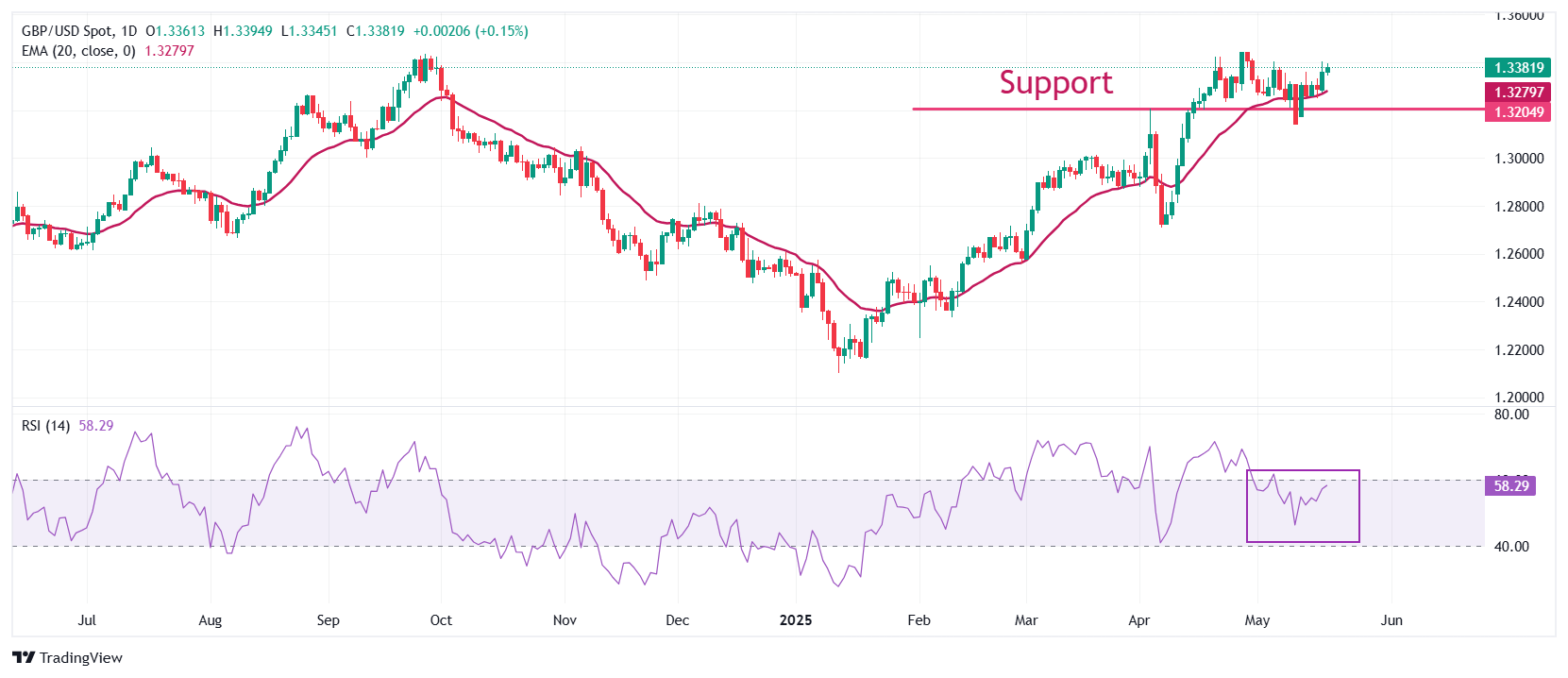
The Pound Sterling trades firmly around 1.3350 against the US Dollar on Tuesday. The GBP/USD pair holds above the 20-day Exponential Moving Average (EMA), which trades around 1.3280, suggesting that the near-term trend is bullish.
The 14-day Relative Strength Index (RSI) points in the upper boundary of the 40.00-60.00 range. A fresh bullish momentum would appear if the RSI breaks above 60.00.
On the upside, the three-year high of 1.3445 will be a key hurdle for the pair. Looking down, the psychological level of 1.3000 will act as a major support area.
Economic Indicator
Core Consumer Price Index (YoY)
The United Kingdom (UK) Core Consumer Price Index (CPI), released by the Office for National Statistics on a monthly basis, is a measure of consumer price inflation – the rate at which the prices of goods and services bought by households rise or fall – produced to international standards. The YoY reading compares prices in the reference month to a year earlier. Core CPI excludes the volatile components of food, energy, alcohol and tobacco. The Core CPI is a key indicator to measure inflation and changes in purchasing trends. Generally, a high reading is seen as bullish for the Pound Sterling (GBP), while a low reading is seen as bearish.
Read more.Next release: Wed May 21, 2025 06:00
Frequency: Monthly
Consensus: 3.6%
Previous: 3.4%
Source: Office for National Statistics
The Bank of England is tasked with keeping inflation, as measured by the headline Consumer Price Index (CPI) at around 2%, giving the monthly release its importance. An increase in inflation implies a quicker and sooner increase of interest rates or the reduction of bond-buying by the BOE, which means squeezing the supply of pounds. Conversely, a drop in the pace of price rises indicates looser monetary policy. A higher-than-expected result tends to be GBP bullish.
Author

Sagar Dua
FXStreet
Sagar Dua is associated with the financial markets from his college days. Along with pursuing post-graduation in Commerce in 2014, he started his markets training with chart analysis.