Pound Sterling outperforms risky peers at the start of the week
- The Pound Sterling is under pressure as the US raid in Venezuela has increased the safe-haven demand.
- The BoE is expected to follow a gradual monetary easing cycle in 2026.
- Investors await the US ISM Manufacturing PMI data for December.

The Pound Sterling (GBP) outperforms its risky currency peers, but faces selling pressure against safe-haven at the start of the week. The British currency gains on expectations that the Bank of England (BoE) will follow a gradual monetary easing cycle in 2026. The BoE stated in its last policy meeting of 2025 that the monetary policy will remain on a “gradual downward path” after reducing interest rates by 25 basis points (bps) to 3.75% with a 5-4 majority in December.
Market experts believe that the BoE favored a moderate easing campaign as the United Kingdom (UK) inflation is well above the 2% target despite cooling down in the last two months. The UK headline Consumer Price Index (CPI) inflation came down to 3.2% in November from the peak of 3.8% seen in September.
Pound Sterling Price Today
The table below shows the percentage change of British Pound (GBP) against listed major currencies today. British Pound was the weakest against the US Dollar.
| USD | EUR | GBP | JPY | CAD | AUD | NZD | CHF | |
|---|---|---|---|---|---|---|---|---|
| USD | 0.32% | 0.12% | 0.02% | 0.31% | 0.29% | 0.31% | 0.54% | |
| EUR | -0.32% | -0.20% | -0.29% | -0.01% | -0.03% | -0.01% | 0.21% | |
| GBP | -0.12% | 0.20% | -0.11% | 0.19% | 0.17% | 0.19% | 0.41% | |
| JPY | -0.02% | 0.29% | 0.11% | 0.30% | 0.29% | 0.30% | 0.53% | |
| CAD | -0.31% | 0.01% | -0.19% | -0.30% | -0.02% | 0.00% | 0.23% | |
| AUD | -0.29% | 0.03% | -0.17% | -0.29% | 0.02% | 0.02% | 0.24% | |
| NZD | -0.31% | 0.00% | -0.19% | -0.30% | 0.00% | -0.02% | 0.23% | |
| CHF | -0.54% | -0.21% | -0.41% | -0.53% | -0.23% | -0.24% | -0.23% |
The heat map shows percentage changes of major currencies against each other. The base currency is picked from the left column, while the quote currency is picked from the top row. For example, if you pick the British Pound from the left column and move along the horizontal line to the US Dollar, the percentage change displayed in the box will represent GBP (base)/USD (quote).
Pound Sterling drops against US Dollar amid sour market mood
- The Pound Sterling drops 0.2% to near 1.3420 against the US Dollar (USD) as investors turn risk-averse, following the United States’ (US) strike on Venezuela and the capture of President Nicolas Maduro against drug-trafficking charges.
- At the same time, the US Dollar Index (DXY), which tracks the Greenback’s value against six major currencies, revisits an over three-week high at 98.80.
- Over the weekend, the US raided Venezuela and announced that it will restructure its Oil industry by bringing American Oil companies. US President Donald Trump also threatened to conduct raids in Colombia and Iran. "Colombia’s very sick, run by a sick man who likes making cocaine and selling it to the United States,” Trump said, Reuters reported. On Iran, US President Trump said the country would “get hit very hard” if Tehran began killing protestors.
- This week, the GBP/USD pair is expected to face significant volatility as a string of US economic data is lined up for release, notably the Nonfarm Payrolls (NFP) data for December on Friday.
- Investors will pay close attention to the US official employment data to get fresh cues on the current state of the job market. In 2025, the Federal Reserve (Fed) delivered three interest rate cuts, pushing them lower to the 3.50%-3.75% range to support weakening labor market conditions.
- In Monday’s session, investors will focus on the ISM Manufacturing Purchasing Managers’ Index (PMI) data for December, which will be published at 15:00 GMT. The ISM Manufacturing PMI is expected to tick higher to 48.3 from 48.2 in November, suggesting that the business activity contracted again, but at a slightly moderate pace.
Technical Analysis: GBP/USD struggles to hold above 61.8% Fibo retracement at 1.3500
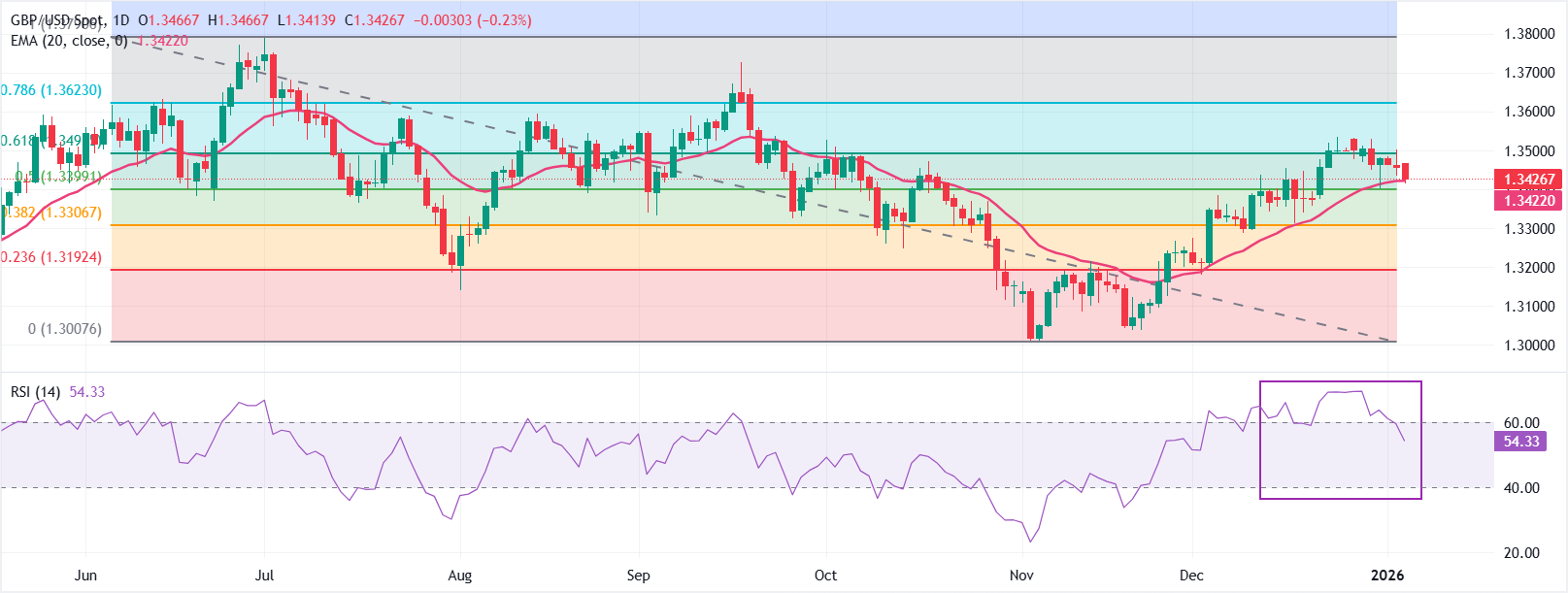
In the daily chart, GBP/USD trades at 1.3427 at the time of writing. Price holds marginally above a rising 20-day Exponential Moving Average (EMA) at 1.3422, keeping the short-term bias pointed higher. The average has advanced steadily and continues to underpin shallow pullbacks.
The Relative Strength Index (RSI) indicator at 54 (neutral) has slipped from recent elevated readings, signaling moderating bullish momentum.
Measured from the 1.3791 high in early July to the 1.3008 low in November, the 61.8% Fibonacci retracement at 1.3491 stands as the next resistance, while the 50% retracement at 1.3399 defines the immediate support. A daily close above 1.3491 would extend the advance, whereas a drop back below 1.3399 could invite a deeper pullback.
(The technical analysis of this story was written with the help of an AI tool.)
Risk sentiment FAQs
In the world of financial jargon the two widely used terms “risk-on” and “risk off'' refer to the level of risk that investors are willing to stomach during the period referenced. In a “risk-on” market, investors are optimistic about the future and more willing to buy risky assets. In a “risk-off” market investors start to ‘play it safe’ because they are worried about the future, and therefore buy less risky assets that are more certain of bringing a return, even if it is relatively modest.
Typically, during periods of “risk-on”, stock markets will rise, most commodities – except Gold – will also gain in value, since they benefit from a positive growth outlook. The currencies of nations that are heavy commodity exporters strengthen because of increased demand, and Cryptocurrencies rise. In a “risk-off” market, Bonds go up – especially major government Bonds – Gold shines, and safe-haven currencies such as the Japanese Yen, Swiss Franc and US Dollar all benefit.
The Australian Dollar (AUD), the Canadian Dollar (CAD), the New Zealand Dollar (NZD) and minor FX like the Ruble (RUB) and the South African Rand (ZAR), all tend to rise in markets that are “risk-on”. This is because the economies of these currencies are heavily reliant on commodity exports for growth, and commodities tend to rise in price during risk-on periods. This is because investors foresee greater demand for raw materials in the future due to heightened economic activity.
The major currencies that tend to rise during periods of “risk-off” are the US Dollar (USD), the Japanese Yen (JPY) and the Swiss Franc (CHF). The US Dollar, because it is the world’s reserve currency, and because in times of crisis investors buy US government debt, which is seen as safe because the largest economy in the world is unlikely to default. The Yen, from increased demand for Japanese government bonds, because a high proportion are held by domestic investors who are unlikely to dump them – even in a crisis. The Swiss Franc, because strict Swiss banking laws offer investors enhanced capital protection.
Author

Sagar Dua
FXStreet
Sagar Dua is associated with the financial markets from his college days. Along with pursuing post-graduation in Commerce in 2014, he started his markets training with chart analysis.