Pound Sterling ticks lower against US Dollar as investors assess Trump tariffs' outcome
- The Pound Sterling drops to near 1.2950 against the US Dollar as investors gauge the consequences of US President Trump’s tariff policies.
- US CPI and PPI cools down more than expected in February.
- The BoE is expected to keep interest rates steady next week.

The Pound Sterling (GBP) falls marginally to near 1.2930 against the US Dollar (USD) in Thursday's North American session. The GBP/USD pair has corrected from a fresh four-month high near 1.2990 posted the previous day as the US Dollar gains after declining for two weeks, while investors weigh the consequences of United States (US) President Donald Trump’s tariff agenda over cooling inflationary pressures and US economic growth. The US Dollar Index (DXY), which tracks the Greenback’s value against six major currencies, gains 0.4% to near 104.00, after recovering from an over four-month low of 103.20 reached on Tuesday.
On Wednesday, US President Trump threatened to announce retaliatory tariffs on the European Union (EU) after the 27-nation bloc warned to impose counter-tariffs on goods imported from the US worth 26 billion Euros (EUR). The shared continent vowed to impose counter-surcharges on the US as Trump’s decision to levy 25% tariffs on imports of steel and aluminum across the globe went into effect.
Fears of a potential EU-US trade war have offered a temporary cushion to the US Dollar. However, softer-than-expected US Consumer Price Index (CPI) and Producer Price Index (PPI) data for February is expected to keep the upside in the Greenback limited. The headline PPI rose by 3.2% on year-on-year, slower than estimates of 3.3% and the 3.7% increase seen in January. In the same period, the core PPI – which excludes volatile food and energy prices – decelerated at a faster pace to 3.4% from expectations of 3.5% and the former reading of 3.8%. Month-on-month core PPI deflated by 0.1% while the headline figure remained flat. This scenario is unfavorable for the US Dollar as cooling price pressures boost Federal Reserve (Fed) dovish bets.
Daily digest market movers: Pound Sterling struggles ahead of UK monthly GDP, factory data
- The Pound Sterling trades with caution as Donald Trump's tariff measures have dampened the appeal of risk-sensitive assets. Market participants expect Trump’s ‘America First’ policies will lead to high inflation and a global economic slowdown. This has increased the demand for safe-haven assets.
- On the domestic front, investors await the United Kingdom's (UK) monthly Gross Domestic Product (GDP) and the factory data for January, which will be released on Friday. Investors will pay close attention to the UK GDP data as Bank of England (BoE) policymakers are worried about the economic outlook.
- In the February policy meeting, the BoE revised the GDP forecast for the year to 0.75%, lowered from the 1.5% projected in November. Also, BoE Monetary Policy Committee (MPC) member Catherine Mann favored a larger-than-usual interest rate cut of 50 basis points (bps) amid concerns over growth prospects.
- The UK economy is expected to have grown at a moderate pace of 0.1%, compared to the 0.4% economic expansion seen in December. Monthly factory data is estimated to have declined in the first month of 2025.
- Going forward, the next major trigger for the British currency will be the Bank of England’s (BoE) monetary policy decision, which will be announced next week. The BoE is expected to keep interest rates steady at 4.5% as most officials have guided a ‘gradual and cautious’ policy-easing approach. In the Feb meeting, the BoE reduced interest rates by 25 bps.
Technical Analysis: Pound Sterling hold gains above 1.2900
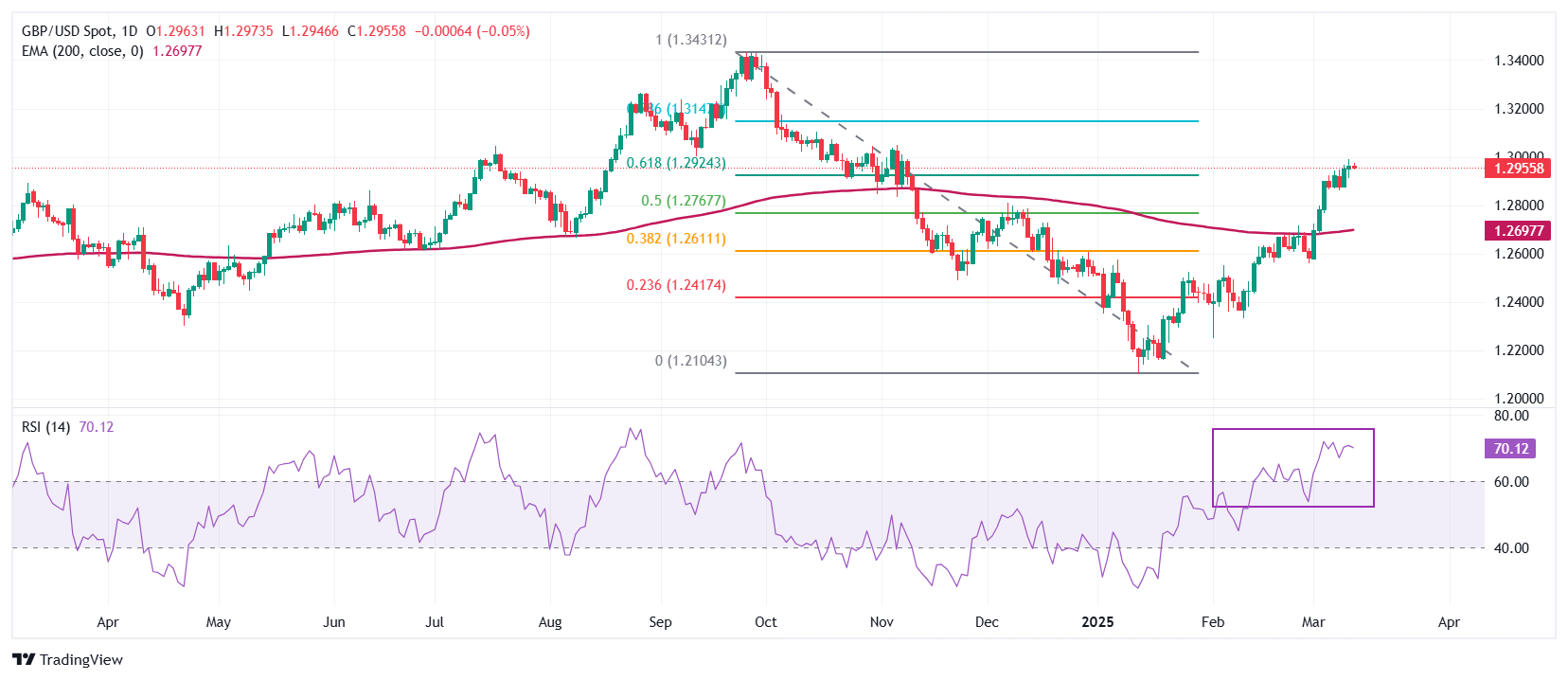
The Pound Sterling faces slight pressure and drops to near 1.2930 against the US Dollar on Thursday from the four-month high around the psychological level of 1.3000. However, the long-term outlook of the GBP/USD pair has turned bullish as it holds above the 200-day Exponential Moving Average (EMA), which is around 1.2697.
The 14-day Relative Strength Index (RSI) holds above 60.00, indicating a strong bullish momentum.
Looking down, the 50% Fibonacci retracement at 1.2767 and the 38.2% Fibonacci retracement at 1.2608 will act as key support zones for the pair. On the upside, the October 15 high of 1.3100 will act as a key resistance zone.
Tariffs FAQs
Tariffs are customs duties levied on certain merchandise imports or a category of products. Tariffs are designed to help local producers and manufacturers be more competitive in the market by providing a price advantage over similar goods that can be imported. Tariffs are widely used as tools of protectionism, along with trade barriers and import quotas.
Although tariffs and taxes both generate government revenue to fund public goods and services, they have several distinctions. Tariffs are prepaid at the port of entry, while taxes are paid at the time of purchase. Taxes are imposed on individual taxpayers and businesses, while tariffs are paid by importers.
There are two schools of thought among economists regarding the usage of tariffs. While some argue that tariffs are necessary to protect domestic industries and address trade imbalances, others see them as a harmful tool that could potentially drive prices higher over the long term and lead to a damaging trade war by encouraging tit-for-tat tariffs.
During the run-up to the presidential election in November 2024, Donald Trump made it clear that he intends to use tariffs to support the US economy and American producers. In 2024, Mexico, China and Canada accounted for 42% of total US imports. In this period, Mexico stood out as the top exporter with $466.6 billion, according to the US Census Bureau. Hence, Trump wants to focus on these three nations when imposing tariffs. He also plans to use the revenue generated through tariffs to lower personal income taxes.
Author

Sagar Dua
FXStreet
Sagar Dua is associated with the financial markets from his college days. Along with pursuing post-graduation in Commerce in 2014, he started his markets training with chart analysis.