Pound Sterling gains as market experts reassess BoE rate cut projections
- The Pound Sterling gains to near 1.3450 against the US Dollar, with investors awaiting fresh developments on US tariffs.
- Traders pare Fed dovish bets, following the US CPI data for June.
- The BoE is unlikely to cut interest rates in the September meeting.

The Pound Sterling (GBP) starts the week on a slightly positive note. The British currency ticks up against its major peers, except the Japanese Yen (JPY), as market experts have pared bets supporting a higher number of interest rate cuts by the Bank of England (BoE) for the remainder of the year.
According to a report from Reuters, a number of Wall Street brokerage houses have reassessed their BoE rate cut expectations, following the release of the hotter-than-projected United Kingdom (UK) Consumer Price Index (CPI) data for June and lesser-than-expected weakness in the labor market data for the three months ending in May.
Analysts at Bank of America (BofA) Global Research, Citigroup, Morgan Stanley and Goldman Sachs pared expectations for a September BoE interest rate cut on Thursday. Citigroup expects the central bank to cut interest rates in August, November and December.
Last week, the UK CPI report showed that inflationary pressures grew at a faster-than-expected pace. The UK headline and core CPI rose by 3.6% and 3.7% on year, respectively. Meanwhile, the labor market data showed that the decline in the number of employees, which are already on payroll, was less than what it appeared in prior readings. According to the employment report, the number of workers laid off was revised lower to 25K from prior estimates of 109K.
This week, investors will pay close attention to the preliminary UK S&P Global Purchasing Managers' Index (PMI) data for July and the Retail Sales data for June, which will be released on Thursday and Friday, respectively.
British Pound PRICE Today
The table below shows the percentage change of British Pound (GBP) against listed major currencies today. British Pound was the strongest against the New Zealand Dollar.
| USD | EUR | GBP | JPY | CAD | AUD | NZD | CHF | |
|---|---|---|---|---|---|---|---|---|
| USD | -0.06% | -0.21% | -0.06% | 0.05% | 0.09% | 0.24% | -0.10% | |
| EUR | 0.06% | -0.07% | 0.03% | 0.09% | 0.12% | 0.12% | -0.07% | |
| GBP | 0.21% | 0.07% | -0.10% | 0.21% | 0.22% | 0.41% | 0.19% | |
| JPY | 0.06% | -0.03% | 0.10% | 0.11% | 0.19% | 0.25% | 0.13% | |
| CAD | -0.05% | -0.09% | -0.21% | -0.11% | 0.11% | 0.19% | -0.20% | |
| AUD | -0.09% | -0.12% | -0.22% | -0.19% | -0.11% | 0.08% | -0.06% | |
| NZD | -0.24% | -0.12% | -0.41% | -0.25% | -0.19% | -0.08% | -0.22% | |
| CHF | 0.10% | 0.07% | -0.19% | -0.13% | 0.20% | 0.06% | 0.22% |
The heat map shows percentage changes of major currencies against each other. The base currency is picked from the left column, while the quote currency is picked from the top row. For example, if you pick the British Pound from the left column and move along the horizontal line to the US Dollar, the percentage change displayed in the box will represent GBP (base)/USD (quote).
Daily digest market movers: Pound Sterling moves higher against US Dollar as latter corrects
- The Pound Sterling rises to near 1.3450 against the US Dollar (USD) during the European trading session on Monday. The GBP/USD gains as the US Dollar (USD) retraces, with investors awaiting developments on tariffs by the United States (US) on its trading partners ahead of the August 1 deadline.
- At the time of writing, the US Dollar Index (DXY), which tracks the Greenback’s value against six major currencies, drops to near 98.15. However, it remains close to the four-week high of around 99.00 set last week.
- So far, the US has announced trade deals with the United Kingdom (UK), Vietnam, and Indonesia, and a limited pact with China. Washington has also expressed confidence that it is close to signing a trade agreement with India. US President Donald Trump has announced tariffs on 22 nations, notably Japan, Vietnam, Canada, Mexico, and the European Union (EU).
- Meanwhile, trade tensions between the US and EU have escalated as the former has demanded a higher baseline tariff on imports from the trading bloc. According to a report from the Financial Times (FT), Washington is eyeing at least a minimum tariff of 15% to 20% in a deal with the Eurozone.
- The report has also shown that President Trump has been reluctant to reduce tariffs on imports of automobiles from the EU, which stand at 25%. Trade tensions between the US and the EU could be unfavorable for global trade flows, given the size of business between both economies.
- On the domestic front, traders have pared Federal Reserve (Fed) dovish bets for the September meeting. According to the CME FedWatch tool, the probability that the Fed will reduce interest rates at the September meeting has declined to 58.5% from almost 70% seen a month ago.
- Traders trimmed expectations for the Fed to reduce interest rates in the September meeting after the release of the US CPI data for June last week, which showed that prices of products that are largely imported have increased after the imposition of sectoral tariffs by President Donald Trump.
Technical Analysis: Pound Sterling strives to rebound to near 20-day EMA
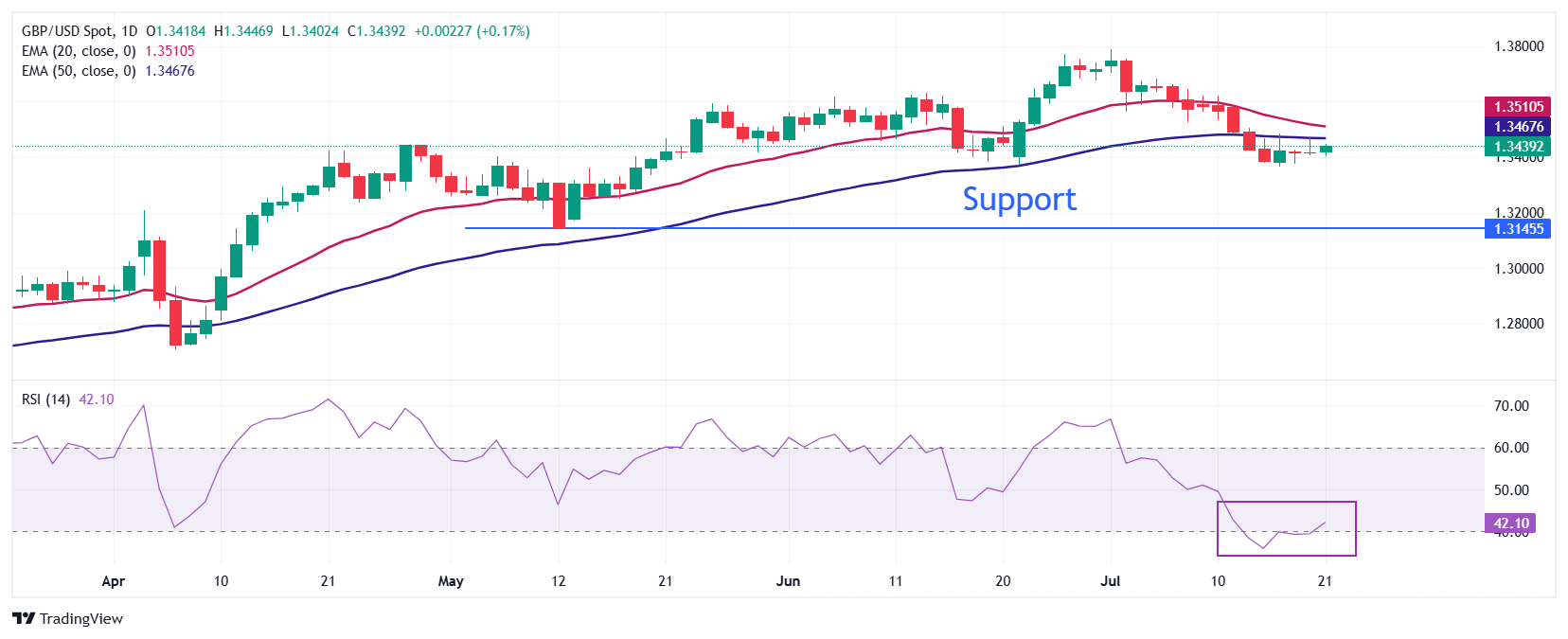
The Pound Sterling oscillates within Friday’s range around 1.3440 against the US Dollar on Monday. The near-term trend of the GBP/USD pair is bearish as it trades below 20-day and 50-day Exponential Moving Averages (EMAs), which trade around 1.3510 and 1.3470, respectively.
The 14-day Relative Strength Index (RSI) strives to hold above the 40.00 level. A fresh bearish momentum would emerge if the RSI falls below that level.
Looking down, the May 12 low of 1.3140 will act as a key support zone. On the upside, the July 11 high around 1.3585 will act as a key barrier.
BoE FAQs
The Bank of England (BoE) decides monetary policy for the United Kingdom. Its primary goal is to achieve ‘price stability’, or a steady inflation rate of 2%. Its tool for achieving this is via the adjustment of base lending rates. The BoE sets the rate at which it lends to commercial banks and banks lend to each other, determining the level of interest rates in the economy overall. This also impacts the value of the Pound Sterling (GBP).
When inflation is above the Bank of England’s target it responds by raising interest rates, making it more expensive for people and businesses to access credit. This is positive for the Pound Sterling because higher interest rates make the UK a more attractive place for global investors to park their money. When inflation falls below target, it is a sign economic growth is slowing, and the BoE will consider lowering interest rates to cheapen credit in the hope businesses will borrow to invest in growth-generating projects – a negative for the Pound Sterling.
In extreme situations, the Bank of England can enact a policy called Quantitative Easing (QE). QE is the process by which the BoE substantially increases the flow of credit in a stuck financial system. QE is a last resort policy when lowering interest rates will not achieve the necessary result. The process of QE involves the BoE printing money to buy assets – usually government or AAA-rated corporate bonds – from banks and other financial institutions. QE usually results in a weaker Pound Sterling.
Quantitative tightening (QT) is the reverse of QE, enacted when the economy is strengthening and inflation starts rising. Whilst in QE the Bank of England (BoE) purchases government and corporate bonds from financial institutions to encourage them to lend; in QT, the BoE stops buying more bonds, and stops reinvesting the principal maturing on the bonds it already holds. It is usually positive for the Pound Sterling.
Author

Sagar Dua
FXStreet
Sagar Dua is associated with the financial markets from his college days. Along with pursuing post-graduation in Commerce in 2014, he started his markets training with chart analysis.