NZD/USD slips on interest rate expectations and geopolitical risks
- NZD/USD slips as risk aversion and central bank divergence support the Greenback.
- The US Dollar is supported by Middle East tensions and delayed Fed cuts, pressuring the New Zealand Dollar.
- NZD/USD slides below 0.6000, threatening channel support.

The New Zealand Dollar (NZD) is weakening against the US Dollar (USD) on Friday, with NZD/USD slipping below the 0.6000 handle at the time of writing.
A firmer Greenback and reduced liquidity due to the Matariki public holiday in New Zealand are weighing on the pair.
While US markets reopened following Thursday’s Juneteenth holiday, full liquidity across both economies is expected to return by Monday.
This week’s price action has been driven by New Zealand’s Gross Domestic Product (GDP) data and the Federal Reserve’s (Fed) interest rate decision, which remain the key catalysts for NZD/USD.
The Israel-Iran conflict, now in its eighth day, has further dented risk appetite. Expectations for the Fed’s first rate cut to arrive only in September have helped limit USD downside. On Wednesday, the Fed held rates steady and warned that tariff-driven inflation could persist longer than expected.
The “higher for longer” narrative overshadowed recession fears in the short term.
Continuing with this theme, New Zealand’s GDP data released on Wednesday offered a glimmer of hope for the Kiwi.
The report revealed that the economy grew 0.8% in the first quarter, surpassing analyst estimates of a 0.7% increase.
Despite the upbeat data, NZD failed to rally. Investor focus remained on Fed Chair Powell’s hawkish remarks and deepening Middle East tensions.
Powell stressed the Fed’s data-dependent stance and persistent inflation risks. NZD/USD surrendered earlier gains and dropped back below the 0.6000 psychological level, which now acts as resistance.
The Reserve Bank of New Zealand (RBNZ), which delivered its sixth consecutive rate cut in May, stated that “the Committee has scope to lower the OCR further as appropriate,”.
With the Official Cash Rate (OCR) currently at 3.25%, the benchmark rate in the US is currently in the 4.25%-4.50% range.
In contrast, Powell and other Fed officials continue to describe the US economy as “solid,” suggesting it can absorb higher interest rates for an extended period.
This conflicting policy stance continues to favor the US Dollar, as elevated rates support Treasury yields.
For the Kiwi, easing policy expectations and weaker sentiment remain downside risks.
NZD/USD slides below 0.6000, threatening channel support
From a technical standpoint, NZD/USD is currently threatening the lower bound of its ascending channel, having slipped below the 0.6000 psychological level, which is now acting as resistance. The pair is hovering just above the 23.6% Fibonacci retracement level of 0.5947, a key support derived from the April–June rally.
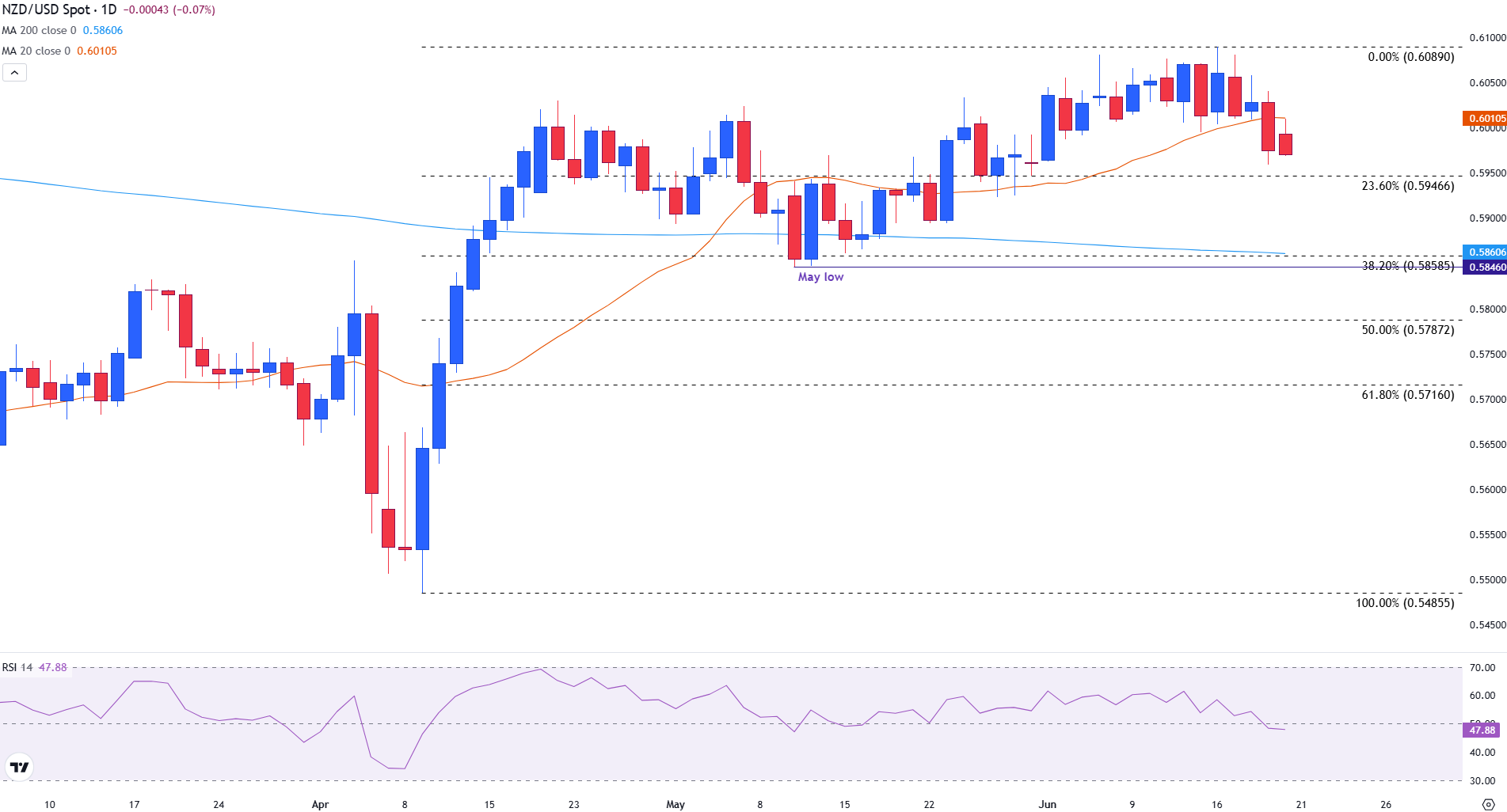
The 20-day Simple Moving Average (SMA) provides resistance at 0.6011. A confirmed break below this zone could expose the 200-day SMA at 0.5860, closely aligned with the 38.2% Fib retracement at 0.5858. Meanwhile, momentum is shifting to cautious, with the Relative Strength Index (RSI) near 49, indicating weakening upside pressure. Bulls need to reclaim 0.6011 to stabilize the near-term outlook.
New Zealand Dollar FAQs
The New Zealand Dollar (NZD), also known as the Kiwi, is a well-known traded currency among investors. Its value is broadly determined by the health of the New Zealand economy and the country’s central bank policy. Still, there are some unique particularities that also can make NZD move. The performance of the Chinese economy tends to move the Kiwi because China is New Zealand’s biggest trading partner. Bad news for the Chinese economy likely means less New Zealand exports to the country, hitting the economy and thus its currency. Another factor moving NZD is dairy prices as the dairy industry is New Zealand’s main export. High dairy prices boost export income, contributing positively to the economy and thus to the NZD.
The Reserve Bank of New Zealand (RBNZ) aims to achieve and maintain an inflation rate between 1% and 3% over the medium term, with a focus to keep it near the 2% mid-point. To this end, the bank sets an appropriate level of interest rates. When inflation is too high, the RBNZ will increase interest rates to cool the economy, but the move will also make bond yields higher, increasing investors’ appeal to invest in the country and thus boosting NZD. On the contrary, lower interest rates tend to weaken NZD. The so-called rate differential, or how rates in New Zealand are or are expected to be compared to the ones set by the US Federal Reserve, can also play a key role in moving the NZD/USD pair.
Macroeconomic data releases in New Zealand are key to assess the state of the economy and can impact the New Zealand Dollar’s (NZD) valuation. A strong economy, based on high economic growth, low unemployment and high confidence is good for NZD. High economic growth attracts foreign investment and may encourage the Reserve Bank of New Zealand to increase interest rates, if this economic strength comes together with elevated inflation. Conversely, if economic data is weak, NZD is likely to depreciate.
The New Zealand Dollar (NZD) tends to strengthen during risk-on periods, or when investors perceive that broader market risks are low and are optimistic about growth. This tends to lead to a more favorable outlook for commodities and so-called ‘commodity currencies’ such as the Kiwi. Conversely, NZD tends to weaken at times of market turbulence or economic uncertainty as investors tend to sell higher-risk assets and flee to the more-stable safe havens.
Author

Tammy Da Costa, CFTe®
FXStreet
Tammy is an economist and market analyst with a deep passion for financial markets, particularly commodities and geopolitics.


![How Wall Street rigs the game [Video]](https://editorial.fxsstatic.com/images/i/market-chaos-01.jpg)