|

NZD/USD recovers from multi-month lows following weak US PMIs

  • NZD/USD rebounded around 0.6085 after bottoming at the lowest since November last week
  • US ISM Services PMI fell to 50.3 in May.
  • S&P Global Composite PMI retreated to 54.3.

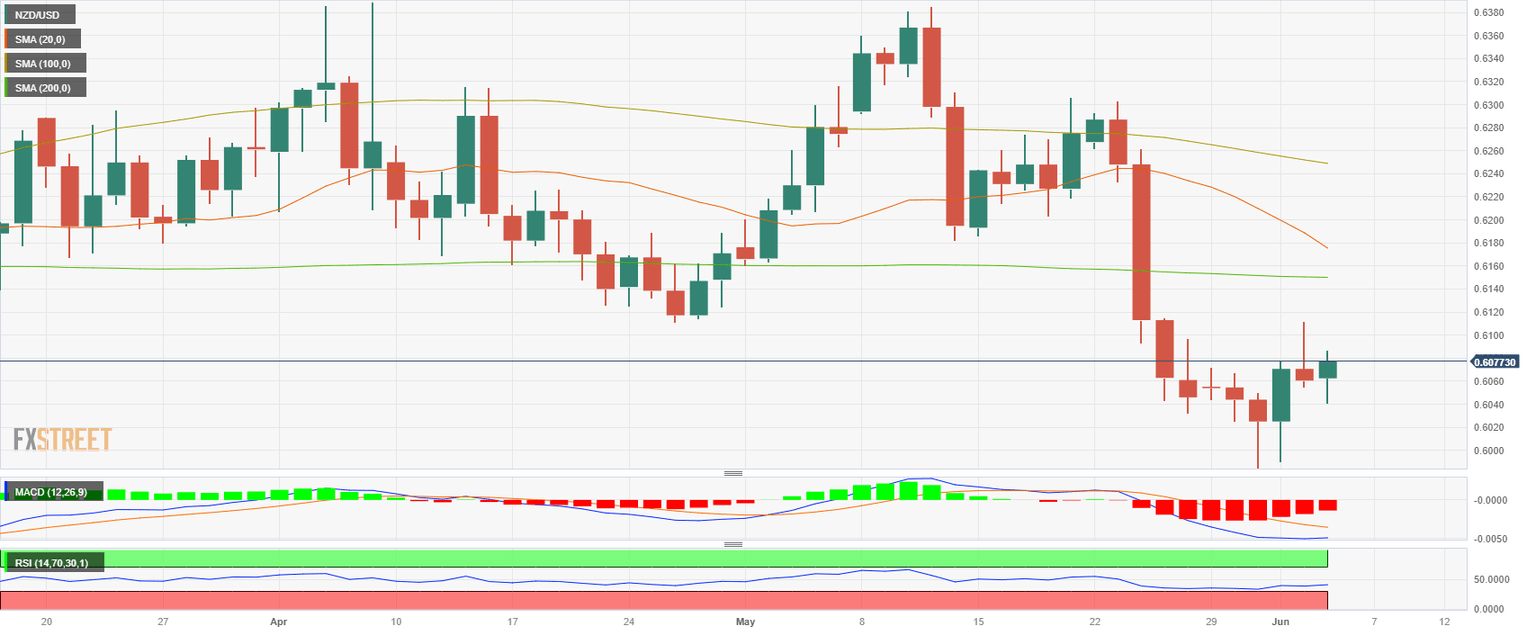
The NZD/USD traded with gains at the beginning of the week near 0.6070, fueled by poor economic data from the US, which sparked a US Dollar sell-off. In reaction to the data, markets are perceiving a stronger case for the Federal Reserve (Fed) not hiking rates in the upcoming meeting on June 13-14 making the US bond yields decline.

US bond yields decline following weak economic data


The US Institute for Supply Management (ISM) Service PMI came in at 50.3 in May vs the 51.5 expected and decelerated from its previous figure of 51.9. In addition, the S&P Global Composite final estimate for the same month slid to 54.3 vs the 54.5 expected from the last reading of 55.1. Meanwhile, the service sector PMI final revision printed at 54.9 vs the preliminary reading of 55.1.

Following the disappointing data, US bond yields have declined throughout the yield curve. The 10-year bond yield has fallen to 3.69%. Similarly, the 2-year yield stands at 4.48%, while the 5-year yield sits at 3.83%,  which weighs on the US Dollar.


According to the CME FedWatch Tool, investors are currently assigning a 77.10% probability to the Federal Reserve maintaining the target rate at 5.25% and not implementing an interest rate hike in the upcoming June 13-14 meeting. However, it is worth highlighting that the Fed's primary objective of achieving full employment and price stability remains steadfast. As a result, the release of the May Consumer Price Index (CPI) on June 13 will play a crucial role in shaping the FOMC's (Federal Open Market Committee) expectations and considerations for future interest rate decisions and hence impacting the US Dollar price dynamics.

Levels to watch

Technically speaking, the NZD/USD maintains a neutral to a bearish outlook for the short term, as per indicators on the daily chart. The Relative Strength Index (RSI) and Moving Average Convergence Divergence (MACD), despite standing in negative territory, show a loss of momentum, suggesting that sellers seem to have run out of steam.

 
On the upside, upcoming resistance for NZD/USD is seen at the daily high of 0.6085, followed by the psychological mark at 0.6100 and June 2 high around 0.6115. On the other hand, if the Kiwi retakes the downside, immediate support levels are seen at the daily low at 0.6040, followed by the psychological mark at the 0.6000 level and the cycle low at 0.5985.
NZD/USD

Overview
Today last price0.6078
Today Daily Change0.0017
Today Daily Change %0.28
Today daily open0.6061
 
Trends
Daily SMA200.6181
Daily SMA500.6204
Daily SMA1000.625
Daily SMA2000.615
 
Levels
Previous Daily High0.6112
Previous Daily Low0.6055
Previous Weekly High0.6112
Previous Weekly Low0.5985
Previous Monthly High0.6385
Previous Monthly Low0.5985
Daily Fibonacci 38.2%0.6077
Daily Fibonacci 61.8%0.609
Daily Pivot Point S10.604
Daily Pivot Point S20.6019
Daily Pivot Point S30.5983
Daily Pivot Point R10.6097
Daily Pivot Point R20.6133
Daily Pivot Point R30.6154

Author

Patricio Martín

Patricio is an economist from Argentina passionate about global finance and understanding the daily movements of the markets.


More from Patricio Martín
Share:

Markets move fast. We move first.

Orange Juice Newsletter brings you expert driven insights - not headlines. Every day on your inbox.

By subscribing you agree to our Terms and conditions.

Editor's Picks

EUR/USD: Sellers attack 1.1700 as USD stages a solid comeback

EUR/USD attacks 1.1700 amid heavy selling interest in the European trading hours on Wednesday. A solid comeback staged by the US Dollar weighs heavily on the pair, as traders look to USD short covering ahead of US CPI on Thursday. However, the downside could be capped by hawkish ECB expectations. 

GBP/USD slides toward 1.3300 after softer-than-expected UK inflation data

GBP/USD has come under intense selling pressure, eyeing 1.3300 in the European session on Wednesday. The UK annual headline and core CPI rose by 3.2% each, missing estimates of 3.5% and 3.4%, respectively, reaffirming dovish BoE expectations and smashing the Pound Sterling across the board. 

Gold: Bulls await breakout through multi-day-old range amid Fed rate cut bets

Gold attracts fresh buyers during the Asian session on Wednesday, though it remains confined in a multi-day-old trading range amid mixed fundamental cues. The global risk sentiment remains on the defensive amid economic woes and fears of the AI bubble burst. Moreover, dovish US Federal Reserve expectations lend support to the non-yielding yellow metal, though a modest US Dollar uptick might cap any further appreciating move.

Bitcoin, Ethereum and Ripple extend correction as bearish momentum builds

Bitcoin, Ethereum, and Ripple remain under pressure as the broader market continues its corrective phase into midweek. The weak price action of these top three cryptocurrencies by market capitalization suggests a deeper correction, as momentum indicators are beginning to tilt bearish.

Ukraine-Russia in the spotlight once again

Since the start of the week, gold’s price has moved lower, but has yet to erase the gains made last week. In today’s report we intend to focus on the newest round of peace talks between Russia and Ukraine, whilst noting the release of the US Employment data later on day and end our report with an update in regards to the tensions brewing in Venezuela.

AAVE slips below $186 as bearish signals outweigh the SEC investigation closure

Aave (AAVE) price continues its decline, trading below $186 at the time of writing on Wednesday after a rejection at the key resistance zone. Derivatives positioning and momentum indicators suggest that bearish forces still dominate in the near term.