NZD/USD Price Forecast: Remains in corrective phase ahead of NZ Q3 GDP data
- NZD/USD declines to near 0.5775 amid a strong recovery by the US Dollar.
- The US Unemployment Rate jumped to 4.6% in November.
- Investors await NZ Q3 GDP and the US inflation data.

The NZD/USD pair trades 0.15% lower to near 0.5775 during the European trading session on Wednesday. The Kiwi pair is under pressure as the US Dollar (USD) recovers sharply, following the release of the United States (US) Nonfarm Payrolls (NFP) data for October and November.
At the time of writing, the US Dollar Index (DXY), which tracks the Greenback’s value against six major currencies, trades 0.33% higher to near 98.50.
The US Dollar gains even as the US NFP report showed that the Unemployment Rate rose to 4.6% in November, the highest reading seen since September 2021. Going forward, the next trigger for the US Dollar will be the Consumer Price Index (CPI) data for November, which will be released on Thursday.
Though investors have underpinned the US Dollar against the New Zealand Dollar (NZD), the latter is outperforming its other peers ahead of the Q3 Gross Domestic Product (GDP) data scheduled for Thursday. The data is expected to show that the New Zealand (NZ) economy expanded by 0.9% after declining at the same pace in the second quarter.
NZD/USD Technical Analysis
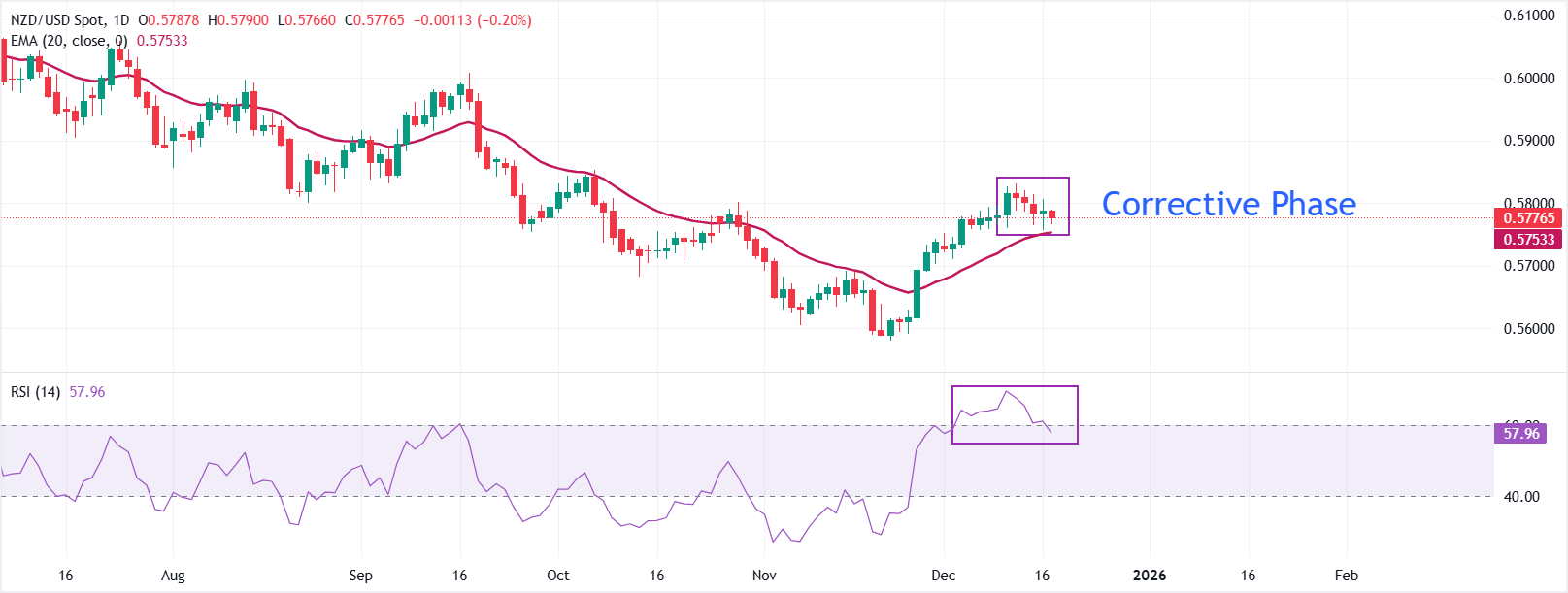
NZD/USD is down 0.15% near 0.5775. The upward-sloping 20-day Exponential Moving Average (EMA) at 0.5753 underpins a bullish bias.
A pullback in the 14-day Relative Strength Index (RSI) to 58 from overbought levels suggests the pair is going through a corrective phase, while the overall momentum remains bullish.
Initial support is at the 20-day EMA at 0.5753; however, a break below it could trigger further correction toward the December low of 0.5711. Whereas a sustained trade above the December 11 high of 0.5832 would clear further upside towards the round-level figure of 0.5900.
(The technical analysis of this story was written with the help of an AI tool.)
Economic Indicator
Gross Domestic Product (QoQ)
The Gross Domestic Product (GDP), released by Statistics New Zealand on a quarterly basis, is a measure of the total value of all goods and services produced in New Zealand during a given period. The GDP is considered as the main measure of New Zealand’s economic activity. The QoQ reading compares economic activity in the reference quarter to the previous quarter. Generally, a high reading is seen as bullish for the New Zealand Dollar (NZD), while a low reading is seen as bearish.
Read more.Next release: Wed Dec 17, 2025 21:45
Frequency: Quarterly
Consensus: 0.9%
Previous: -0.9%
Source: Stats NZ
The Gross Domestic Product (GDP), released by Statistics New Zealand, highlights the overall economic performance on a quarterly basis. The gauge has a significant influence on the Reserve Bank of New Zealand’s (RBNZ) monetary policy decision, in turn affecting the New Zealand dollar. A rise in the GDP rate signifies improvement in the economic conditions, which calls for tighter monetary policy, while a drop suggests deterioration in the activity. An above-forecast GDP reading is seen as NZD bullish.
Author

Sagar Dua
FXStreet
Sagar Dua is associated with the financial markets from his college days. Along with pursuing post-graduation in Commerce in 2014, he started his markets training with chart analysis.


![How Wall Street rigs the game [Video]](https://editorial.fxsstatic.com/images/i/market-chaos-01.jpg)