|

NZD/USD Price Analysis: Pair falls to 0.5800 after strong rejection at 20-day SMA

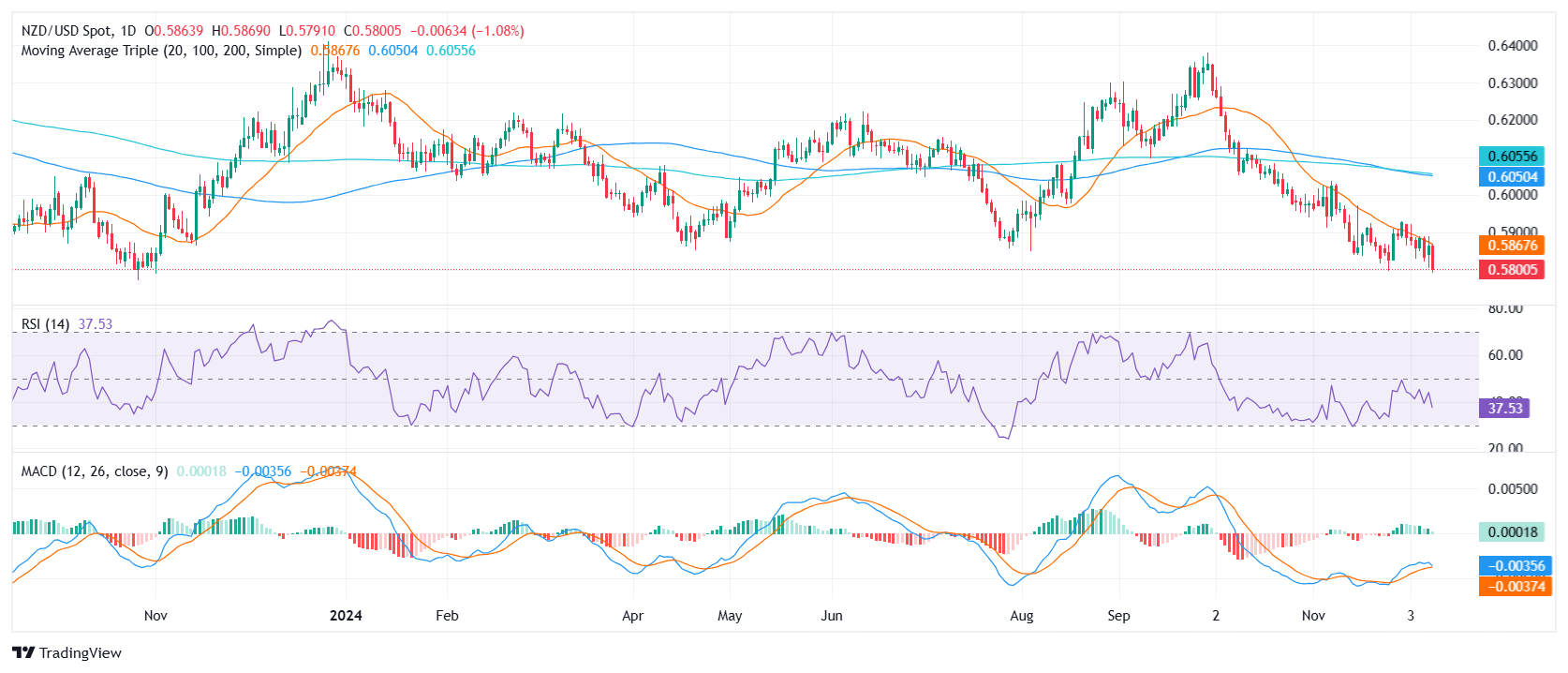
  • NZD/USD declines on Tuesday, retreating to 0.5800 after failing to reclaim the 20-day SMA.
  • Pair faces strong rejection at the 20-day SMA, falling to fresh lows not seen since November 2023.
  • RSI declines sharply in negative territory, while MACD histogram shows weakening bullish momentum with decreasing green bars.

The NZD/USD pair faced renewed selling pressure on Tuesday, dropping by 1.14% to 0.5800 after a failed attempt to reclaim the 20-day Simple Moving Average (SMA). The rejection at this key resistance level highlights the pair's inability to reverse its bearish trend, pushing it to fresh lows not seen since November 2023.

Technical indicators reinforce the bearish sentiment. The Relative Strength Index (RSI) has declined sharply to 39, remaining in negative territory and signaling intensifying selling pressure. Similarly, the Moving Average Convergence Divergence (MACD) histogram prints decreasing green bars, suggesting weakening bullish momentum and a lack of recovery signals.

With the pair now trading near the critical 0.5800 psychological support level, the downside risks remain elevated. A break below this level could pave the way for further declines, potentially targeting the 0.5770-0.5750 range. On the upside, the 20-day SMA at 0.5890 remains the key barrier, with a decisive break above it needed to shift the outlook back to neutral or bullish.

NZD/USD daily chart
Author

Patricio Martín

Patricio is an economist from Argentina passionate about global finance and understanding the daily movements of the markets.


More from Patricio Martín
Share:

Markets move fast. We move first.

Orange Juice Newsletter brings you expert driven insights - not headlines. Every day on your inbox.

By subscribing you agree to our Terms and conditions.

Editor's Picks

EUR/USD: Bulls pray for a dovish Fed

EUR/USD has finally taken a breather after a pretty energetic climb. The pair broke above 1.1680 in the second half of the week, reaching its highest levels in around two months before running into some selling pressure. Even so, it has gained almost two cents from the late-November dip just below 1.1500 the figure.

GBP/USD trims gains, recedes toward 1.3320

GBP/USD is struggling to keep its daily advance, coming under fresh pressure and retreating to the 1.3320 zone following a mild bullish attempt in the Greenback. Even though US consumer sentiment surprised to the upside, the US Dollar isn’t getting much love, as traders are far more interested in what the Fed will say next week.

Gold: Bullish momentum fades despite broad USD weakness

After rising more than 3.5% in the previous week, Gold has entered a consolidation phase and fluctuated at around $4,200. The Federal Reserve’s interest rate decision and revised Summary of Economic Projections, also known as the dot plot, could trigger the next directional move in XAU/USD. 

Week ahead: Rate cut or market shock? The Fed decides

Fed rate cut widely expected; dot plot and overall meeting rhetoric also matter. Risk appetite is supported by Fed rate cut expectations; cryptos show signs of life. RBA, BoC and SNB also meet; chances of surprises are relatively low. Dollar weakness could linger; both the aussie and the yen best positioned to gain further. Gold and oil eye Ukraine-Russia developments; a peace deal remains elusive.

Week ahead – Rate cut or market shock? The Fed decides

Fed rate cut widely expected; dot plot and overall meeting rhetoric also matter. Risk appetite is supported by Fed rate cut expectations; cryptos show signs of life. RBA, BoC and SNB also meet; chances of surprises are relatively low.

Ripple faces persistent bear risks, shrugging off ETF inflows

Ripple is extending its decline for the second consecutive day, trading at $2.06 at the time of writing on Friday. Sentiment surrounding the cross-border remittance token continues to lag despite steady inflows into XRP spot ETFs.