El Ibex 35 visita mínimos de dos semanas arrastrado por International Consolidated Airlines y Amadeus IT Group
- El Ibex 35retrocedeun2.83% de la primera jornada de la semana, visitando mínimos del 16 de febreroen 17.724.
- Los valores de Amadeus IT Group(AMS) pierdenun5.31% en el día,visitando mínimosdel 26 de febrero en 49.55€.
- Las acciones de InternationalConsolidated Airlines(IAG)se desplomanun5.39%el día de hoy,operando el momento de escribir sobre 4.563€.
- El PMI manufacturero HCOB de España se ubica en 50 puntos en febrero, por debajo de las proyecciones de los analistas.

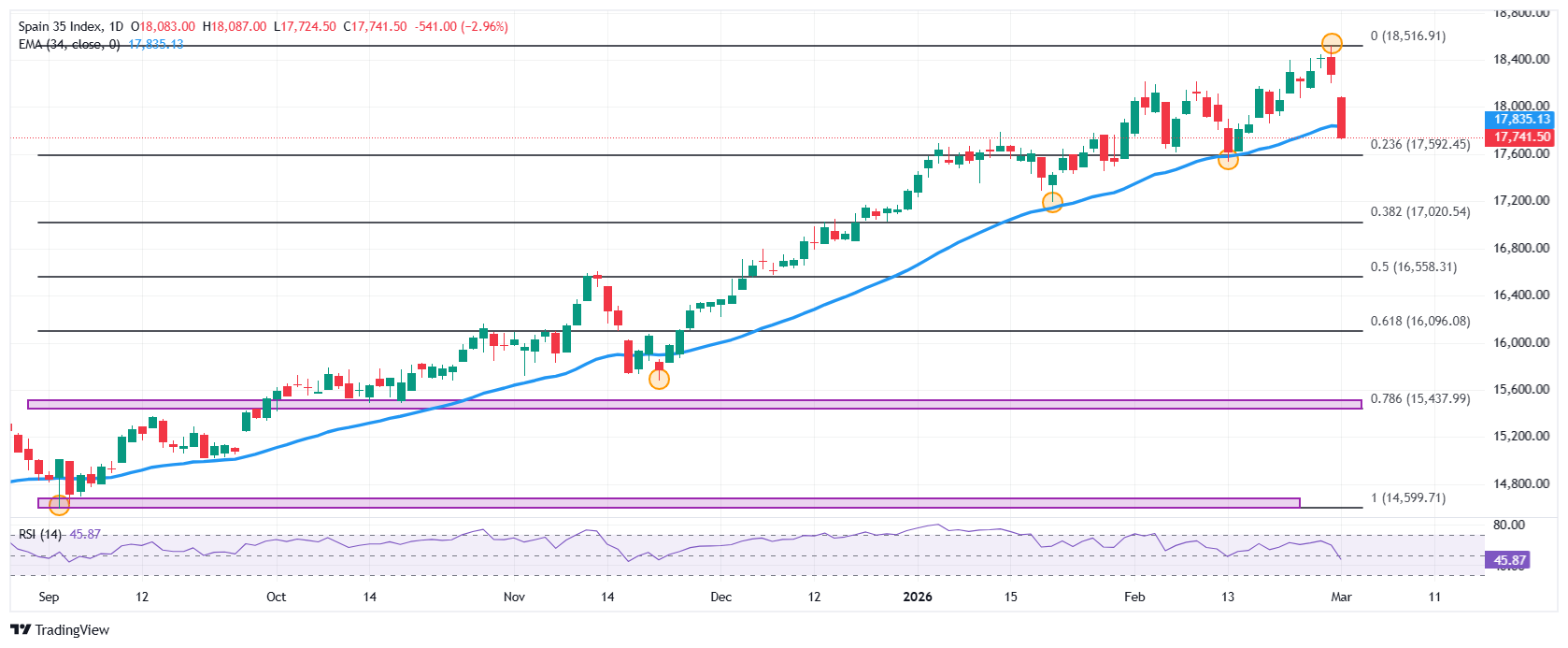
El Ibex 35registró un máximo diarioen 18.087,encontrando vendedores agresivos que llevaron el índice a mínimos del 16 de febrero en 17.724. Actualmente, el Ibex 35 opera en 17.770, perdiendo un 2.83% diario.
Amadeus IT Group e International Consolidated Airlines lideran las pérdidas en el Ibex 35
Los títulos de Amadeus IT Group (AMS) se deslizan un 5.31% el día de hoy, llegando a mínimos del 26 de febrero en 49.55€, terminado con una racha de cuatro sesiones consecutivas en zona de ganancias.
En la misma sintonía, los valores de International Consolidated Airlines (IAG) retroceden un 5.39% en la jornada de lunes, alcanzando mínimos no vistos desde el 24 de noviembre de 2025 en 4.350€, firmando su segunda sesión consecutiva en terreno negativo.
Por otro lado, el PMI manufacturero HCOB de España avanzó ligeramente en febrero, situándose en 50 puntos frente a los 49.2 observados en enero. Sin embargo, esta cifra se ubica ligeramente por debajo de los 50.1 puntos estimados por el mercado.
La agenda económica de la Eurozona contempla para el día de mañana el Índice Armonizado de Precios al Consumo preliminar de febrero. El consenso proyecta que se sitúe en un 1.7%, igualando la cifra del período anterior.
En este contexto, el Ibex 35 pierde 535 puntos, cotizando en estos momentos sobre 17.746, cayendo un 2.83% en la jornada del lunes.
Niveles técnicos en el Ibex 35
El Ibex 35 reaccionó ala baja desde una resistencia de corto plazo dadapor el máximo histórico alcanzado el 27 de febrero en 18.519. A la baja, el soporte más cercano lo observamos en 17.538, mínimo del 13 de febrero. El siguiente soporte clave se encuentra en 17.191, punto pivote del 21 de enero.
Gráfico diario del Ibex 35
Author

Carlos Martínez
FXStreet
Carlos Aristóteles Martínez Guzmán es Licenciado en Comercio y Negocios Internacionales con estudios de posgrado en Ingeniería Económica y Financiera, ambos por la Universidad La Salle.
















