|

NZD/USD Price Analysis: Kiwi slips as moving average cluster offers key support

  • NZD/USD was seen around the 0.5730 zone, posting modest daily losses ahead of the Asian session.
  • The pair is testing a key confluence of the 20 and 100-day moving averages, with downside risks emerging below this area.

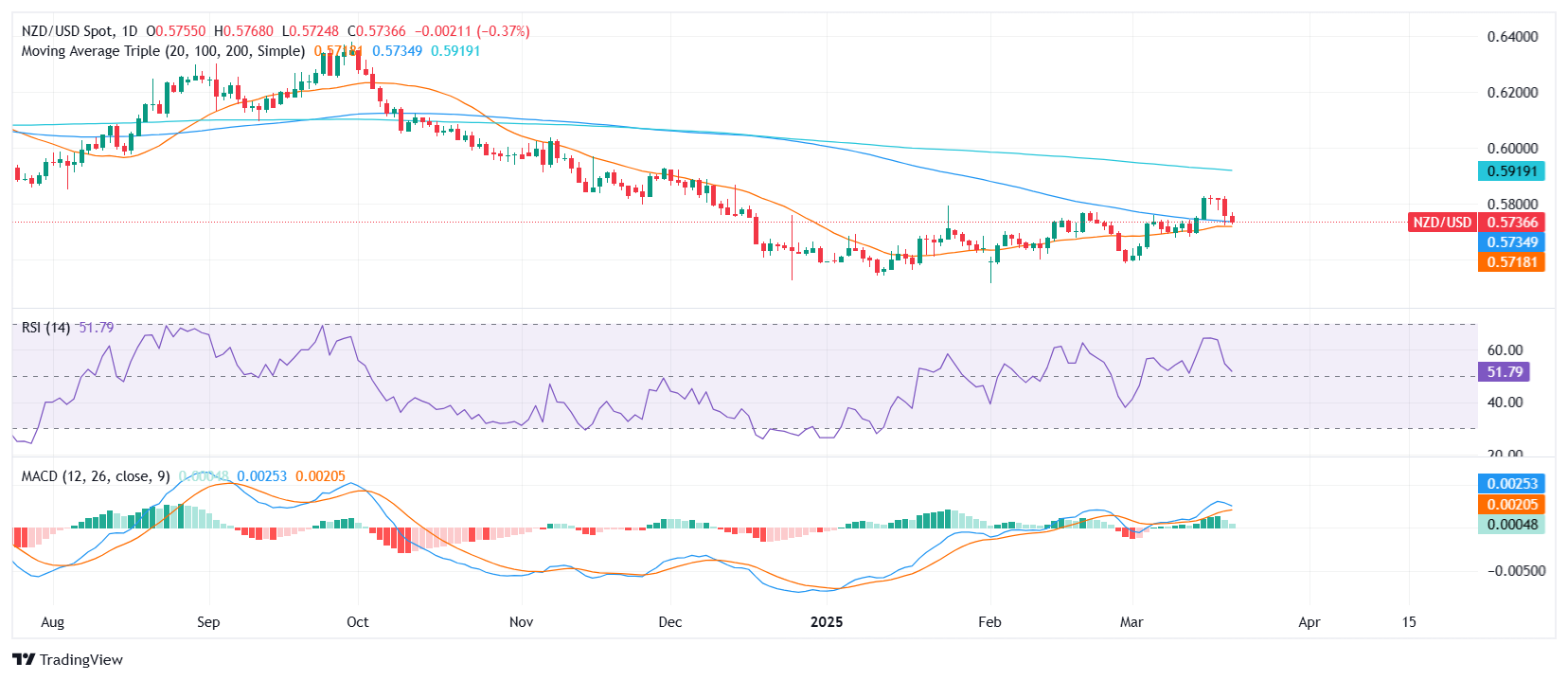
During Friday’s session ahead of the Asian open, NZD/USD declined modestly and was last seen hovering around the 0.5730 area. The pair remains under pressure after sellers stepped in earlier in the day, with price action now centered around the convergence of the 20-day and 100-day Simple Moving Averages—a key technical juncture for the short-term outlook.

The Relative Strength Index (RSI) has sharply dropped but still holds in the positive region, hovering just above the 50 mark, suggesting that bullish momentum is fading. The Moving Average Convergence Divergence (MACD) remains above zero, but its histogram is printing smaller green bars, reflecting weakening upside pressure.

Technically, a clean break below the 0.5730 support area—where the 20-day and 100-day SMAs intersect—could expose the pair to a deeper pullback toward 0.5680 and then the 0.5620 zone. On the flip side, if buyers manage to defend this support cluster, recovery attempts could target resistance around 0.5780 and 0.5820 next.

NZD/USD daily chart
Author

Patricio Martín

Patricio is an economist from Argentina passionate about global finance and understanding the daily movements of the markets.


More from Patricio Martín
Share:

Editor's Picks

GBP/USD drops to fresh weekly low below 1.3400

GBP/USD turns south in the second half of the day on Tuesday and trades at a fresh weekly-low below 1.3400 as the Middle East uncertainty causes investors to adopt a cautious stance. Earlier in the day, the data from the UK showed that the Unemployment Rate remained at 4.9% in the three months to May, compared with expectations of 5%, but failed to support the British Pound.

EUR/USD keeps range above 1.1400 after German ZEW

EUR/USD struggles to find direction and fluctuates in a narrow channel above 1.1400 on Tuesday, as the US Dollar (USD) stabilizes following Monday's rebound. The uncertainty around the US-Iran conflict limits the pair's upside but traders refrain from taking large positions ahead of the European Central Bank policy announcements on Thursday, which could drive the Euro's near-term valuation.

Gold clings to moderate gains above $4,050

Gold gains traction following Monday's choppy action and advances toward $4,100 on Tuesday. However, the uncertainty surrounding the conflict in the Middle East and growing expectations for a hawkish Federal Reserve policy outlook make it difficult for the precious metal to gather bullish momentum in the near term.

Bitcoin extends advance as ETF inflows, Iran war mediators' proposal lift risk mood

Bitcoin extends its gains, trading above $65,800 after closing above the key technical hurdle the previous day. The bullish price action is further supported by the return of institutional demand, with spot Exchange Traded Funds continuing their inflows on Monday. In addition, the renewed hopes for peace between the US and Iran have lifted risk sentiment, providing an additional tailwind for the Crypto King.

Buy the dip on the Dow Jones and S&P? Forex Trading Gold descending triangle

Trading during a war, a pandemic, during trade disputes, and other geopolitical events, especially when some major players are sociopathic, can be quite challenging. The Iran war is no exception. The Iran war is no exception.

US Dollar mid-year outlook: Exceptional currency, exceptional risks?
The US Dollar enters the second half of 2026 in a markedly different position from a year ago. The King currency has recovered, reflecting persistent US inflation, changing expectations for Fed policy, geopolitical tensions and renewed demand for defensive assets.