|

NZD/USD Price Analysis: Bearish trend prevails, potential for further declines expected

  • The daily RSI for the NZD/USD reveals growing selling pressure, nearing oversold conditions.
  • The hourly indicators also remain weak.
  • The pair will close a 0.80% losing week.

The NZD/USD pair saw a 0.25% loss on Friday’s sessing and continues exhibiting a significant bearish tendency. Both short-term and long-term outlooks suggest the prevalence of sellers, which may signal that the pair is bound for further downside.

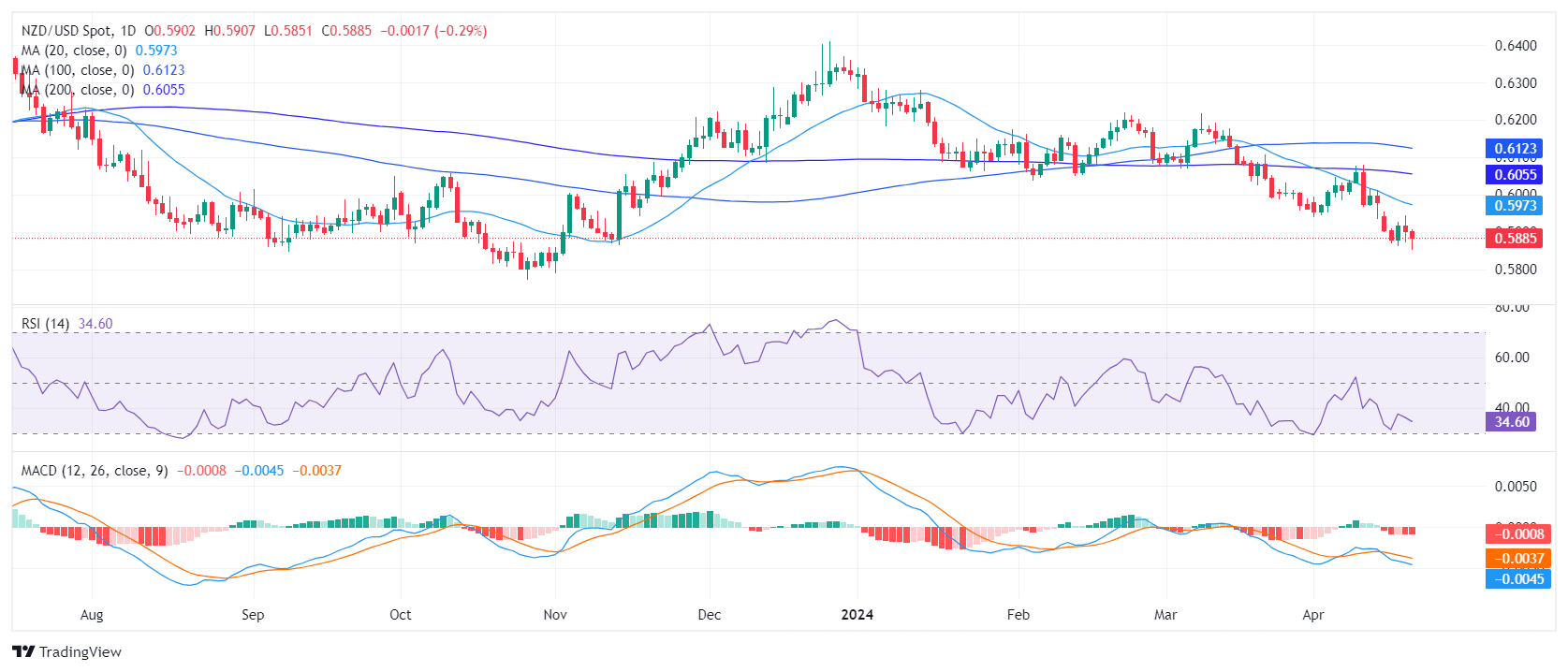
On the daily chart, the Relative Strength Index (RSI) indicates a bearish trend. It lies deep in negative terrain and edged near oversold territory. The escalating red bars on the Moving Average Convergence Divergence (MACD) histogram align with this bearish stance, augmenting this downturn prediction.

NZD/USD daily chart
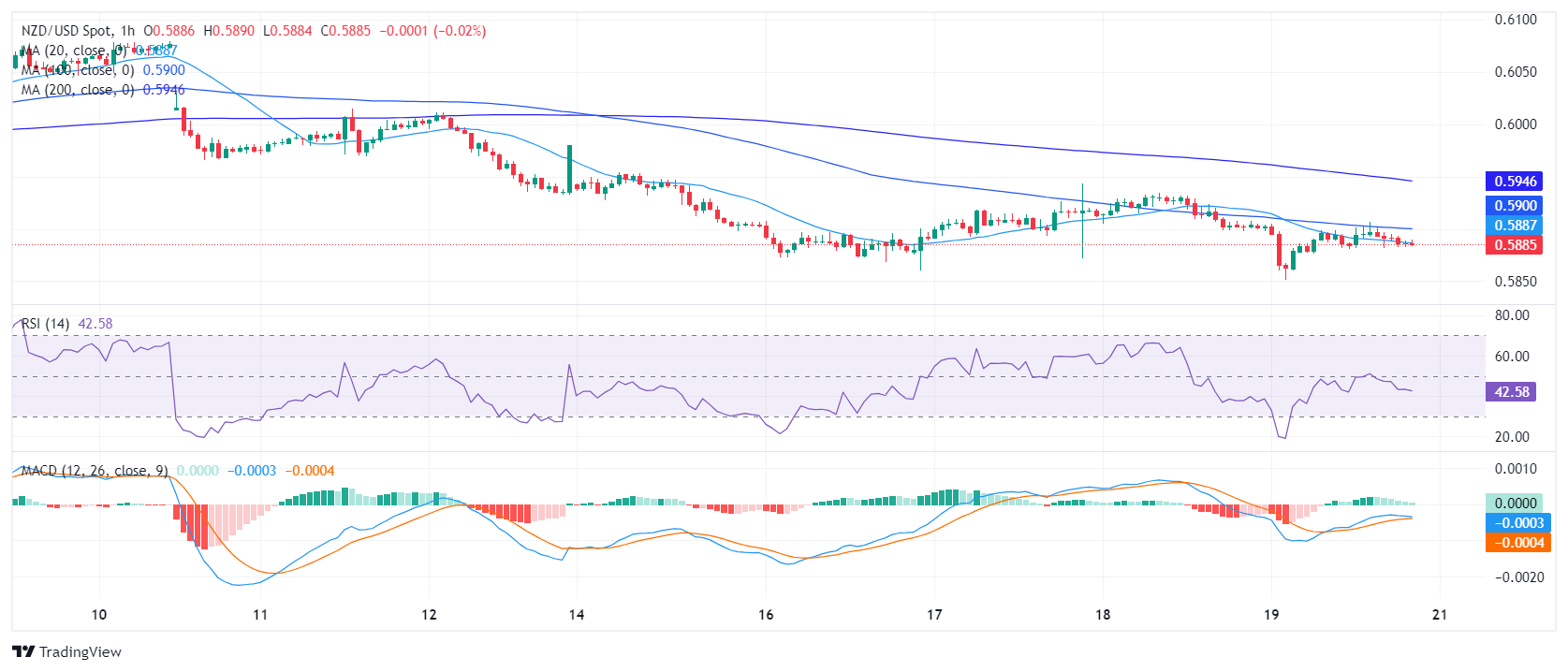
On the hourly chart, the  RSI also points south standing below 50 while the MACD exhibits dwindling green bars, indicative of reduced buying momentum.

NZD/USD hourly chart
From a wider viewpoint, NZD/USD presently exhibits a clear bearish trend, given its position below the Simple Moving Average (SMA) for 20, 100, and 200-day periods. However, as indicators approach oversold conditions, the pair may stage a corrective rebound which could give the buyers a chance to reclaim the 20-day SMA. In the meantime, movements below these levels would leave the trend bearish.

NZD/USD

Overview
Today last price0.5885
Today Daily Change-0.0017
Today Daily Change %-0.29
Today daily open0.5902
 
Trends
Daily SMA200.5978
Daily SMA500.6067
Daily SMA1000.6127
Daily SMA2000.6057
 
Levels
Previous Daily High0.5943
Previous Daily Low0.5872
Previous Weekly High0.6079
Previous Weekly Low0.5933
Previous Monthly High0.6218
Previous Monthly Low0.5956
Daily Fibonacci 38.2%0.5899
Daily Fibonacci 61.8%0.5916
Daily Pivot Point S10.5869
Daily Pivot Point S20.5835
Daily Pivot Point S30.5798
Daily Pivot Point R10.594
Daily Pivot Point R20.5977
Daily Pivot Point R30.6011

Author

Patricio Martín

Patricio is an economist from Argentina passionate about global finance and understanding the daily movements of the markets.


More from Patricio Martín
Share:

Editor's Picks

GBP/USD finds support but stays below 1.3400

GBP/USD found support near 1.3370 after starting the week on the back foot but lost its recovery momentum after testing 1.3400 on Monday. The pair's upside remains capped as investors await clarity regarding the conflict in the Middle East. Later in the day, comments from central bank officials will be watched closely by market participants.

EUR/USD holds above 1.1400 as focus remains on Middle East

EUR/USD holds steady above 1.1400 following the bearish action seen during the weekly opening. As the uncertainty surrounding the US-Iran conflict keeps investors on edge, the pair's upside remains limited, while hawkish ECB expectations help the Euro stay resilient against its rivals. In the second half of the day, investors will pay close attention to comments from central bank officials.

Gold struggles to rebound, trades well below $4,100

Gold struggles to recover after opening with a bearish gap and trades well below $4,100, losing more than 1% on a daily basis. The US Dollar (USD) stays resilient against its rivals as markets cling to a cautious stance amid the persistent uncertainty in the Middle East. Tuesday's CPI inflation data from the US and Fed Chair Warsh's testimony could trigger the next big reaction in the precious metal.

Bitcoin retreats as Middle East conflict overshadows ETF inflows

Bitcoin struggles to hold above $64,000 after a modest recovery the previous week. Risk sentiment dampens as tensions in the Middle East escalated after the US launched fresh strikes on Iran on Sunday, weighing on BTC. Meanwhile, improving institutional demand, with spot Bitcoin Exchange Traded Funds ending an eight-week streak of net outflows, has provided only limited support amid rising geopolitical uncertainty.

The US won't default on $39 trillion debt: Why financial repression is coming and Gold is the only hedge
As the US national debt surges past $39 trillion, policymakers face an unsustainable economic trajectory that threatens the global financial system. With a formal default out of the question and fiscal austerity politically unfeasible, the US government is increasingly likely to rely on financial repression, artificially keeping interest rates below inflation to erode the real value of its debt.
Five sessions, one round trip: Why the whipsaw is exactly what Warsh ordered

Markets opened July with a December hike as the base case and spent five trading sessions unlearning and relearning it. A 57K payrolls print bled the tightening bets out of the strip; a re-shut Strait of Hormuz is pushing them back in. Wednesday's minutes from the June FOMC meeting landed mid-round-trip, describing a world that had already stopped existing.