AUD/USD flubs key technical level as holiday season drains market volume
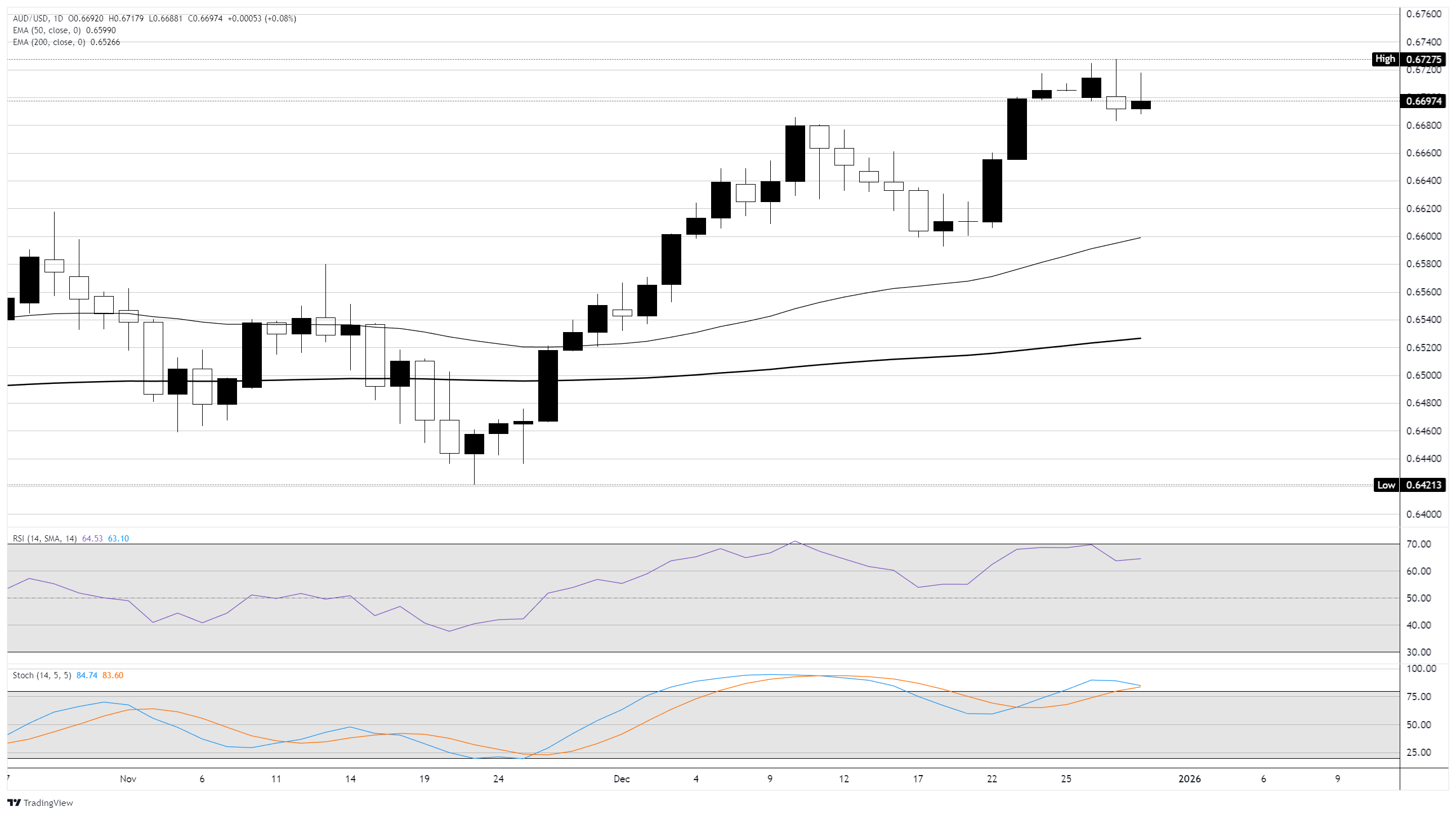
- AUD/USD flubbed the 0.6700 handle for a second day in a row on Tuesday.
- Markets remain tepid and cautious during the final week of trading in 2025.
- Diverging centra lbank rate paths are the key focus heading into 2026.

AUD/USD strung itself along the 0.6700 handle for the second day in a row as the Aussie-Dollar pairing grapples with end-of-year market volumes restraining overall momentum. The Australian Dollar is looking upward as the Reserve Bank of Australia (RBA) inches toward a fresh rate hiking cycle, with the US Dollar (USD) under pressure across the board from a dovish Federal Reserve (Fed) poised for further rate cuts through 2026.
The RBA is staring down the barrel of a fresh rate cutting cycle as Australian economic data supports higher rates. Australian futures markets are pricing in a 34% chance that the RBA will get pushed into delivering a rate hike at its next rate call on February 3.
Fed heading for more rate cuts, but inflation remains the linchpin
The Federal Reserve’s (Fed) latest Meeting Minutes from its last interest rate decision of the year were released, giving investors a confirmation that Federal Open Market Committee (FOMC) voters are willing to play ball on the concept of further rate cuts, but otherwise revealing little of note. The Fed is tilting into the dovish side, with the majority of rate-setters willing to explore further rate trims, but Fed policy changes still rely on easing, not absent, inflation data.
AUD/USD daily chart
Australian Dollar FAQs
One of the most significant factors for the Australian Dollar (AUD) is the level of interest rates set by the Reserve Bank of Australia (RBA). Because Australia is a resource-rich country another key driver is the price of its biggest export, Iron Ore. The health of the Chinese economy, its largest trading partner, is a factor, as well as inflation in Australia, its growth rate and Trade Balance. Market sentiment – whether investors are taking on more risky assets (risk-on) or seeking safe-havens (risk-off) – is also a factor, with risk-on positive for AUD.
The Reserve Bank of Australia (RBA) influences the Australian Dollar (AUD) by setting the level of interest rates that Australian banks can lend to each other. This influences the level of interest rates in the economy as a whole. The main goal of the RBA is to maintain a stable inflation rate of 2-3% by adjusting interest rates up or down. Relatively high interest rates compared to other major central banks support the AUD, and the opposite for relatively low. The RBA can also use quantitative easing and tightening to influence credit conditions, with the former AUD-negative and the latter AUD-positive.
China is Australia’s largest trading partner so the health of the Chinese economy is a major influence on the value of the Australian Dollar (AUD). When the Chinese economy is doing well it purchases more raw materials, goods and services from Australia, lifting demand for the AUD, and pushing up its value. The opposite is the case when the Chinese economy is not growing as fast as expected. Positive or negative surprises in Chinese growth data, therefore, often have a direct impact on the Australian Dollar and its pairs.
Iron Ore is Australia’s largest export, accounting for $118 billion a year according to data from 2021, with China as its primary destination. The price of Iron Ore, therefore, can be a driver of the Australian Dollar. Generally, if the price of Iron Ore rises, AUD also goes up, as aggregate demand for the currency increases. The opposite is the case if the price of Iron Ore falls. Higher Iron Ore prices also tend to result in a greater likelihood of a positive Trade Balance for Australia, which is also positive of the AUD.
The Trade Balance, which is the difference between what a country earns from its exports versus what it pays for its imports, is another factor that can influence the value of the Australian Dollar. If Australia produces highly sought after exports, then its currency will gain in value purely from the surplus demand created from foreign buyers seeking to purchase its exports versus what it spends to purchase imports. Therefore, a positive net Trade Balance strengthens the AUD, with the opposite effect if the Trade Balance is negative.
Author

Joshua Gibson
FXStreet
Joshua joins the FXStreet team as an Economics and Finance double major from Vancouver Island University with twelve years' experience as an independent trader focusing on technical analysis.
















