USD/JPY treads water near 156.00 as Yen traders grapple with multiple headwinds
- USD/JPY failed to make any meaningful moves on Tuesday as holiday trading volumes bite.
- Yentervention risk remains elevated with the Yen drifting toward previous intervention levels.
- Even rate hikes from the hyperdovish BoJ couldn’t spark a bullish Yen rally.

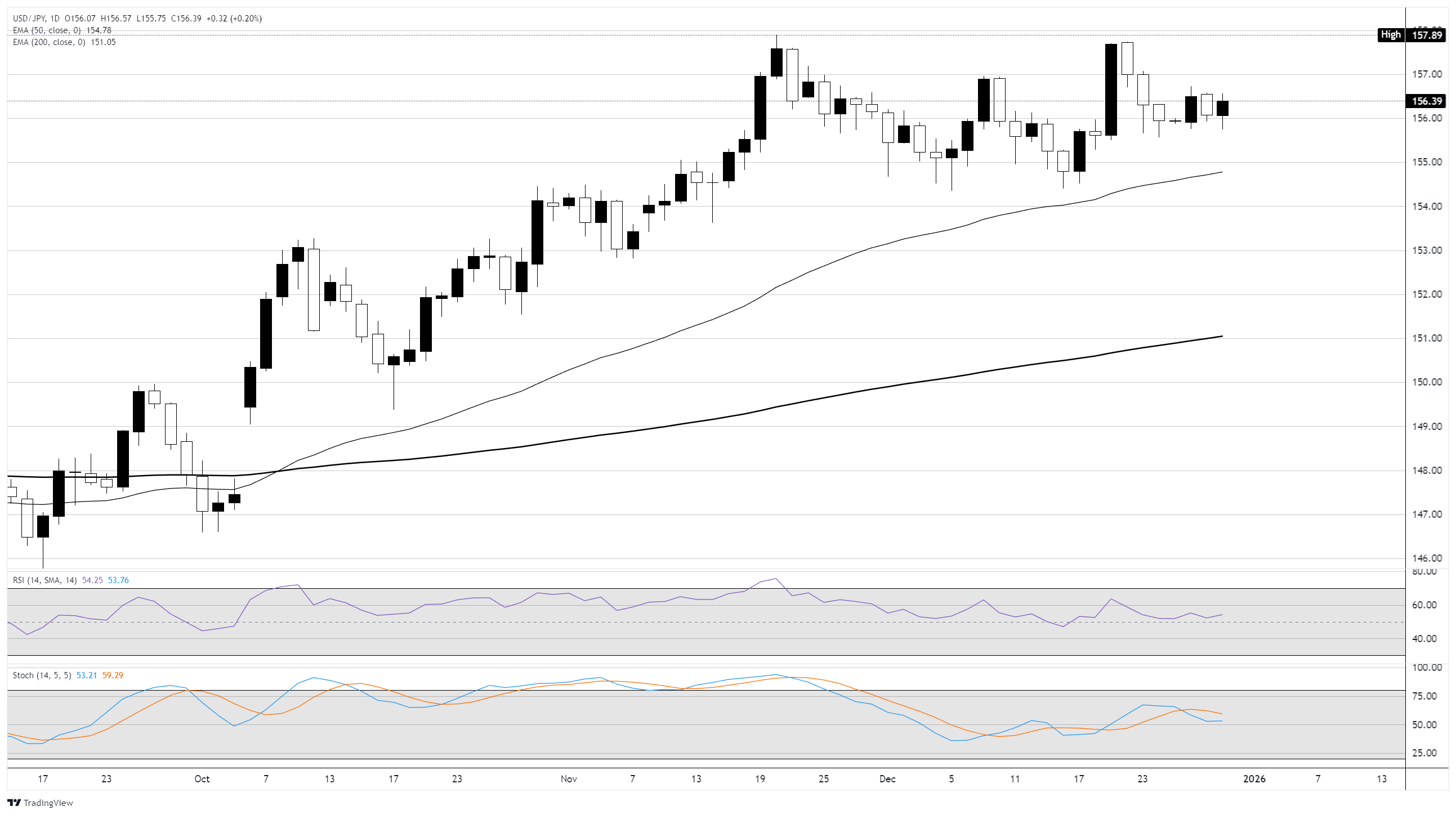
USD/JPY remains caught in near-term congestion just north of the 156.00 handle during the final week of 2025’s trading year. Yen traders are battling headwinds on multiple fronts, with the Bank of Japan (BoJ) carrying much of the vexation risk for Yen markets.
The BoJ broke away from the pack as the only central bank raising interest rates heading into the end of the year after delivering another quarter-point interest rate hike on December 19. Further rate hikes. The current cash rate from the BoJ currently sits at a three-decade peak of 0.75%.
Even with climbing Japanese interest rates, the world’s favorite funding currency remains unable to find meaningful strength. The Dollar-Yen pair has risen nearly 12% from its annual low of 139.89 set in April, and is set to end 2025 close to where it began, near technical levels that have sparked previous currency market interventions from the BoJ.
Fed sees more cuts, but only if data plays ball
The latest Meeting Minutes from the Federal Reserve (Fed) show Federal Open Market Committee (FOMC) members are cautiously tilted toward the dovish side, with the majority of policymakers expecting further rate cuts in the future; however, the pace of future rate cuts remains contingent on several factors, specifically that US inflation metrics continue to ease lower.
Quality of American inflation data remains a concern for both investors and central bankers: despite a steep cooling in headline Consumer Price Index (CPI) inflation data at the last print, investors noted that the underlying data was missing several key components, and a large swath of the data that was present involved a high degree of assumptions and carry-forward estimates due to large chunks of missing price information. Even if headline inflation ticket figures continue to ease lower, a lack of accurate measurement will keep both FOMC votes and trader expectations on the back foot.
USD/JPY daily chart
Japanese Yen FAQs
The Japanese Yen (JPY) is one of the world’s most traded currencies. Its value is broadly determined by the performance of the Japanese economy, but more specifically by the Bank of Japan’s policy, the differential between Japanese and US bond yields, or risk sentiment among traders, among other factors.
One of the Bank of Japan’s mandates is currency control, so its moves are key for the Yen. The BoJ has directly intervened in currency markets sometimes, generally to lower the value of the Yen, although it refrains from doing it often due to political concerns of its main trading partners. The BoJ ultra-loose monetary policy between 2013 and 2024 caused the Yen to depreciate against its main currency peers due to an increasing policy divergence between the Bank of Japan and other main central banks. More recently, the gradually unwinding of this ultra-loose policy has given some support to the Yen.
Over the last decade, the BoJ’s stance of sticking to ultra-loose monetary policy has led to a widening policy divergence with other central banks, particularly with the US Federal Reserve. This supported a widening of the differential between the 10-year US and Japanese bonds, which favored the US Dollar against the Japanese Yen. The BoJ decision in 2024 to gradually abandon the ultra-loose policy, coupled with interest-rate cuts in other major central banks, is narrowing this differential.
The Japanese Yen is often seen as a safe-haven investment. This means that in times of market stress, investors are more likely to put their money in the Japanese currency due to its supposed reliability and stability. Turbulent times are likely to strengthen the Yen’s value against other currencies seen as more risky to invest in.
Author

Joshua Gibson
FXStreet
Joshua joins the FXStreet team as an Economics and Finance double major from Vancouver Island University with twelve years' experience as an independent trader focusing on technical analysis.

















