NZD/USD declines for third day on risk aversion ahead of RBNZ rate decision
- NZD/USD extends its decline for the third consecutive day, pressured by risk aversion and a cautious mood ahead of the RBNZ interest rate decision.
- Markets are widely expecting the RBNZ to hold the OCR at 3.25% on Wednesday, following six consecutive rate cuts.
- The 50-day EMA near 0.5980 acts as key support, reinforcing the lower boundary of the bullish flag pattern.


The New Zealand Dollar (NZD) extends its losing streak against the US Dollar (USD) for the third consecutive day on Monday, with the NZD/USD trading near 0.6005, down nearly 0.90% on the day. The Kiwi is under pressure as traders adopt a cautious stance ahead of the Reserve Bank of New Zealand's (RBNZ) rate decision on Wednesday, while risk-off sentiment, driven by US tariff threats, adds to the downside.
The Reserve Bank of New Zealand (RBNZ) is set to announce its latest policy decision on Wednesday. Markets are widely expecting the central bank to hold the Official Cash Rate (OCR) steady at 3.25%, following six consecutive cuts since August 2024. According to a Reuters poll conducted from June 30 to July 3, 19 of 27 economists expect the RBNZ to hold the OCR at 3.25% while eight see a potential 25 bps cut. Still, investors anticipate one or two more 25-basis-point cuts later this year due to downside risks to growth from the economic impact of US tariffs.
The central bank faces a delicate balancing act, as inflation has eased back within its 1–3% target range and the economy shows signs of cooling. However, the Kiwi remains vulnerable to global headwinds, including heightened US-China trade tensions and slowing demand in China. Analysts will closely scrutinize the tone of the RBNZ’s statement for any clues on the forward path of interest rates.
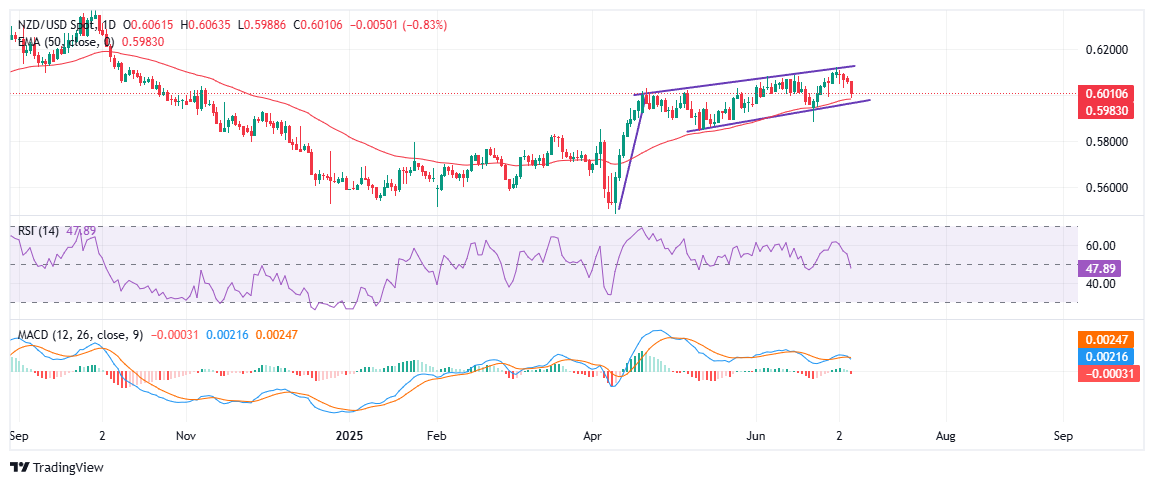
Technically, despite the recent pullback, the broader structure of the NZD/USD chart remains constructive, with the pair consolidating within a well-defined bullish flag pattern. This pattern, typically seen as a pause within an uptrend, suggests that the Kiwi may be gearing up for another leg higher, provided key support levels hold. Price action on the daily chart shows NZD/USD hovering above the lower boundary of the flag, which also coincides with the 50-day Exponential Moving Average (EMA) at 0.5983, a level that has acted as dynamic support throughout May and June. A rebound from this area could confirm the pattern and pave the way for a breakout above the 0.6100 mark.
Momentum indicators, however, are starting to reflect a more cautious tone. The Relative Strength Index (RSI) has slipped to 48.2, moving below the neutral 50 threshold, which signals fading bullish momentum without yet indicating oversold conditions. Meanwhile, the Moving Average Convergence Divergence (MACD) has turned less encouraging. The MACD line has crossed below the signal line, and the histogram has entered negative territory, indicating a bearish crossover. Although this crossover is still relatively shallow, it highlights a loss of bullish momentum and increases the risk of a downside break if price action weakens further.
In the near term, 0.5980 remains the key support zone, a confluence of the flag’s lower boundary and the 50-day EMA. A decisive daily close below this area would invalidate the bullish flag and shift the short-term bias in favor of the bears, exposing the next support levels around 0.5900.
Economic Indicator
RBNZ Interest Rate Decision
The Reserve Bank of New Zealand (RBNZ) announces its interest rate decision after each of its seven scheduled annual policy meetings. If the RBNZ is hawkish and sees inflationary pressures rising, it raises the Official Cash Rate (OCR) to bring inflation down. This is positive for the New Zealand Dollar (NZD) since higher interest rates attract more capital inflows. Likewise, if it reaches the view that inflation is too low it lowers the OCR, which tends to weaken NZD.
Read more.Next release: Wed Jul 09, 2025 02:00
Frequency: Irregular
Consensus: 3.25%
Previous: 3.25%
Source: Reserve Bank of New Zealand
The Reserve Bank of New Zealand (RBNZ) holds monetary policy meetings seven times a year, announcing their decision on interest rates and the economic assessments that influenced their decision. The central bank offers clues on the economic outlook and future policy path, which are of high relevance for the NZD valuation. Positive economic developments and upbeat outlook could lead the RBNZ to tighten the policy by hiking interest rates, which tends to be NZD bullish. The policy announcements are usually followed by interim Governor Christian Hawkesby's press conference.
Author
Vishal Chaturvedi
FXStreet
I am a macro-focused research analyst with over four years of experience covering forex and commodities market. I enjoy breaking down complex economic trends and turning them into clear, actionable insights that help traders stay ahead of the curve.