Nvidia sells off 7% after Singapore investigates Blackwell fraud, market awaits Trump tariff news
- Nvidia stock sinks 7%, trending below supportive range.
- Singapore is investigating whether Nvidia chips were being resold to Chinese buyers.
- The US government has placed export curbs on Nvidia from selling Blackwell chips to China.
- Market is sour ahead of Trump's tariffs for China, Canada and Mexico.

Nvidia (NVDA) stock sank over 7% by Monday afternoon as the fallout from its quite decent quarterly results last week continued to play out.
Separately, Singapore is investigating whether Nvidia’s Blackwell chipsets, which are barred from being sold to Chinese companies, were purchased in Singapore and then re-exported on to Malaysia and possibly resold to Chinese buyers.
The broad market is significantly lower at the time of writing, but some observers think US President Donald Trump might alter the details concerning tariffs on Canada, Mexico and China that are set to go into effect on Tuesday. One month ago, Trump delayed the 25% tariffs on Mexico and Canada, but they are currently set to go into effect on March 4.
The Dow Jones Industrial Average (DJIA) has shifted 1% lower at the time of writing, while the NASDAQ has reversed as much as 1.6%.
Nvidia stock news
Investors have to wonder whether Singapore’s investigation might uncover further cases of China circumventing the US government’s sanctions against selling state-of-the-art AI chips from Nvidia to Chinese end-users. If it does, then Nvidia could face a deterioration for its popular Blackwell chips, introduced last year.
The investigation began when Singapore arrested three individuals, who were caught up in the activities. Officials know that Super Micro Computer (SMCI) and Dell Technologies (DELL) sold servers that contained the Blackwell chipsets to a company based in Singapore. But it appears that they were re-exported to a Malaysian buyer.
“The question is whether Malaysia was a final destination, or from Malaysia it went to somewhere else, which we do not know for certain at this point,” said K. Shanmugam, Singapore's law minister, on Monday. “We assessed that there may have been false representation on the final destination.”
The Wall Street Journal recently reported that Chinese companies are reportedly using cutouts or third-party companies in Taiwan, Malaysia and Vietnam to legally purchase the servers, which are then re-routed to the Chinese entities.
US officials are also involved in investigations of Malaysian companies possibly selling Blackwell chipsets to DeepSeek, which earlier this year launched its generative AI engine that competes with US versions.
Super Micro sank 9% on the news, while Dell sold off more than 4%.
Also in the semiconductor industry, Intel (INTC) gained 1.5% after Nvidia and Broadcom (AVGO) were said to be testing out chip production with the company. Intel was a large recipient of government funding from former President Joe Biden’s CHIPS & Science Act, signed in 2022.
Nvidia stock forecast
Nvidia broke through a quite important support range on Monday, which has been in place since January 2024, about 14 months ago. Nvidia has been losing strength since reporting Q4 earnings last Wednesday that underwhelmed the market based on the outlook ahead. Still, the earnings result was quite impressive, but NVDA shares traded lower late last week on the back of it.
NVDA stock has been putting in a number of lower highs recently. If it puts in a new range low below February 3's $113.01, then expect to see most technical traders sell.
Monday saw NVDA sink to an intraday low of $114.51. Below here lies historical support from the past year at $105 and $92.
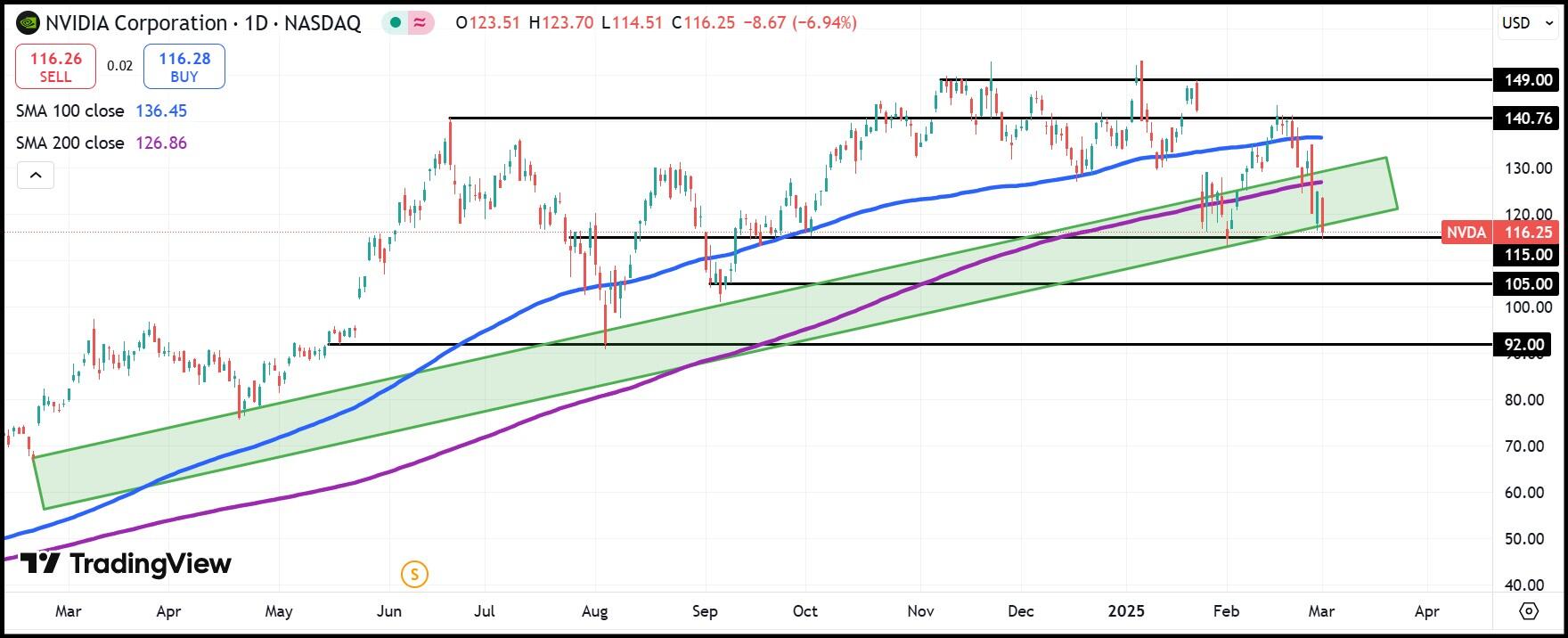
NVDA daily stock chart
Author

Clay Webster
FXStreet
Clay Webster grew up in the US outside Buffalo, New York and Lancaster, Pennsylvania. He began investing after college following the 2008 financial crisis.

















