|

Nikkei 225 Index: Stiff resistance forms around 23,600

  • Nikkei 225 Index fell for second straight day on Tuesday. 
  • US-China trade conflict continues to weigh on global equity indexes.

After closing the first day of the week with a loss of 0.3%, the Nikkei 225 Index pushed lower on Tuesday as caution over the December 15 deadline for the US' tariff hike on Chinese imports continues to weigh on sentiment. During an interview with Fox Business on Tuesday, US Commerce Secretary Wilbur Ross noted that having a good deal for the US was more important than the tariff hike.

Reflecting the dismal mood, major European equity indexes are losing more than 1% and the S&P 500 futures are down 0.3% to suggest that Wall Street is likely to start the day in the negative territory.

Nikkei 225 Chart

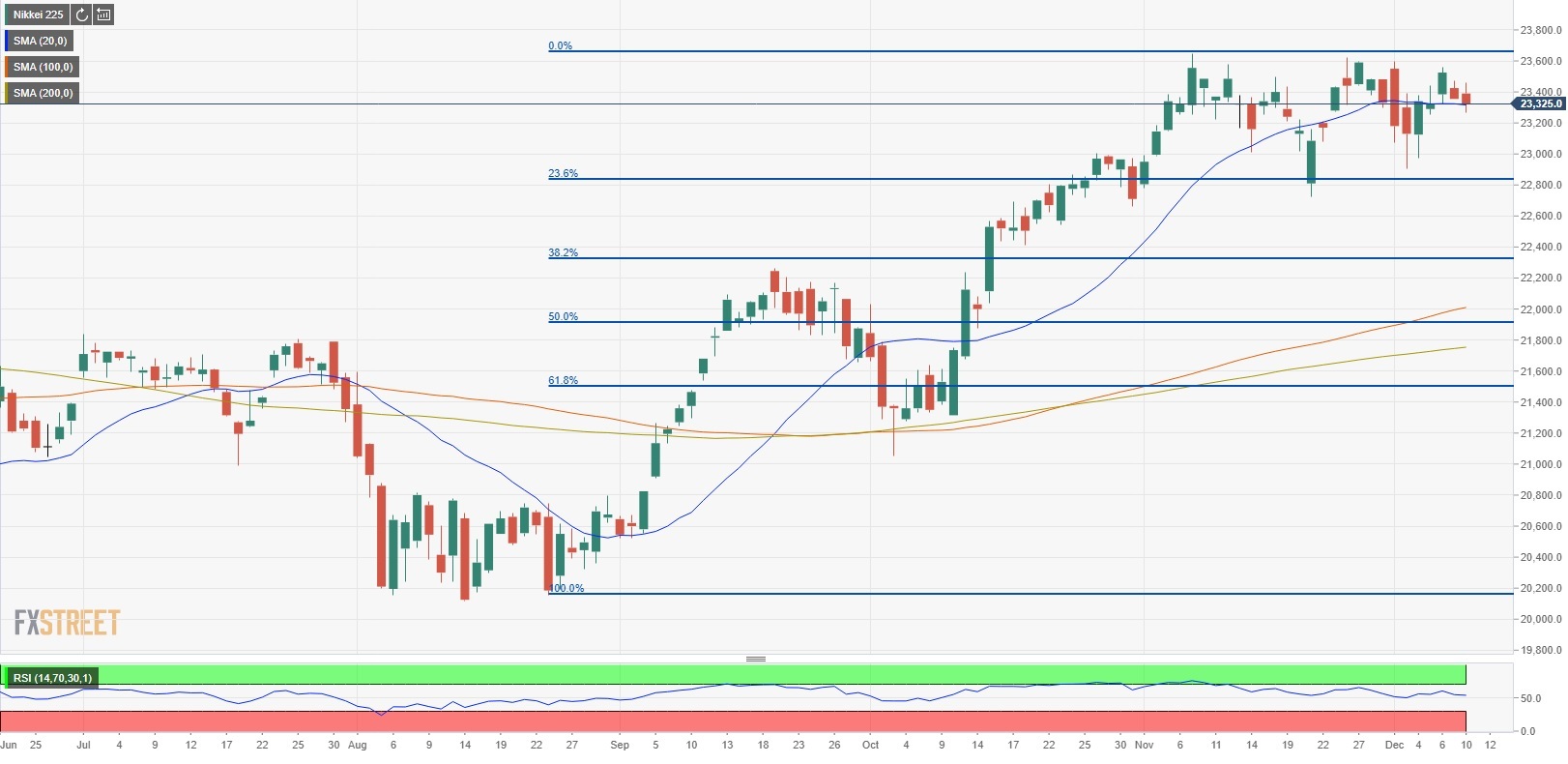
Looking at the daily chart, the index seems to be making lower highs below the 23,600-23,650 area, where the 2019-top that was defined back in early November is located. On the same chart, the RSI indicator continues to move sideways a little above the 50 mark, pointing out to a neutral near-term outlook.

The initial support for the index could be seen at 23,300 (20-day MA) ahead of 23,000 (psychological level) and 22,800 (Fibonacci 23.6% retracement of September-November rally). On the upside, 23,600-23,650 is a significant hurdle before the index could target 24,000 (Sep. 25, 2018, high) and 24,480 (all-time high).
Author

Eren Sengezer

As an economist at heart, Eren Sengezer specializes in the assessment of the short-term and long-term impacts of macroeconomic data, central bank policies and political developments on financial assets.


More from Eren Sengezer
Share:

Editor's Picks

AUD/USD eyes 100-SMA hurdle near 0.7035 as hawkish RBA counters firmer USD

AUD/USD regains positive traction on Tuesday and climbs to 0.7030 during the Asian session, reversing the previous day's corrective slide from a one-month high as hawkish RBA rate expectations continue to support the Aussie. Spot prices, however, remain below the 100-day SMA pivotal resistance amid a firmer US Dollar as traders brace for Australia’s September CPI report on Wednesday ahead of the Fed rate decision.

USD/JPY sticks to modest gains above 157.50 as traders await Fed, BoJ meetings

USD/JPY attracts buyers for the third straight day, recovering further from a one-month low ahead of Wednesday’s FOMC decision and the BoJ policy update on Friday. Meanwhile, expectations that the BoJ may hold off on aggressive rate hikes weigh on the Japanese Yen, and the US Dollar advances to a nearly two-week high, supporting the currency pair.

Gold bears flirt with $4,000 amid sustained USD buying ahead of FOMC decision

Gold meets with a fresh supply during the Asian session, stalling the previous day's modest bounce from the vicinity of a three-month low amid a firmer US Dollar. The precious metal, however, defends the $4,000 psychological mark as traders now seem hesitant and opt to wait for the outcome of the two-day FOMC policy meeting on Wednesday.

Pi Network stalls as weak crypto sentiment caps recovery

Pi Network (PI) holds steady above $0.0760 at press time on Tuesday, stalling after a roughly 2% rebound the previous day. The broader market's weak sentiment and reduced trading volume weigh on the PI token. The technical outlook is bearish, with price capped below a long-term resistance trendline and weak momentum.

France tests the Euro's nerve: What the OAT spread is telling FX traders
France's 10-year borrowing premium over Germany hit its widest since the 2011 debt crisis last week. With public spending above 57% of GDP, unrest on the streets and a presidential election next spring, cuts look unlikely. If Paris cannot trim, the bill may be paid quietly through financial repression.
What November 3 means for the Fed's rate path and the US Dollar

The USD faces a decisive period ahead of the November 3 midterm elections. While markets anticipate another interest rate increase from the Fed in December, the battle for control of Congress could reshape fiscal policy expectations and, indirectly, the path of US monetary policy in 2027.