|

NEM Elliott Wave technical forecast [Video]

NEM Elliott Wave technical analysis

This updated Elliott Wave analysis focuses on the Australian Stock Exchange's NEWMONT CORPORATION – NEM.
Our current assessment indicates that ASX:NEM is advancing within wave three. The purpose of this report is to provide clear targets and the key invalidation level to help traders identify when the current trend may reverse or continue.

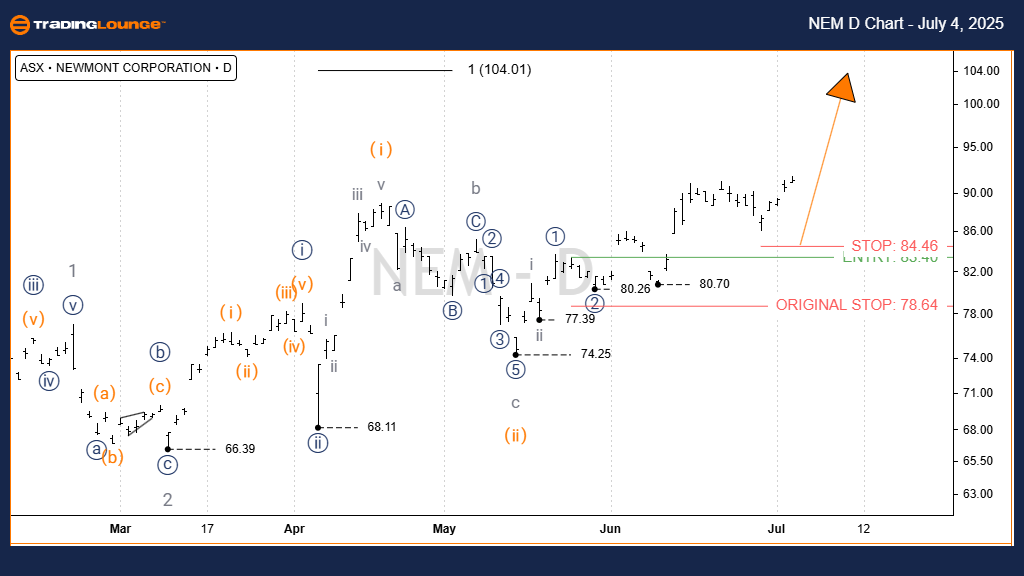
1D chart (Semilog Scale) technical breakdown

  • Function: Major trend (Minor degree, grey).

  • Mode: Motive.

  • Structure: Impulse.

  • Position: Wave iii) - orange of Wave iii)) - navy of Wave 3 - grey.

Key details:

Wave ii) - orange likely completed at the 74.25 low as a zigzag (a, b, c - grey).
From that point, wave iii) - orange has been progressing upward, now targeting the 100.00 level.

  • Invalidation point: 74.25.

Chart

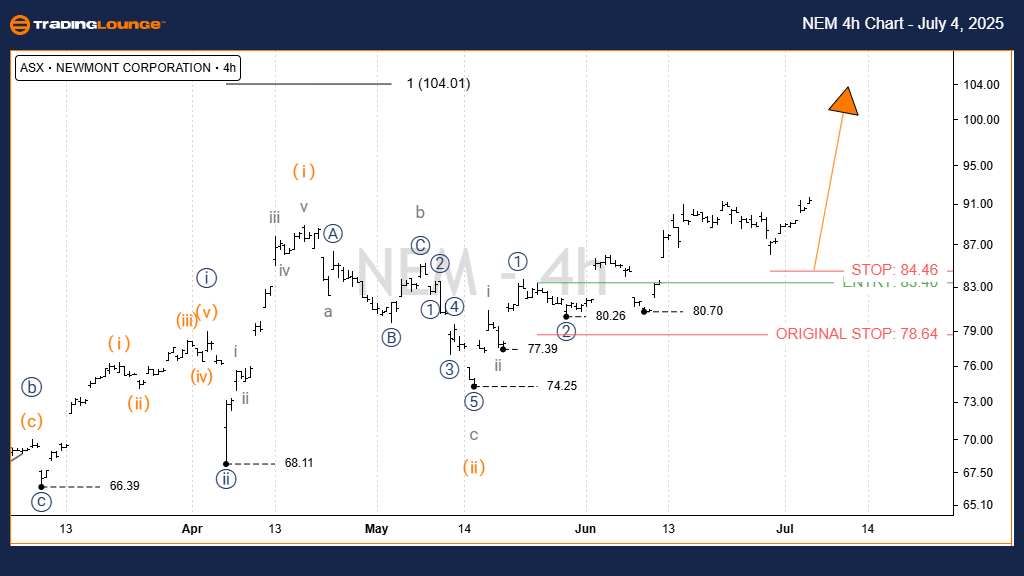
Four-hour chart review

  • Function: Major trend (Minor degree, grey).

  • Mode: Motive.

  • Structure: Impulse.

  • Position: Wave iii) - orange of Wave ((iii)) - navy of Wave 3 - grey.

Key details:

The 4-hour analysis confirms the ongoing trend observed in the 1D chart.
Wave iii) - orange continues its upward trajectory, with the main target at 100.00.
In the shorter term, wave iii - grey is also climbing, targeting 90.00.

  • Invalidation point: 74.25.

Chart

Conclusion

This technical outlook on ASX: NEWMONT CORPORATION – NEM aims to equip traders with insightful and objective analysis on current market behavior.
By identifying crucial price levels for trend validation or invalidation, we offer a solid framework for interpreting the Elliott Wave count.
Our goal is to support traders with transparent, professional perspectives.

NEM Elliott Wave technical analysis [Video]

Author

Peter Mathers

Peter Mathers

TradingLounge

Peter Mathers started actively trading in 1982. He began his career at Hoei and Shoin, a Japanese futures trading company.


More from Peter Mathers
Share:

Editor's Picks

160.80: Japanese Yen remains close to nearly two-year lows

USD/JPY inches lower after four days of gains, trading around 160.60 during the Asian hours. The USD/JPY pair surged to 160.80 the previous day, marking its highest level since July 2024 and significantly heightening speculation that Japanese authorities could soon intervene to support the struggling Yen.

AUD/USD eyes 0.7050 on weaker USD; 100-day SMA holds the key for bulls

The AUD/USD pair regains positive traction during the Asian session, reversing part of the previous day's slide to sub-0.7000 levels, or the weekly low. Spot prices currently trade around the 0.7040 region, up nearly 0.40% for the day, amid a broadly weaker US Dollar.

Gold stays firm near $4,300 as Iran peace deal offsets hawkish Fed

Gold clings to its modest intraday gains in the European session on Thursday and hangs close to the $4,300 mark amid a broadly weaker US Dollar (USD). The optimism over a US-Iran peace deal prompts USD profit-taking and supports the bullion. The Fed’s hawkish tilt could limit USD losses, capping the commodity.


Ripple awaits a breakout while Stellar rally gathers pace

Ripple steadies at $1.19 below the upper boundary of its falling channel after facing rejection. Meanwhile, Stellar extends its gains, rallying over 25% so far this week. Derivatives metrics suggest a cautious outlook for XRP, while XLM's improving futures positioning suggests a bullish outlook.

BoE expected to keep interest rate unchanged as inflation pressures abate

The Bank of England is on track to leave the benchmark Bank Rate unchanged at 3.75% for the fourth consecutive time on Thursday, as the US-Iran peace deal and the softer-than-expected consumer inflation figures seen earlier in the week have eased pressures to tighten its monetary policy.

Why a hawkish RBA is no longer enough to lift the Australian Dollar

The Reserve Bank of Australia delivered more than what markets expected: a hawkish hold that should have supported the Aussie. But markets widely ignored it, focusing instead on slowing economic growth and proving that central bank messaging alone isn’t always enough to drive currencies.