Natural Gas jumps over 4% on LNG vessel demand remaining bullish
- Natural Gas prices jump in US trading session.
- Traders are seeing gas prices higher with demand for LNG vessels soaring.
- The US Dollar Index consolidates below 104.00 though jumps higher for this Tuesday.

Natural Gas (XNG/USD) is soaring higher in the US trading session after an upbeat outlook from 'Gaztransport & Technigaz'. The French company is a leading designer of storage tanks and reported that its orderbook filled with over 450 order against a 400 estimate. Meanwhile on the geopolitical front, comments from French President Emmanuel Macron could quickly defused by German Prime Minister Olaf Scholz and NATO Secretary General Jens Stoltenberg saying that European boots on the ground is not an option. This means the situation in Ukraine is not about to escalate further with NATO remaining sidelined.
The US Dollar (USD) is recovering after downbeat US Durable Goods orders. Although the numbers were bad, markets ignored them in the fact that Boeing's decline after issues with its door malfuctioning in full flight, triggered a massive decline in sales. This triggered in its turn some stronger US Dollar in a counterintuitive move.
Natural Gas is trading at $1.85 per MMBtu at the time of writing.
Natural Gas market movers: Order books filled
- Russian gas deliveries via Ukraine are set to come to a halt at the end of 2024 with a transit agreement coming to an end between Russia and Ukraine. Under current conditions it does not look likely that a new deal will get signed, leaving Europe scrambling to replace the already reduced exposure to Russian gas via external flows.
- Bloomberg has issued a Natural Gas supply report where it calculated markets will need 1.8% more volume over the summer to meet demand growth compared with a year earlier..
- Several European trading desks report that Asian buyers are coming into the European markets to buy at low prices, creating further upward pressure on European gas prices.
- BP has appointed its top LNG executive James Cheeseman to lead the Ammonia trading business as demand for more green energy pairs with conventional energy sources like Gas and Oil.
- Russia and the US are fighting for the biggest piece of market share in the gas market. Russian supply is at risk of more sanctions and bottlenecks, while the US trying to guarantee a stable and secured supply. Australia is further falling behind in market share as output declines due to ageing fields.
Natural Gas Technical Analysis: Back above 1.80
Natural Gas traders are heading all-in again on Gas futures, jacking up prices in the US trading session. The leading French company that designs and builds gas storages said that its order book is near full and exceeding expectations, pointing to more demand to come for LNG. Meawhile comments from French President Emmanuel Macron got quickly contradicted by both the German Prime Minister Olaf Scholz and Secretary General of NATO Jens Stoltenberg. No boots on the ground means no involvment of NATO into Ukraine, which is a red line from the start for Russia, which now means that tensions are not escalating further and the escalation remains stuck in a rut.
On the upside, Natural Gas is facing some pivotal technical levels to get back to. The next step is $1.99, – the level which, when broken, saw an accelerated decline. After that, the green line at $2.13 comes into view, with the triple bottoms from 2023. If Natural Gas sees sudden demand pick up, $2.40 could come into play.
On the downside, $1.64 and $1.53 (the low of 2020) are targets to look out for. Another leg lower could come if global growth starts to shrink and there is less demand. Add to that equation both the US and Canada trying to free up more volume of Natural Gas mining, and the scale could quickly tip into an oversupplied market with more downside prices at hand.
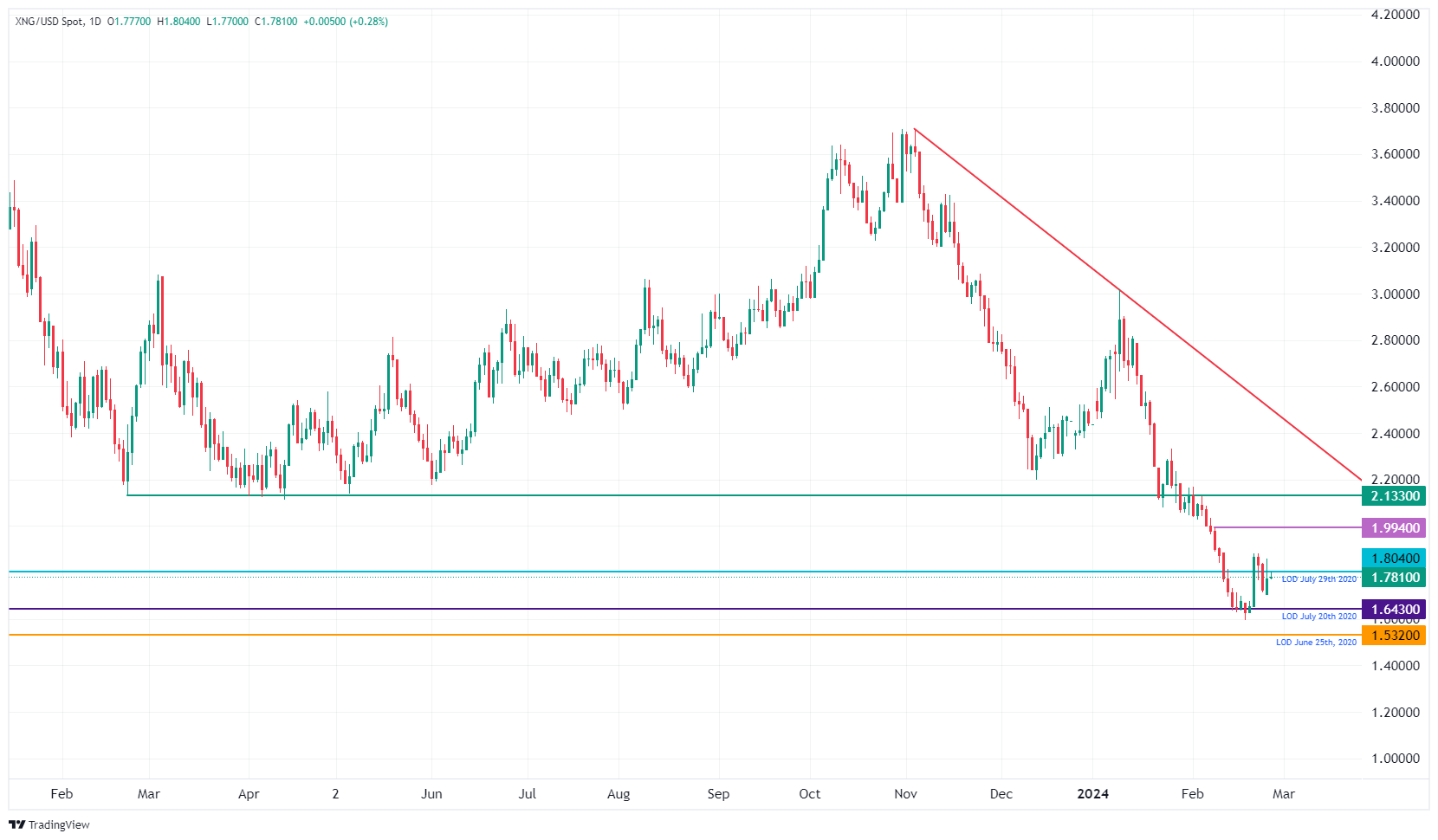
XNG/USD (Daily Chart)
Natural Gas FAQs
What fundamental factors drive the price of Natural Gas?
Supply and demand dynamics are a key factor influencing Natural Gas prices, and are themselves influenced by global economic growth, industrial activity, population growth, production levels, and inventories. The weather impacts Natural Gas prices because more Gas is used during cold winters and hot summers for heating and cooling. Competition from other energy sources impacts prices as consumers may switch to cheaper sources. Geopolitical events are factors as exemplified by the war in Ukraine. Government policies relating to extraction, transportation, and environmental issues also impact prices.
What are the main macroeconomic releases that impact on Natural Gas Prices?
The main economic release influencing Natural Gas prices is the weekly inventory bulletin from the Energy Information Administration (EIA), a US government agency that produces US gas market data. The EIA Gas bulletin usually comes out on Thursday at 14:30 GMT, a day after the EIA publishes its weekly Oil bulletin. Economic data from large consumers of Natural Gas can impact supply and demand, the largest of which include China, Germany and Japan. Natural Gas is primarily priced and traded in US Dollars, thus economic releases impacting the US Dollar are also factors.
How does the US Dollar influence Natural Gas prices?
The US Dollar is the world’s reserve currency and most commodities, including Natural Gas are priced and traded on international markets in US Dollars. As such, the value of the US Dollar is a factor in the price of Natural Gas, because if the Dollar strengthens it means less Dollars are required to buy the same volume of Gas (the price falls), and vice versa if USD strengthens.
Author

Filip Lagaart
FXStreet
Filip Lagaart is a former sales/trader with over 15 years of financial markets expertise under its belt.