Bitcoin trades in compression as 2026 begins with structure still unresolved

BTC/USD remains locked in a two-way structure, with micro supply-and-demand levels guiding early-year price behaviour.
BTC/USD — MacroStructure desk observation
As of January 1, 2026
Daily timeframe | Year-block structure | Micro supply–demand mapping
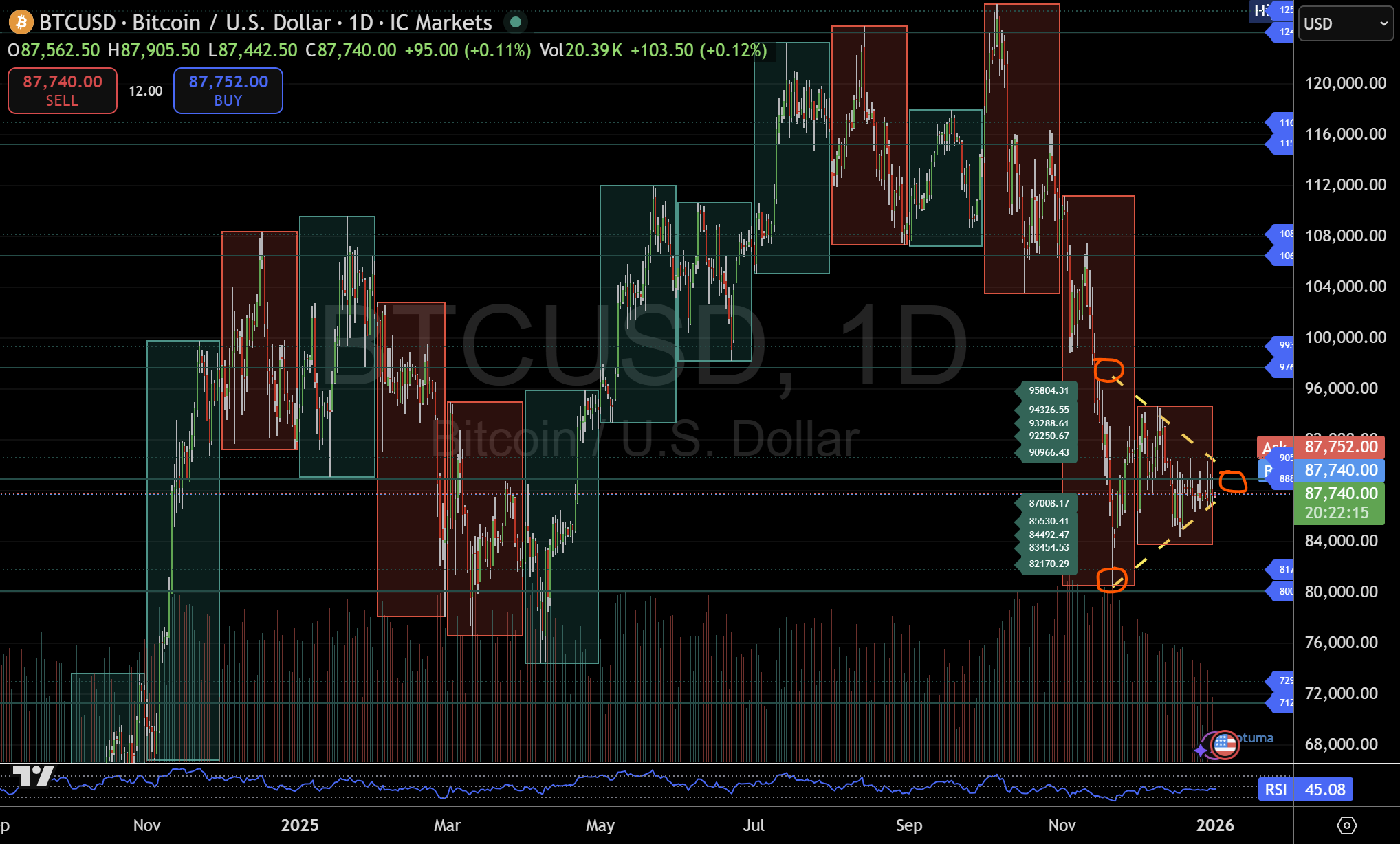
Bitcoin ended 2025 having erased its yearly gains, closing the year in a compressed, two-way structure rather than a directional resolution. The final two months of the year were defined less by trends and more by squeeze and compression, leaving price positioned at a critical inflection point as 2026 begins.
This desk update is a direct follow-up to the December 25 report, which documented Bitcoin’s historical structure from 2017 through 2025 using the MacroStructure framework. That broader structure remains intact. What has changed—and what now matters most—is how price behaves within it at the micro level.
MacroStructure phases
Balance → expansion → rotation → stress test
Context: a compressed end to 2025
November and December 2025 produced a clear two-way structure on the daily timeframe. Price compressed into a narrowing range, characterised by lower highs and higher lows, with no decisive resolution before year-end.
Rather than trending, Bitcoin spent this period rotating around a central reference, suggesting balance and indecision rather than continuation or breakdown. This type of behaviour has historically preceded meaningful directional movement, but only once the structure has resolved.
The central pivot: 88,890
At the centre of the current structure sits 88,890, which has emerged as the primary pivot on the daily timeframe.
- Price has repeatedly rotated around this level.
- Acceptance above or below it has dictated short-term response.
- It currently separates the upper and lower microstructures.
As long as price remains near this pivot, two-way trades dominate. Directional bias develops only when price moves away from it.
Upper micro structure: 90,966–95,804
Above the central pivot, the upper microstructure (Micro 1–5) spans approximately:
- 90,966 (Micro 1)
- 92,250
- 93,288
- 94,326
- 95,804
This band defines the upper supply-and-demand zone within the current range.
Structurally:
- Holding above 88,890 and accepting above Micro 1 (90,966) would keep microstructure price aligned with the upper structure.
- Acceptance through this zone would shift focus toward higher structural references, including the 97,000 and 106,000 regions already defined in the broader framework.
These levels are references, not forecasts, and remain conditional on price behaviour.
Lower micro structure: 87,008–82,170
Below the central pivot, the lower microstructure (Micro 5–1) is defined between:
- 87,008 (Micro 5)
- 85,530
- 84,492
- 83,454
- 82,170
This zone represents the lower demand band of the current two-way structure.
At the time of writing (January 1, 2026), BTC/USD trades near 87,498, holding just above Micro 5 (87,008). This level provides immediate structural support.
- Holding this band keeps price within balance.
- Loss of 87,008 would increase the probability of rotation toward the lower microstructure between 85,530 and 82,170.
Again, structure defines the pathway—price behaviour determines whether it is taken.
Why this period matters
The final months of 2025 have created a compressed structural setup heading into the new year. These conditions often act as decision points, where price transitions from balance into either expansion or deeper rotation.
Periods of compression like this often resolve on time as much as price, meaning early-year trade may remain rotational before structure fully reveals itself.
Despite heavy narrative flow around year-end macro themes, price behaviour remains the primary guide at this stage.
Importantly, this is not about calling direction. It is about documenting the battlefield as 2026 begins.
The two-way structure now in place will likely guide the early-year trade, whichever side ultimately gains acceptance.
Desk takeaway
- Bitcoin has ended 2025 in compression, not trend.
- 88,890 is the key pivot separating the upper and lower microstructures.
- Above: 90,966–95,804 defines the upper structural band.
- Below: 87,008–82,170 defines the lower demand zone.
- Direction emerges only after acceptance, not anticipation.
These desk updates document a structure-first process, observing how price accepts or rejects predefined levels over time. Coverage spans futures, commodities, forex, bonds, crypto, stocks, and indices, with structure providing context before direction.
This observation is for informational purposes only and does not constitute financial advice.
Author

Denis Joeli Fatiaki
Independent Analyst
Denis Joeli Fatiaki possesses over a decade of extensive experience as a multi-asset trader and Market Strategist.