|

Natural Gas Price Analysis: XNG/USD recaptures $2.60 within six-week-old bearish channel

  • Natural Gas Price defends the previous day’s corrective bounce off three-week low within bearish chart formation.
  • Two-month-long support-turned-resistance guards immediate recovery of XNG/USD.
  • Convergence of weekly resistance line, 200-SMA adds to the upside filters.
  • Natural Gas sellers may find it difficult to break $2.43 support confluence.

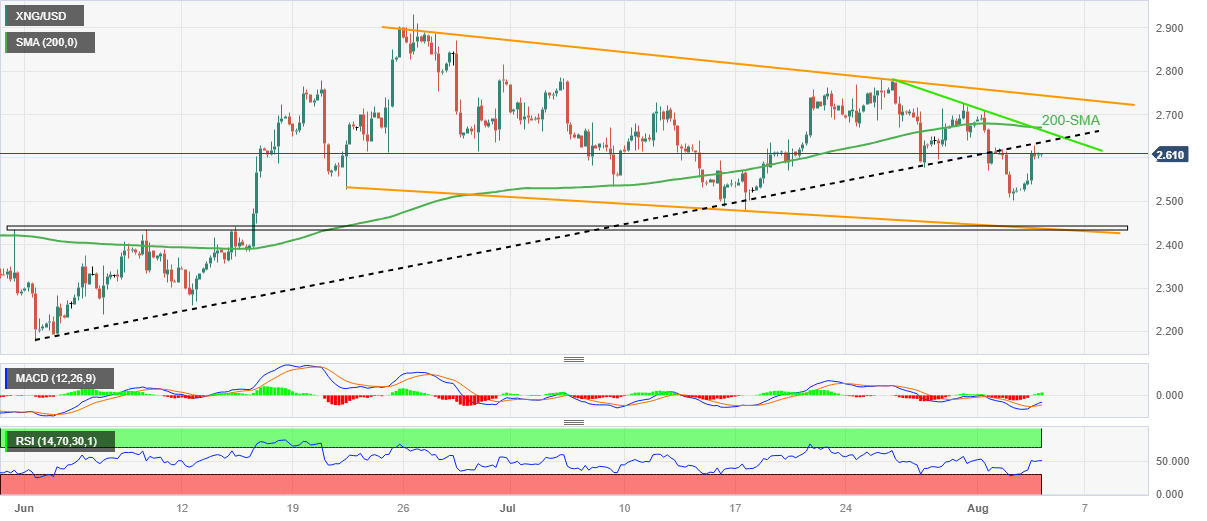
Natural Gas Price (XNG/USD) pares weekly losses around $2.61 during early Friday as markets consolidate ahead of the US employment report for July. In doing so, the XNG/USD extends the previous day’s recovery from the lowest level in three weeks while staying within a 1.5-month-long descending trend channel.

It’s worth noting, however, that the recently bullish MACD signals and the upbeat RSI, as well as the US Dollar’s retreat from a multi-day high, allowed the Natural Gas Price to recover.

Even so, the previous support line from early June guards the immediate recovery of the XNG/USD near $2.64.

Following that, a convergence of the 200-SMA and a one-week-old falling trend line, close to $2.67 could challenge the Natural Gas buyers.

It’s worth noting, however, that the XNG/USD bulls must defy the bearish channel by crossing the $2.75 hurdle to restore the market’s confidence.

On the contrary, pullback moves may aim for the latest swing low of around $2.50. However, a convergence of the nine-week-old horizontal support zone joins the aforementioned bearish channel’s lower line to around $2.43 while offering a major challenge to the Natural Gas sellers.

Overall, XNG/USD remains on the bear’s radar despite the latest recovery.

Natural Gas Price: Four-hour chart
Trend: Limited upside expected

Author

Anil Panchal

Anil Panchal

FXStreet

Anil Panchal has nearly 15 years of experience in tracking financial markets. With a keen interest in macroeconomics, Anil aptly tracks global news/updates and stays well-informed about the global financial moves and their implications.


More from Anil Panchal
Share:

Editor's Picks

AUD/USD sticks to neutral bias above 0.7100 amid cautious markets

AUD/USD holds steady above 0.7100 in the Asian session on Monday as the US Dollar stalls its modest pullback from the highest level since late July amid persistent geopolitical uncertainties. The PBOC status quo on Loan Prime Rates also weighs on the Aussie. However, bets on another RBA rate hike continue to underpin the Australian Dollar ahead of the Trump-Xi Summit.

USD/JPY eases below 157.00 amid looming intervention risks

USD/JPY is easing back below 157.00 in Asia on Monday, undermined by modest Japanese Yen strength amid looming intervention risks after Friday's BoJ rate check. A Japanese holiday also keeps traders on edge amid escalating geopolitical tensions between Russia and Ukraine and in the Middle East. As a result, the US Dollar pauses its pullback, limiting the pair's downside.

Gold meets resistance around $4,400

Gold kicks in the new trading with on the back foot, keeping its trade near $4,350 per troy ounce. The precious metal’s correction comes on the back of the firmer US Dollar and espite declining US Treasury yields across the curve.

Bitcoin hits $85,000 for the first time in eight months
Bitcoin price reclaims $85,000 on Monday, advancing last week’s 5% recovery toward an eight-month high. The recovery in King Crypto aligns with renewed institutional demand, with Exchange Traded Funds (ETFs) recording $433 million in inflows on Friday.
The week ahead: Fuel prices in focus as we lead up to key eco releases

Financial markets are in a strange position as we move to the final weeks of Q3, uncertainty and volatility continue to grip markets, but the oil price is falling; and European and US stocks are poised to open higher later on Monday. Market stresses are concentrated in sovereign bonds, and European and US yields had another scare late on Friday, and moved higher.

BoJ Recap: Not as hawkish as expected

The Bank of Japan (BoJ) raised its short-term interest-rate target to 1.25% from 1.00% in a 7-2 vote, marking another step in the normalisation of monetary policy and widely matching what everyone has been expecting for weeks.













