Natural Gas drops 2% with European demand shrinking
- Natural Gas prices are falling again in bloodred week.
- Gas demand in Europe sinks further as industrial production contracted more than expected in January.
- The US Dollar Index trades below 103.00 after failing to break higher on Tuesday.

Natural Gas (XNG/USD) trades well below $2.00 on Wednesday, extending its steep decline last week. More and more selling pressure is accumulating from a pure technical point of view, while geopolitical factors are not falling in favor of higher Gas prices either. Data published on Wednesday showed that European Industrial Production fell more than expected in January, a bad sign for demand at a time when Gas consumption from households is fading as well with spring and summer just around the corner.
Meanwhile, the US Dollar (USD) is sinking lower after a failed attempt to jump higher on Tuesday. The US Consumer Price Index (CPI), though clearly proving that inflation is still sticky, was not enough to push the US Dollar Index (DXY) firmly above 103.00 and saw it retreating at the end of the US trading session, with risk of more downside once Dollar bulls run out of belief.
Natural Gas is trading at $1.75 per MMBtu at the time of writing.
Natural Gas market movers: Europe's demand just got smaller
- US Oil and Gas investor Kimmeridge Energy Management Company has proposed to merge its Texas gas unit with Silverbow Resources.
- Despite recent negative Industrial Production data out of Europe, speculators are pushing Futures contracts for this winter higher on bullish bets.
- Former US President Donald Trump and current US President Joe Biden both secured enough votes to be the candidates and will have a rematch after four years in November to see who will become the next President. This will be important in terms of Trump’s former pledges for the US to become energy independent.
- Russian Gas exports are set to rise by 13% this summer, though US sanctions are expected to limit this projection.
- Spreads between summer and winter contracts on the Dutch Gas market show a discount for the summer contracts, making it less expensive for Europe to restock ahead of the next heating season. This means less price pressure for European households.
- A tail risk is still present in the Middle East with still no breakthrough in ceasefire talks between Gaza and Israel.
Natural Gas Technical Analysis: Prices being shot down
Natural Gas prices are trading substantially lower, away from that $2.00 marker which was crucial in its road upwards. Instead, with more and more Moving Averages (SMA) trending lower, it is nearly undeniable that Gas prices are stuck in a downturn and will soon test the low of 2024 at $1.60. This is good news for households, which are set to benefit from cheaper Gas.
On the upside, the key $2.00 level needs to be regained first. The next key level is the historic pivotal point at $2.12, which falls in line with the 55-day SMA at $2.13. Should Gas prices pop up in that region, a broad area opens up with the first cap at the red descending trend line near $2.40.
On the downside, again multi-year lows are nearby with $1.65 as the first line in the sand. This year’s low at $1.60 needs to be kept an eye on as well. Once a new low for the year is printed, keep an eye on $1.53 as the next supportive area.
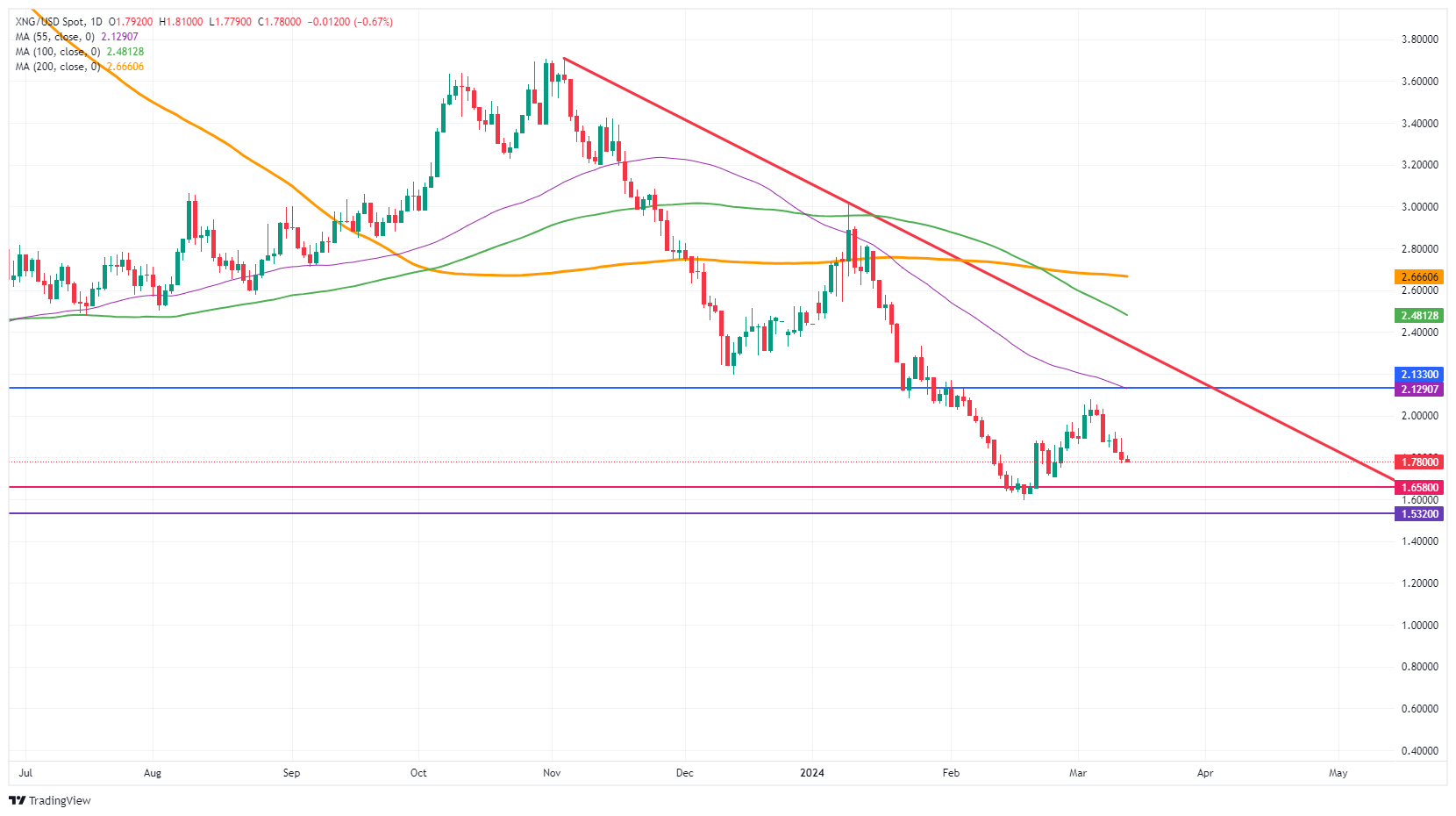
XNG/USD (Daily Chart)
Natural Gas FAQs
Supply and demand dynamics are a key factor influencing Natural Gas prices, and are themselves influenced by global economic growth, industrial activity, population growth, production levels, and inventories. The weather impacts Natural Gas prices because more Gas is used during cold winters and hot summers for heating and cooling. Competition from other energy sources impacts prices as consumers may switch to cheaper sources. Geopolitical events are factors as exemplified by the war in Ukraine. Government policies relating to extraction, transportation, and environmental issues also impact prices.
The main economic release influencing Natural Gas prices is the weekly inventory bulletin from the Energy Information Administration (EIA), a US government agency that produces US gas market data. The EIA Gas bulletin usually comes out on Thursday at 14:30 GMT, a day after the EIA publishes its weekly Oil bulletin. Economic data from large consumers of Natural Gas can impact supply and demand, the largest of which include China, Germany and Japan. Natural Gas is primarily priced and traded in US Dollars, thus economic releases impacting the US Dollar are also factors.
The US Dollar is the world’s reserve currency and most commodities, including Natural Gas are priced and traded on international markets in US Dollars. As such, the value of the US Dollar is a factor in the price of Natural Gas, because if the Dollar strengthens it means less Dollars are required to buy the same volume of Gas (the price falls), and vice versa if USD strengthens.
Author

Filip Lagaart
FXStreet
Filip Lagaart is a former sales/trader with over 15 years of financial markets expertise under its belt.

















