Natural Gas holds on to gains after US opening bell
- Natural Gas up near 1% in European trading.
- Traders are sending Gas higher with help from a weaker US Dollar.
- The US Dollar Index is in the red with markets catching up after Monday’s US holiday.

Natural Gas (XNG/USD) is jumping back above $1.64 and is trying another attempt to snap its losing streak. The countermove gets a bit of help from the US Dollar which is retreating a touch just hours before the US opening bell. Selling pressure meanwhile comes from European headlines where Natural Gas is facing even more headwinds.
The US Dollar (USD) is retreating on Monday with US markets trying to catch up after a National Holiday. Traders are sending European bond yields higher after the European Central Bank Report (ECB) shows European wages are still very elevated. The Euro is up against the US Dollar, which makes the US Dollar Index (DXY) retreat a touch.
Natural Gas is trading at $1.64 per MMBtu at the time of writing.
Natural Gas market movers: Gas finds some room to go up for a day
- EU member states and the EU parliament have agreed on a framework to certify carbon removals, which is part of an effort to pull carbon dioxide out of the atmosphere and cut emissions further.
- Several companies have asked the EU to cut energy costs and the regulatory burden for green rules, in order to maintain competitiveness with China.
- Windy weather in Europe is increasing energy production via wind turbines, reducing the need for Natural Gas in an already tepid demand climate.
- Record deliveries from Qatar to Europe in LNG were recorded last week.
Natural Gas Technical Analysis: Easing further despite Tuesday's relief
Natural Gas faces more and more headaches, on a near daily basis when looking at the headlines that are emerging from one of its biggest consumers: Europe. The green sprint in Europe, together with more and more green energy sources overtaking Natural Gas as a source of energy, threatens the future for Gas in terms of volumes needed. For now India is happy to take over those excess volumes, though the question remains for how long?
On the upside, Natural Gas is facing some pivotal technical levels to get back to. First stop is $1.99, – the level which, when broken, saw an accelerated decline. Next is the blue line at $2.13 with the triple bottoms from 2023. In case Natural Gas sees sudden demand pick up, possibly $2.40 could come into play.
Keep an eye on $1.80, which was a pivotal level back in July 2020 and should act as a cap now. Should more supply emerge in the markets, or more weakening data globally point to even more sluggish global growth – $1.64 and $1.53 (the low of 2020) are targets to look out for.
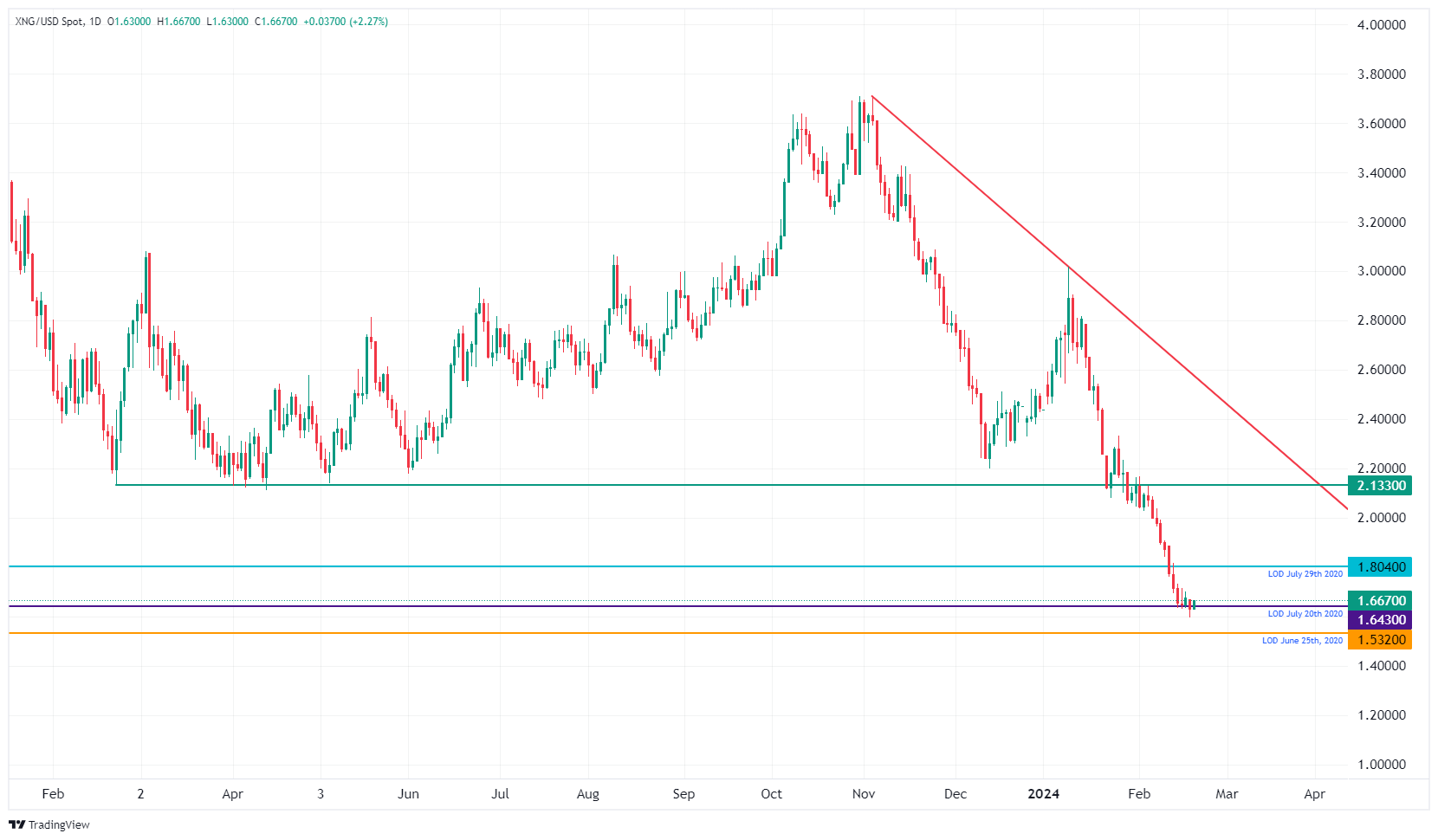
XNG/USD (Daily Chart)
Natural Gas FAQs
What fundamental factors drive the price of Natural Gas?
Supply and demand dynamics are a key factor influencing Natural Gas prices, and are themselves influenced by global economic growth, industrial activity, population growth, production levels, and inventories. The weather impacts Natural Gas prices because more Gas is used during cold winters and hot summers for heating and cooling. Competition from other energy sources impacts prices as consumers may switch to cheaper sources. Geopolitical events are factors as exemplified by the war in Ukraine. Government policies relating to extraction, transportation, and environmental issues also impact prices.
What are the main macroeconomic releases that impact on Natural Gas Prices?
The main economic release influencing Natural Gas prices is the weekly inventory bulletin from the Energy Information Administration (EIA), a US government agency that produces US gas market data. The EIA Gas bulletin usually comes out on Thursday at 14:30 GMT, a day after the EIA publishes its weekly Oil bulletin. Economic data from large consumers of Natural Gas can impact supply and demand, the largest of which include China, Germany and Japan. Natural Gas is primarily priced and traded in US Dollars, thus economic releases impacting the US Dollar are also factors.
How does the US Dollar influence Natural Gas prices?
The US Dollar is the world’s reserve currency and most commodities, including Natural Gas are priced and traded on international markets in US Dollars. As such, the value of the US Dollar is a factor in the price of Natural Gas, because if the Dollar strengthens it means less Dollars are required to buy the same volume of Gas (the price falls), and vice versa if USD strengthens.
Author

Filip Lagaart
FXStreet
Filip Lagaart is a former sales/trader with over 15 years of financial markets expertise under its belt.

















