NASDAQ gives up early gains on Monday as Nvidia sells off on Huawei AI competition
- Huawei hints that new AI chip will be ready for testing in late May.
- The Ascend 910D processor is designed to compete with Nvidia's H100, a popular AI chip.
- NASDAQ sheds weight despite optimism over coming Microsoft, Apple, Amazon and Meta Platforms earnings.
- Longer-term support for NVDA might be as low as $76.
The NASDAQ Composite index is bowing to pressure from Nvidia (NVDA) stock on Monday as the latter succumbs to renewed pressure out of China. In light of recent export curbs on Nvidia's AI chips, China's Huawei is expected to receive its first shipment of an AI-workload chip that company executives believe will go toe-to-toe with Nvidia's offerings.
The NASDAQ rose about half a percentage point in the early going on Monday before bending to pressure from Nvidia, which has sunk more than 3.5% at the time of writing. The NASDAQ index has declined by about 1% at the same time.
Much of the US equity market is still rather optimistic in a week that will witness the earnings releases of quite a few of the largest tech stocks. Microsoft (MSFT) and Meta Platforms (META) report earnings on Wednesday, while Apple (AAPL) and Amazon (AMZN) report on Thursday.
In other news, a massive electricity blackout has hit Portugal, Spain and France, and investigators are uncertain what caused it.
Nvidia stock news
The Wall Street Journal reported on Sunday that Huawei was telling interested parties that the first shipments of its new AI chip will arrive in late May. Huawei's Ascend 910D processor will supposedly offer more power than Nvidia's H100 chip, which is used by data centers to process large AI workloads that train large language models and other AI systems.
Huawei has approached a number of Chinese tech companies, which the article says have shown interest in testing the new product. China had been the buyer of as much as a quarter of Nvidia's AI chips until the Biden administration subjected the H100 and certain other US-designed chips to export licenses in late 2022.
Nvidia sought to contend with the Biden policy by introducing the H20 chip, a less powerful AI chip that Chinese companies could purchase legally. But earlier this month, the Trump administration added the export license restriction to the H20 chip as well.
With the introduction of the Ascend 910D processor, Chinese tech giants might become less reliant on Nvidia's tech in the future, even if US policymakers eventually drop their barriers to AI tech exports.
Many Silicon Valley observers view Huawei's new processor as the second shoe to drop after China's DeepSeek demonstrated in January that it could build its own AI LLMs much cheaper than existing US offerings.
Nvidia stock forecast
Nvidia stock fell through its bottom ascending trend range (green) back on March 3, and ever since NVDA has been in a clear downtrend. Nvidia has been trending below its 50-day Simple Moving Average (SMA) since late February at this point, and it should worry bulls that the recent recovery has not touched that moving average.
The real question is whether NVDA can drop below the April 7 low of $86.62. The evidence would lead toward an affirmative answer since the clear historical support at $92 did not stand a chance.
If the $86 vicinity does not hold, then the April 2024 low surrounding $76 is the next bet. Most market observers are still optimistic about Nvidia's long-term prospects, so shares at that level should garner serious dip-buying.
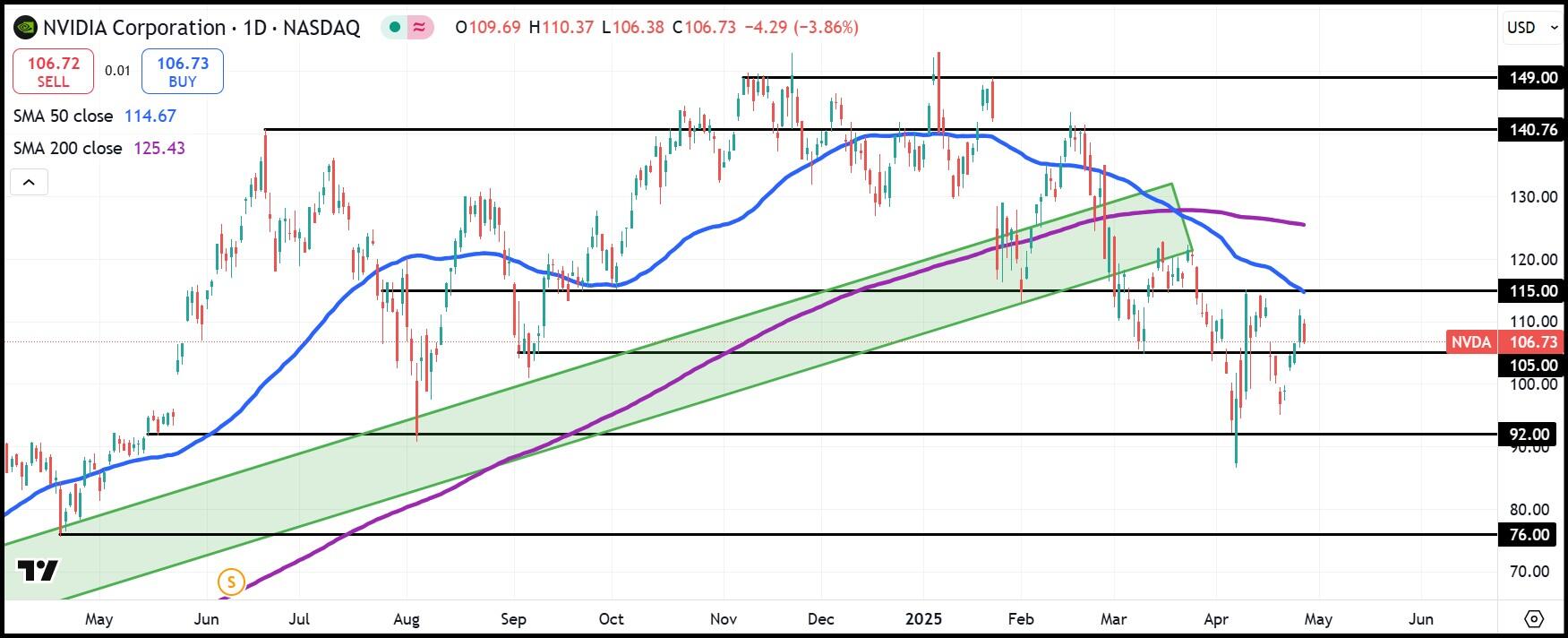
NVDA daily stock chart
Author

Clay Webster
FXStreet
Clay Webster grew up in the US outside Buffalo, New York and Lancaster, Pennsylvania. He began investing after college following the 2008 financial crisis.
















