|

MULN Stock News: Mullen Automotive cools off and snaps its five-day winning streak

  • NASDAQ:MULN fell by 6.04% during Wednesday’s trading session.
  • Mullen Automotive fell but other meme stocks rallied.
  • Electric vehicle stocks pulled back amidst a red-hot streak.

NASDAQ:MULN saw its stock fall for the first time in six sessions as the suddenly hot EV startup fell alongside the broader markets. On Wednesday, shares of MULN fell by 6.04% and closed the trading session at $3.11. All three major indices dropped lower on Wednesday as rising oil prices and a surge in the ten-year treasury bond yield put an end to the market’s recent relief rally. The Dow Jones dropped 448 basis points for its worst performance so far this week, while the S&P 500 and NASDAQ fell by 1.23% and 1.32% respectively.


Stay up to speed with hot stocks' news!


Mullen Automotive has been behaving like a meme stock as of late with gains of 46% over the past week and 401% over the past month. The ticker symbol has also been trending on social media sites like Reddit. On Wednesday, Mullen took a back seat to some legacy meme stocks as AMC (NYSE:AMC) and GameStop (NYSE:GME) soared higher by 13.58% and 14.5% respectively. GameStop ripped higher after Chairman Ryan Cohen bought 100,000 more shares, sending meme stock traders into a frenzy.

MULN stock forecast
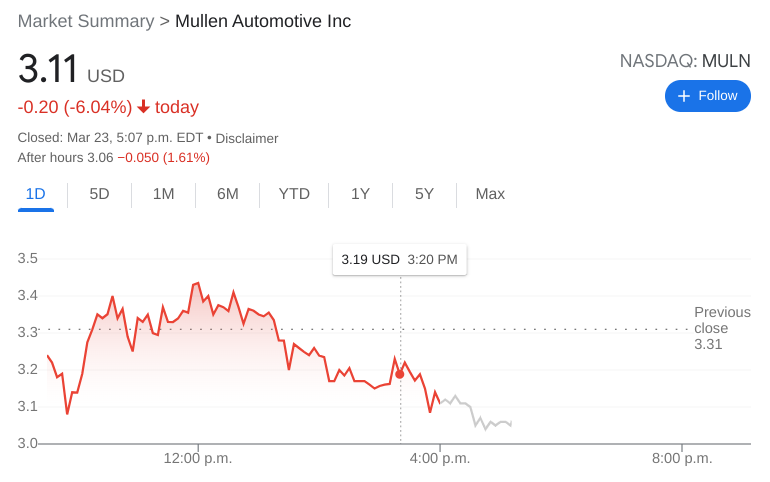
MULN Stock

EV stocks ripped higher out of the gate this morning but most erased their losses and succumbed to a weakening market in the afternoon. Shares of industry leader Tesla (NASDAQ:TSLA) eked out a small gain of 0.52%, while Chinese EV makers Nio (NYSE:NIO) and XPeng (NYSE:XPEV) inched higher by 0.46% and 0.24% respectively. Other EV makers weren’t as lucky as Lucid (NASDAQ:LCID) dropped by 2.81% and Rivian (NASDAQ:RIVN) dipped by 2.26% during the session.

Author

More from Stocks Reporter
Share:

Editor's Picks

AUD/USD stays defensive below 0.7150 after Chinese data

AUD/USD remains on the back foot below 0.7150 in the Asian session on Tuesday, close to an over three-week low touched the previous day. US bond yields hold near multi-year highs ahead of the FOMC meeting and oil-driven inflation risks, supporting the US Dollar and weighing on the currency pair. Mixed Chinese activity data for August also fail to inspire the Aussie.

USD/JPY extends gains toward 155.00 amid USD resurgence

USD/JPY keeps pushing higher toward 155.00 early Tuesday, looking for more upside, as traders await the FOMC and BoJ meetings this week. Meanwhile, Fed rate-hike bets and oil-driven inflation risks keep US bond yields near multi-year highs, supporting the US Dollar and the pair. That said, a more hawkish repricing of the BoJ normalization path might continue to underpin the Japanese Yen and could limit USD/JPY's upside. .

Gold struggles below $4,300, near one-month low as USD sticks to gains ahead of Fed

Gold struggles to capitalize on its modest Asian session uptick, and remains close to a one-month low, which it touched the previous day. The commodity currently trades just below the $4,300 mark as traders move to the sidelines ahead of the crucial two-day FOMC policy meeting, starting later today.

Dogecoin clings to EMA support as recovery lacks conviction
Dogecoin (DOGE) hovers around $0.083 at the time of writing on Tuesday after finding support around the key support zone the previous day. Quiet institutional demand, along with mixed derivatives positioning, suggests fading interest in the dog-themed meme coin.
AI, markets and a more complicated world
The week started with upward pressure on energy prices, US 10-year yield breaching the 5% mark and very uncomfortable questions regarding AI, and this time, it was not about the circular deals, financing capabilities, investor greed, earnings, the impact of AI on different sectors and businesses, the parabolic rise in market prices, PE ratios and so on.
Venezuela’s 65-billion-barrel Oil deal could reshape America’s inflation fight
The United States (US) has secured unprecedented access to part of Venezuela’s vast Oil reserves. The timing is particularly significant as the war with Iran is disrupting Middle Eastern supplies, keeping energy prices elevated and reviving concerns about inflation.