|

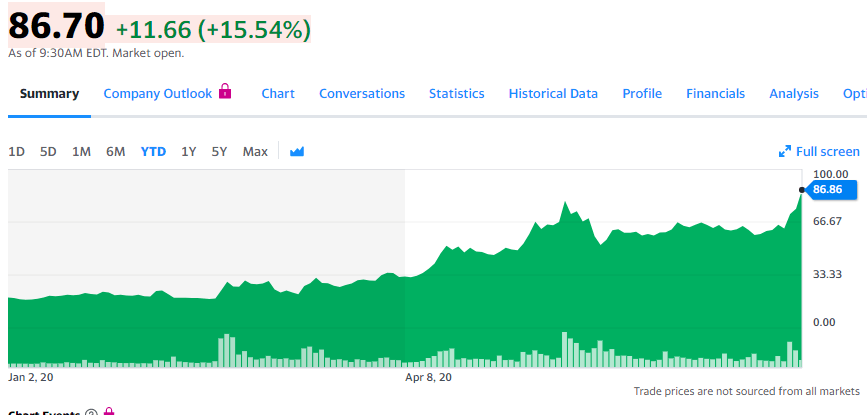
MRNA Stock Price: Moderna hits record high amid coronavirus vaccine progress, new test underway

  • NASDAQ: MRNA shares are set to jump to around $85, a record high.
  • Moderna Inc reported progress in its COVID-19 vaccine efforts 
  • Broader stock markets are also on the rise in the hopes of a broad turnaround.

Moderna Inc. (MRNA) is trading around $87, the highest on record and above the previous peak in May. The company has been at the forefront of efforts to develop immunization for the disease that is gripping the world and is now benefiting from progress as the trial produces a "robust immune response". 
MRNA Stock News

The prestigious New England Journal of Medicine reported details about Moderna's vaccine efforts. The Massachusetts-based pharmaceutical firm tested its candidate on 45 humans, which all showed a robust amount of antibodies – as much as four times the level seen in recovered coronavirus patients. 

Moreover, side-effects were minimal among those that were tested, showing the vaccine is safe. There still is a long road to approving, producing, and administering a vaccine to the globe's population is still long. Moderna's next step is a broad test of 30,000 people.

Contrary to the previous publication – when Moderna only issued a press release – the publication by the highly regarded magazine is already applauded by the medical community. 

It is essential to note that other efforts are in play, most notably cooperation between the University of Oxford and AstraZeneca. 

The S/P 500 has turned positive for the year, boosted by the NASDAQ: MRNA news. 

Author

Yohay Elam

Yohay Elam

FXStreet

Yohay is in Forex since 2008 when he founded Forex Crunch, a blog crafted in his free time that turned into a fully-fledged currency website later sold to Finixio.


More from Yohay Elam
Share:

Editor's Picks

AUD/USD keeps range near mid-0.7100s as USD bulls await US CPI

AUD/USD steadies near mid-0.7100s in the Asian session on Friday, stalling the previous day's sharp decline to an over one-week low. The August PPI report reaffirmed Fed rate-hike bets and boosted the US Dollar on Thursday, which weighed heavily on the pair. However, hawkish RBA expectations limited losses for the Aussie as USD bulls now await the release of the US consumer inflation figures before placing fresh bets.

USD/JPY holds lower ground toward 154.00; looks to US CPI

USD/JPY holds lower ground toward 154.00 in the Asian session on Friday after hot Japanese PPI data bolster a more hawkish BoJ repricing and provide fresh impetus to the Japanese Yen. However, the downside appears capped as the US Dollar preserves overnight gains ahead of the latest US consumer inflation data.

Gold: Gains remain capped by $4,400

Gold regains composure and trades with decent gains on Friday, managing to refocus attention on the $4,440 mark per ounce troy. Therefore, the precious metal reverses Thursday’s decline as the US Dollar alternates gains with losses at the end of the week.

Ripple Price Forecast: XRP extends decline as returning ETF inflows fail to lift outlook
Ripple (XRP) falls below $1.33 on Friday, marking the third consecutive day of declines. The token continues to track the broader cryptocurrency market downturn, with investors closely monitoring heightened macroeconomic uncertainty ahead of the United States (US) Consumer Price Index (CPI) release and next week’s Federal Reserve (Fed) monetary policy decision.
Weekly focus – The hawks set the tone
Risky assets came under pressure this week as energy prices kept creeping higher and the ECB surprised the markets with a hawkish tone. The price of Brent crude touched USD 110 per barrel on Thursday night, highest since mid-May, as news emerged that the Yemeni Houthis had reached control of key port cities and islands near the Bab el-Mandeb strait.
Venezuela’s 65-billion-barrel Oil deal could reshape America’s inflation fight
The United States (US) has secured unprecedented access to part of Venezuela’s vast Oil reserves. The timing is particularly significant as the war with Iran is disrupting Middle Eastern supplies, keeping energy prices elevated and reviving concerns about inflation.