MicroStrategy Stock Forecast: MSTR sinks more than 15% to kick off week
- MicroStrategy lost more than 15% on Monday.
- This considerable pullback follows three weeks of rallying.
- CEO Saylor in the market for another $575 million.
- MSTR is up 138% YTD in 2024.

MicroStrategy (MSTR) stock shunted lower a whopping 15.7% on Monday. The pullback came alongside a continued slackening over the weekend in the price of Bitcoin, which lost as much as 2% during the session to trade near $67,000.
Since stocks tied to the price of Bitcoin like MicroStrategy don’t trade over the weekend, they can experience serious volatility on Monday after catching up to the weekend’s Bitcoin dynamics.
MSTR stock moved in contrast, closing at $1,502.76 to the broader market as the S&P 500 rose about 0.6% and the NASDAQ registered a gain near 0.8%.
MicroStrategy stock news
MicroStrategy stock is still up 138% year to date, so this pullback should be viewed in the wider scheme of things. During the previous three weeks, MSTR stock clocked in gains of 57%, 32% and 25% in consecutive order.
That means that it was high time for a pullback. Still many traders took the chance to dunk on MSTR across social media. Some mentioned that CEO Michael Saylor has been selling MSTR shares, albeit those related to stock options. This back-in-forth spat in turn drove supporters to pile on.
Those bullish about Bitcoin still have major reasons for optimism though. The market is just 30 days away from the halving event in which miners receive a 50% reduced reward for mining a new block of BTC. In the past, this has caused a large surge in price action for BTC in the 18 months following a halving event since it means that miners are selling a drastically-reduced amount of Bitcoin on average.
Last Wednesday, Saylor and company announced that it would be selling another $500 million worth of convertible senior notes in a private offerings to fund further purchases of Bitcoin. The notes are due in 2031 and allow the buyers to purchase an additional $75 million if desired. The software company already owns 205,000 or so BTC coins.
This announcement came on the heels of an earlier announcement that MicroStrategy had purchased 12,000 Bitcoins following a successful $781 million sale of convertible senior notes.
S&P 500 FAQs
The S&P 500 is a widely followed stock price index which measures the performance of 500 publicly owned companies, and is seen as a broad measure of the US stock market. Each company’s influence on the computation of the index is weighted based on market capitalization. This is calculated by multiplying the number of publicly traded shares of the company by the share price. The S&P 500 index has achieved impressive returns – $1.00 invested in 1970 would have yielded a return of almost $192.00 in 2022. The average annual return since its inception in 1957 has been 11.9%.
Companies are selected by committee, unlike some other indexes where they are included based on set rules. Still, they must meet certain eligibility criteria, the most important of which is market capitalization, which must be greater than or equal to $12.7 billion. Other criteria include liquidity, domicile, public float, sector, financial viability, length of time publicly traded, and representation of the industries in the economy of the United States. The nine largest companies in the index account for 27.8% of the market capitalization of the index.
There are a number of ways to trade the S&P 500. Most retail brokers and spread betting platforms allow traders to use Contracts for Difference (CFD) to place bets on the direction of the price. In addition, that can buy into Index, Mutual and Exchange Traded Funds (ETF) that track the price of the S&P 500. The most liquid of the ETFs is State Street Corporation’s SPY. The Chicago Mercantile Exchange (CME) offers futures contracts in the index and the Chicago Board of Options (CMOE) offers options as well as ETFs, inverse ETFs and leveraged ETFs.
Many different factors drive the S&P 500 but mainly it is the aggregate performance of the component companies revealed in their quarterly and annual company earnings reports. US and global macroeconomic data also contributes as it impacts on investor sentiment, which if positive drives gains. The level of interest rates, set by the Federal Reserve (Fed), also influences the S&P 500 as it affects the cost of credit, on which many corporations are heavily reliant. Therefore, inflation can be a major driver as well as other metrics which impact the Fed decisions.
MicroStrategy stock forecast
Once again, a pullback in MSTR stock at this juncture should not be overly worrisome to shareholders. Rather, these shakeouts are common when a stock has heavy trading in the options markets.
A good sign is that MicroStrategy halted its intraday lows near $1,440. This time the daily low was also above the March 12 low of $1,438. That gives this level a certain significance. If MSTR bounces off here tomorrow, the rally will be back on.
However, a break of $1,440 will send a certain swath of traders bailing this week. If that is the case, expect MSTR to descend to the $1,200 level. This price coincides with the 20-day Simple Moving Average (SMA), as well as considerable price action from earlier this month.
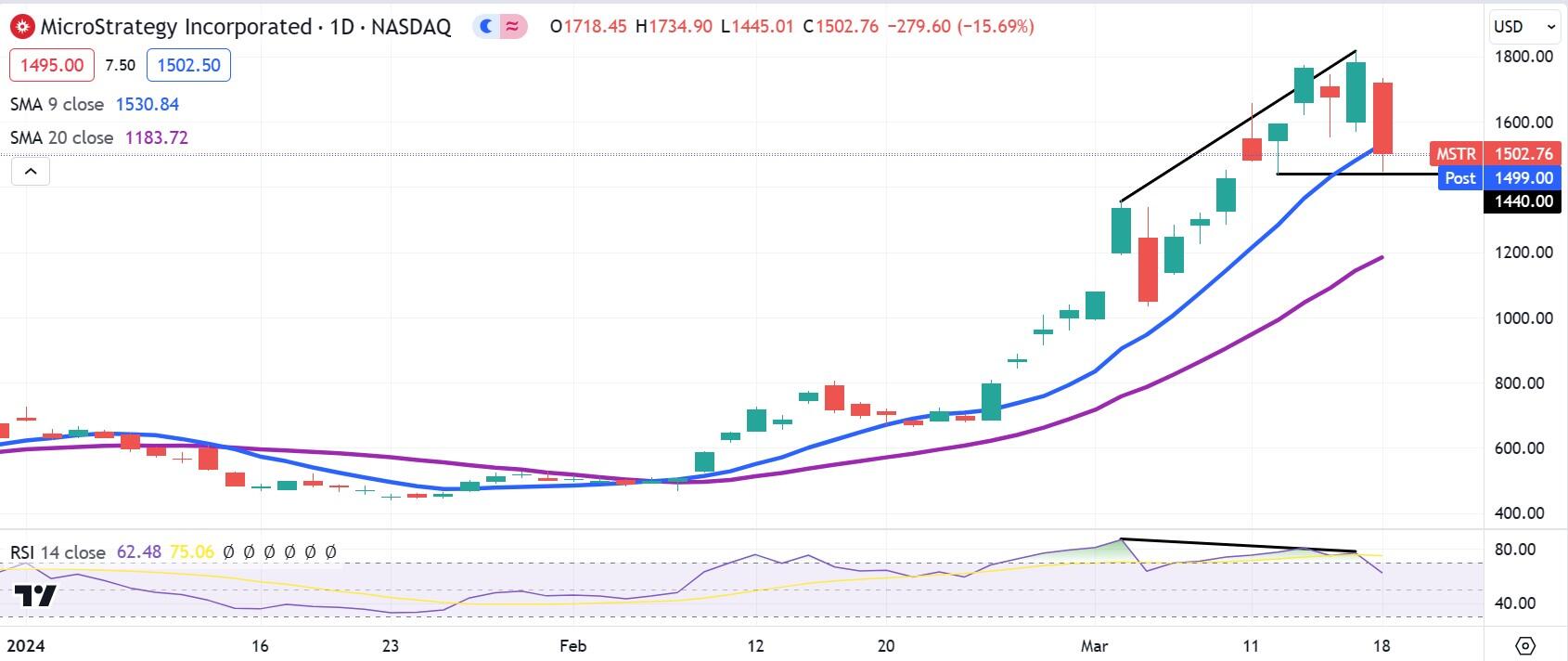
MSTR daily stock chart
Author

Clay Webster
FXStreet
Clay Webster grew up in the US outside Buffalo, New York and Lancaster, Pennsylvania. He began investing after college following the 2008 financial crisis.

















