Microsoft stock gains as Azure becomes first cloud with Nvidia Blackwell chips
- Microsoft says its first to incorporate Blackwell GPUs into cloud.
- Nvidia CEO Huang has called Blackwell demand "insane".
- MSFT stock rises 1%, while Dow Jones gains more gingerly.
- Microsoft stock has been giving up ground since mid-September.

Microsoft (MSFT) shares gained more than 1% on Tuesday after it said its cloud business had become the first to offer Nvidia’s (NVDA) new Blackwell GPUs.
Nvidia shares gained 2% as well since there has been talk over the past few months that the new Blackwell architecture might be delayed to end users. However, Nvidia has been taking orders for months, and just last week CEO Jensen Huang called demand for the new GPU “insane”.
The Dow Jones Industrial Average (DJIA) has gracefully advanced 0.2% midway through Tuesday’s session, while the NASDAQ and S&P 500 have been boosted much higher. Risk appetite has returned on Tuesday with oil prices down over 5%.
Microsoft stock news
Although it is understandable that Microsoft’s Azure cloud business was the first to operate the Blackwell GPUs in the cloud since it’s a major investor and partner of OpenAI, the maker of the ChatGPT franchise, it still remains an impressive coup from management.
Amazon’s (AMZN) AWS cloud unit is larger and was assuredly intent on being first, not to mention Alphabet (GOOGL) or Oracle (ORCL). Introducing the Blackwell GPU to the cloud will likely spur some customers of Azure’s competitors to jump ship and opt for Microsoft’s first-mover advantage. This could be due to worries that other cloud companies could be left behind with the soaring demand for Blackwell.
Microsoft is specifically using Nvidia's GB200 servers that incorporate 72 Blackwell GPUs into a more useful system.
On its website, Nvidia touts this product’s advantages: “The NVIDIA GB200 NVL72 connects 36 GB200 Grace Blackwell Superchips with 36 Grace CPUs and 72 Blackwell GPUs in a rack-scale design. The GB200 NVL72 is a liquid-cooled solution with a 72-GPU NVLink domain that acts as a single massive GPU.”
"We're optimizing at every layer to power the world's most advanced AI models, leveraging Infiniband networking and innovative closed loop liquid cooling," Microsoft officials wrote in a post on the X social media site.
The Blackwell GPU is said to be as much as 30 times faster than Nvidia’s predecessor chip, the Hopper, when performing specific inference tasks related to artificial intelligence (AI). The rise in speed falls to four times faster than Hopper in terms of normal processing.
“The demand for Blackwell is insane. Everybody wants to have the most, and everybody wants to be first,” Huang told CNBC hosts during a televised interview last Wednesday.
Microsoft stock news
Microsoft stock is now in its fourth week of trending lower. During its range high in mid-September, MSFT found resistance at $441.50. Its early July all-time high near $466 is now three months old, and in the past two weeks Microsoft's share price has drifted solemnly below the 50-day, 100-day and 200-day Simple Moving Averages (SMA).
Momentum has dropped over the past three weeks with the Relative Strength Index (RSI) trending at 41. The Moving Average Convergence Divergence (MACD) indicator is flashing bearish signals with its recent crossover.
The primary support band that worked in April and again during the August 5 crash ranges from $385 to $390, and that region is where long-term investors will look to grab more shares.
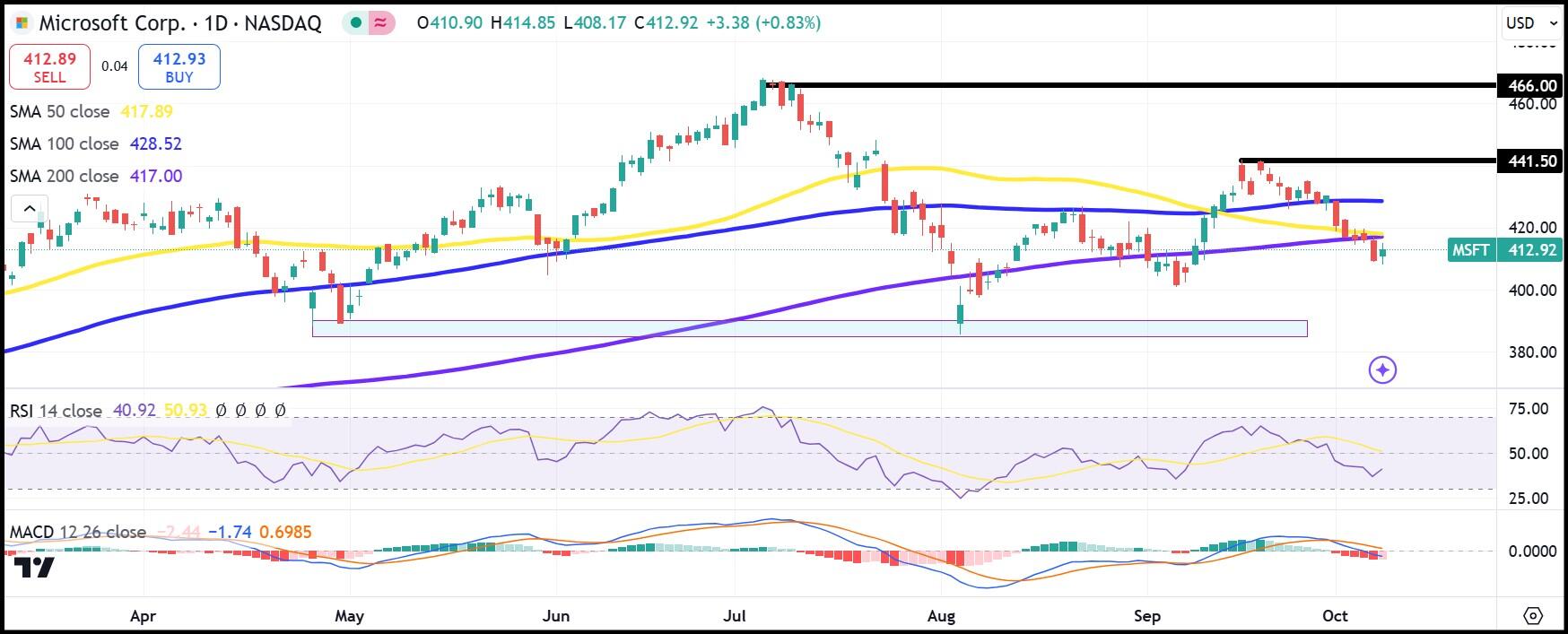
MSFT daily stock chart
Author

Clay Webster
FXStreet
Clay Webster grew up in the US outside Buffalo, New York and Lancaster, Pennsylvania. He began investing after college following the 2008 financial crisis.