Mexican Peso depreciates a percent against Euro after French elections

Most recent article: Mexican Peso depreciates as Banxico Governor Rodriguez stays dovish
- The Mexican Peso weakens a percent against the Euro after preliminary results from Sunday’s French election.
- The far-right National Rally failed to win as many votes as expected and is unlikely to win an outright majority.
- USD/MXN looks vulnerable to unfolding another leg lower in the short-term.
The Mexican Peso (MXN) trades a percent lower against the Euro on Monday as markets breathe a sigh of relief following the first round of the French elections. These showed the French far-right National Rally failing to win enough votes to have a high probability of forming a ruling majority.
At the time of writing, one US Dollar (USD) buys 18.40 Mexican Pesos, EUR/MXN is trading at 19.77, and GBP/MXN at 23.30.
Mexican Peso falls to the Euro after French elections
The Mexican Peso is falling against the Euro after the preliminary results of the French election allay fears of the far-right nationalists grabbing power and undermining the institutions of the European Union (EU).
Initial results show the far-right National Rally (NR) is set to win around 33.0% of the vote, slightly underperforming its 36.2% of the final poll of polls. The left-wing New Popular Front (NPF) coalition is forecast to win around 29%, slightly outperforming their last-polled 28.0%. French President Emmanuel Macron’s Renaissance party is on track to win 20.0%, which is in line with the 20.4% gained in the final poll.
The French election system uses a two-step process whereby in all constituencies where there is no outright winner with over 25% of the vote, there is a second round of voting to decide a winner using the two leading candidates and anyone else who won more than 12.5% of the votes. This is likely to apply to about half of the 577 seats in the French parliament. The left alliance has said it will remove candidates in remaining seats who are in third place and encourage their supporters to vote for the leading non-right-wing contender. Tactical voting is likely to deny NR an overall majority, according to Jim Reid, Global Head of Macro Research at Deutsche Bank.
Mexican Peso claws back losses from Banxico meeting
The Mexican Peso has managed to win back most of the losses it suffered following the dovish Bank of Mexico (Banxico) meeting last week. Although Banxico did not lower its policy rate from 11.00%, as expected, the board made several changes to the language of the accompanying statement that suggested an increased probability of a rate cut coming down the track. Unlike the previous meeting, one of the board members, Omar Mejía, also voted to cut interest rates.
“Of note was the seemingly little weight the Bank placed on recent MXN depreciation filtering through to higher inflation. Overall, we would argue there is a dovish tilt that leaves the door wide open to further rate cuts this year,” said Rabobank in a note.
On the data front, Mexican Business Confidence falls to 53.0 from 53.3 in June, according to data from INEGI. The Fiscal Balance will also be released for May on Monday.
Technical Analysis: USD/MXN looking to unfold another down leg
USD/MXN is looking vulnerable to further weakness in the near-term as it starts to slide following a shallow pull back from the June 28 low.
USD/MXN 4-hour Chart
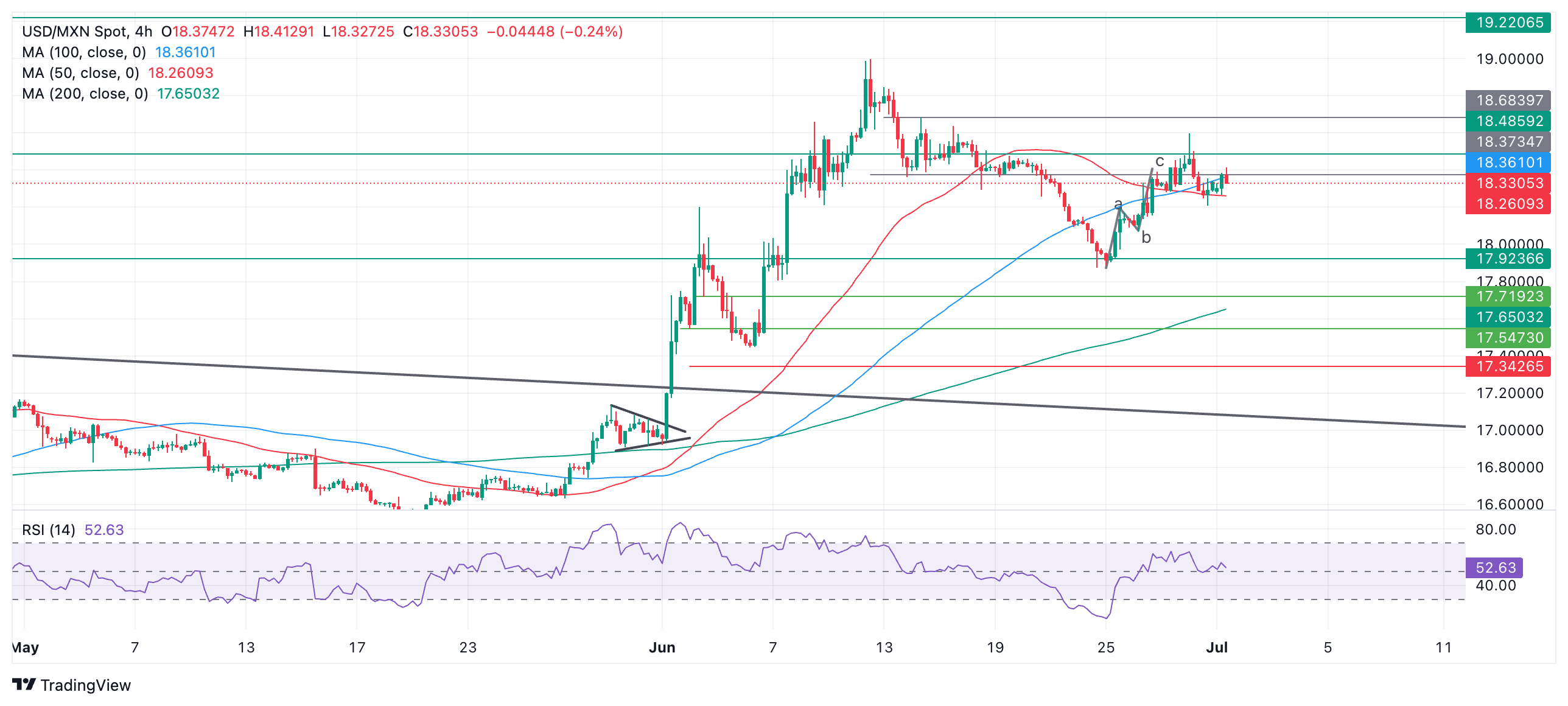
If USD/MXN continues lower in another bearish leg it will probably reach a target at around 18.17, the 0.618 Fibonacci extrapolation of the June 28 decline.
The pair is no overall trend in the short term, so there is no bearish or bullish bias.
A move below 18.06 (June 26 low) would suggest the short-term downtrend was resuming and probably see a continuation down to 17.87 (June 24 low).
Alternatively, if USD/MXN rallies and breaks above 18.60 (June 28 high), it is likely to continue up to 18.68 (June 14 high), followed by 19.00 (June 12 high). A break above 19.00 would provide strong confirmation of a resumption of the short-and-intermediate term uptrend.
The direction of the long-term trend also remains in doubt.
Banxico FAQs
The Bank of Mexico, also known as Banxico, is the country’s central bank. Its mission is to preserve the value of Mexico’s currency, the Mexican Peso (MXN), and to set the monetary policy. To this end, its main objective is to maintain low and stable inflation within target levels – at or close to its target of 3%, the midpoint in a tolerance band of between 2% and 4%.
The main tool of the Banxico to guide monetary policy is by setting interest rates. When inflation is above target, the bank will attempt to tame it by raising rates, making it more expensive for households and businesses to borrow money and thus cooling the economy. Higher interest rates are generally positive for the Mexican Peso (MXN) as they lead to higher yields, making the country a more attractive place for investors. On the contrary, lower interest rates tend to weaken MXN. The rate differential with the USD, or how the Banxico is expected to set interest rates compared with the US Federal Reserve (Fed), is a key factor.
Banxico meets eight times a year, and its monetary policy is greatly influenced by decisions of the US Federal Reserve (Fed). Therefore, the central bank’s decision-making committee usually gathers a week after the Fed. In doing so, Banxico reacts and sometimes anticipates monetary policy measures set by the Federal Reserve. For example, after the Covid-19 pandemic, before the Fed raised rates, Banxico did it first in an attempt to diminish the chances of a substantial depreciation of the Mexican Peso (MXN) and to prevent capital outflows that could destabilize the country.
Author

Joaquin Monfort
FXStreet
Joaquin Monfort is a financial writer and analyst with over 10 years experience writing about financial markets and alt data. He holds a degree in Anthropology from London University and a Diploma in Technical analysis.