Mexican Peso weakens as trade war jitters boost US Dollar
- Mexican Peso depreciates over 1% as Trump threatens more China tariffs; risk-off sentiment crushes EM currencies.
- Peso slumps for second straight day as VIX hits pandemic-era highs, fueling flight to safety into USD.
- Sheinbaum avoids retaliatory tariffs as Mexico pushes for dialogue; auto sector fears long-term disruption.

The Mexican Peso (MXN) plunges against the US Dollar (USD), extending its losses for the second consecutive day as risk appetite deteriorates, with traders moving into the safe-haven status of the Greenback. Hopes that Washington would reconsider the tariff decision over the weekend were cut short. At the time of writing, the USD/MXN exchange rate is 20.68, representing an increase of more than 1%.
The financial markets are under stress as volatility measures reach levels last seen since the Covid crisis in March 2020, as depicted by the Volatility Index (VIX) futures. Hence, Emerging Market (EM) currencies remain pressured with the Peso trading near five-week lows.
Recently, US President Donald Trump threatened China that if they don’t retract from imposing new 34% duties on US exports to its country, the US will add 50% tariffs on Chinese products effective April 9.
Recently, the Mexican President, Claudia Sheinbaum, said that she would like to avoid imposing reciprocal tariffs on the US, adding that the Economy Minister Marcelo Ebrard would continue negotiations with US officials.
Mexican Auto Exports and Production improved in March compared to February’s figures. However, tariffs imposed on automobiles could weigh on future numbers, as some companies have expressed that they will relocate to the United States (US) and even reduce work hours in Mexico’s factories.
Ahead in the calendar, Mexico’s docket will feature inflation figures and the release of Banco de Mexico’s (Banxico) latest meeting minutes. In the US, inflation data and the Federal Reserve’s (Fed) minutes will be announced.
Daily digest market movers: Mexican Peso ignores decent economic figures and drops
- Mexico’s Auto Exports rose by 3.8% YoY up from -9.2% contraction. Auto Production increased by 12.1% on an annual basis, exceeding the -0.8% contraction in February.
- Mexico’s Consumer Confidence deteriorated further in March, showing the economy continues to slow down.
- Fed Governor Adriana Kugler said that tariffs and shortages are important to consider when forecasting inflation. She added that new tariffs will be “consequential” and have already begun to see some price increases.
- Banxico’s Governor, Victoria Rodríguez Ceja, stated that the central bank will remain attentive to US trade policies and their impact on the country, with a primary focus on inflation, as she noted in an interview with El Financiero.
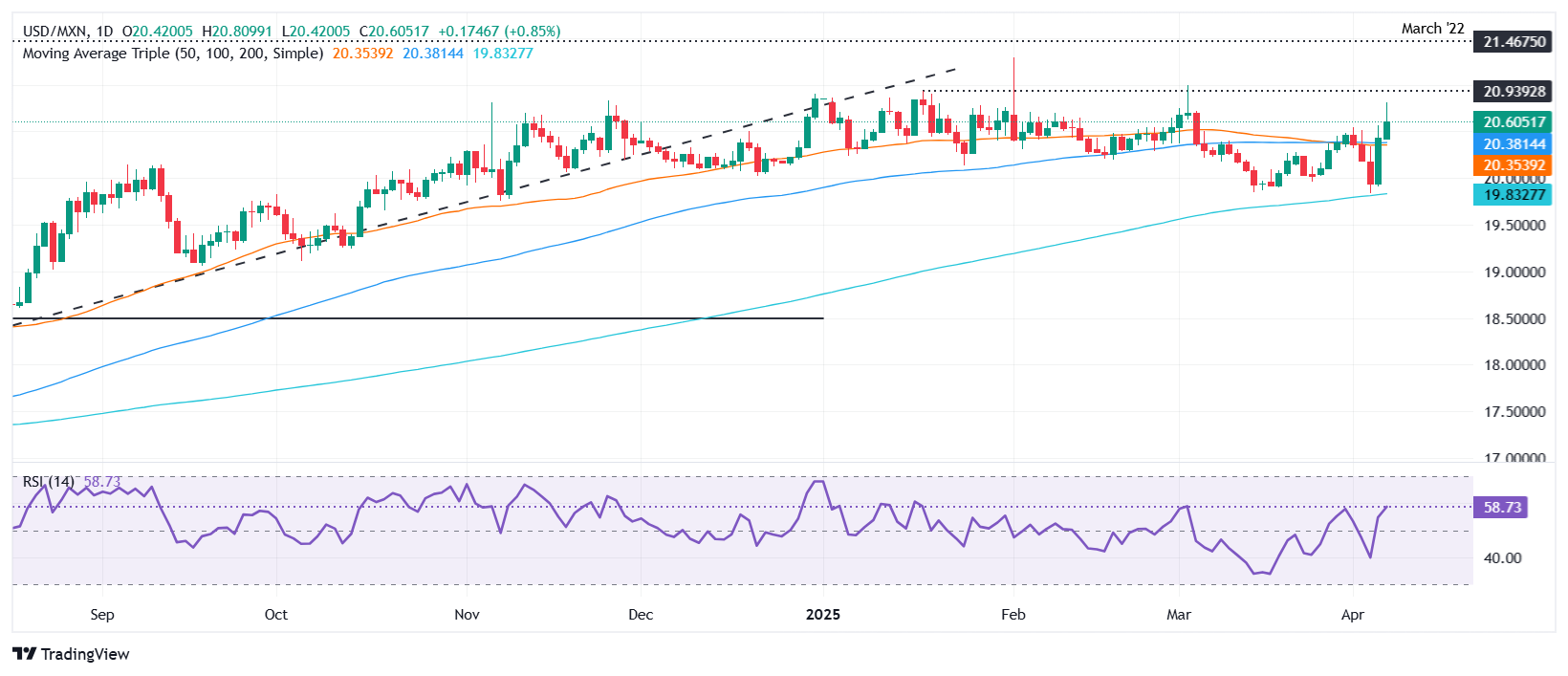
USD/MXN technical outlook: Mexican Peso treads water as USD/MXN climbs above 20.50
The USD/MXN uptrend continues with buyers clearing the confluence of the 50 and 100-day Simple Moving Averages (SMAs) near 20.34/36, which has exacerbated a rally to a multi-week high of 20.80. Nevertheless, buyers are reluctant to push prices higher, and the pair remains above 20.50.
If USD/MXN clears 20.80, the next resistance would be the March 4 peak at 20.99. A breach of the latter will expose 21.00, followed by the February 3 high of 21.28. Conversely, the first support is the confluence of the 50 and 100-day Simple Moving Averages (SMAs) around 20.34/36, followed by the 20.00 mark. A breach of the latter will expose the 200-day SMA at 19.76.
Economic Indicator
12-Month Inflation
The 12-month inflation index released by the Bank of Mexico is a measure of price movements by the comparison between the retail prices of a representative shopping basket of goods and services. The purchase power of Mexican Peso is dragged down by inflation. The inflation index is a key indicator since it is used by the central bank to set interest rates. Generally speaking, a high reading is seen as positive (or bullish) for the Mexican Peso, while a low reading is seen as negative (or Bearish).
Read more.Next release: Wed Apr 09, 2025 12:00
Frequency: Monthly
Consensus: -
Previous: 3.77%
Source: National Institute of Statistics and Geography of Mexico
Author

Christian Borjon Valencia
FXStreet
Markets analyst, news editor, and trading instructor with over 14 years of experience across FX, commodities, US equity indices, and global macro markets.