Mexican Peso trades sideways against the US Dollar as US jobs data remains in focus
- USD/MXN trades sideways with prices stalling above 19.20.
- The Mexican Peso remains vulnerable to broader risk sentiment, capping USD/MXN losses.
- US inflation moderates, but the Fed may not be willing to change its tone just yet.

The Mexican Peso (MXN) is trading in a tight range against the US Dollar (USD) on Tuesday, following the Greenback's recovery from Monday’s sell-off.
With USD/MXN trading above the psychological support level at 19.20, the 10-day Simple Moving Average (SMA) is providing resistance at 19.31.
US Job Openings increase in April, providing slight optimism for the US Dollar
Tuesday’s Job Openings and Labor Turnover Survey showed JOLTS beat analyst forecasts, posting a 7.391 million increase in the number of job openings in April. The results came in above the estimated 7.1 million increase and higher than March's 7.2 million increase.
Federal Reserve (Fed) Governor Lisa Cook commented on the current state of the US economy. In her speech at the Council on Foreign Relations, she stated that: "I see the US economy as still being in a solid position, but heightened uncertainty poses risks to both price stability and unemployment." Although this comment alone may seem to reiterate the Fed’s hawkish tone, Cook also stated that "The resulting policy decisions may look quite different from those that would be optimal under certainty."
These comments reaffirm the Fed’s commitment to maintaining a cautious balance between economic growth and price stability. For the Fed’s next move, job data released throughout this week remains key, with emphasis on Friday’s NFP numbers.
Mexican Peso daily digest: USD/MXN stalls with prices above 19.20
- The release of the JOLTS data has helped ease fears surrounding a softening labour market in the United States, reducing pressure on the Federal Reserve to deviate from its hawkish monetary policy stance in the near term.
- Factory Orders, released on Tuesday, reflected a 3.7% MoM decline in April, missing analyst forecasts of a 3% contraction. Although the data came in well below the 3.4% increase in March, tariffs implemented in early April played a major role in influencing demand for goods from US manufacturers. For this reason, the economic data print had a limited influence on the momentum of the US Dollar.
- On Wednesday, the ADP Employment data will be released at 12:15 GMT, reflecting the number of jobs added to the US private sector in May. Analysts expect the report to show that the private sector added 115,000 jobs last month, nearly double the 62,000 added in April.
- Friday’s NFP figures are expected to show that 130,000 new jobs were added to the US economy in May, down from 177,000 in April.
- Meanwhile, the unemployment rate is expected to remain at 4.2%, reflecting a resilient US labour market.
- According to the CME FedWatch Tool, market participants are currently pricing in a 70% chance of a rate cut in September. For June and July meetings, the expectation is that the Fed will maintain its benchmark rate at the current range of 4.25%-4.50%.
- On Thursday, Mexico will release the Consumer Confidence data for May, which gauges how individuals and consumers in Mexico perceive the economy's resilience in the face of current economic risks, as well as their expectations for near-term growth prospects.
- With April’s reading of 45.5 serving as the benchmark, any upside or downside surprises could further influence the direction of the Mexican Peso.
Mexican Peso technical analysis: USD/MXN remains conflicted above psychological support
USD/MXN is currently trading below the 10-day Simple Moving Average (SMA), providing near-term support at 19.31. With the 20-day SMA standing at 19.38, the 19.20 psychological level has become a support level.
For the pair’s next move, technical and fundamental headwinds remain in place.
A break above the 20-day SMA would bring the 78.6% Fibonacci retracement level of the October–February rally (near 19.58) into focus, and a successful move beyond that could open the door to the 23.6% Fib of the April–May decline around 19.63. The Relative Strength Index (RSI) has risen to 45, indicating that bearish momentum is fading, although it has not yet signaled bullish strength.
USD/MXN daily chart
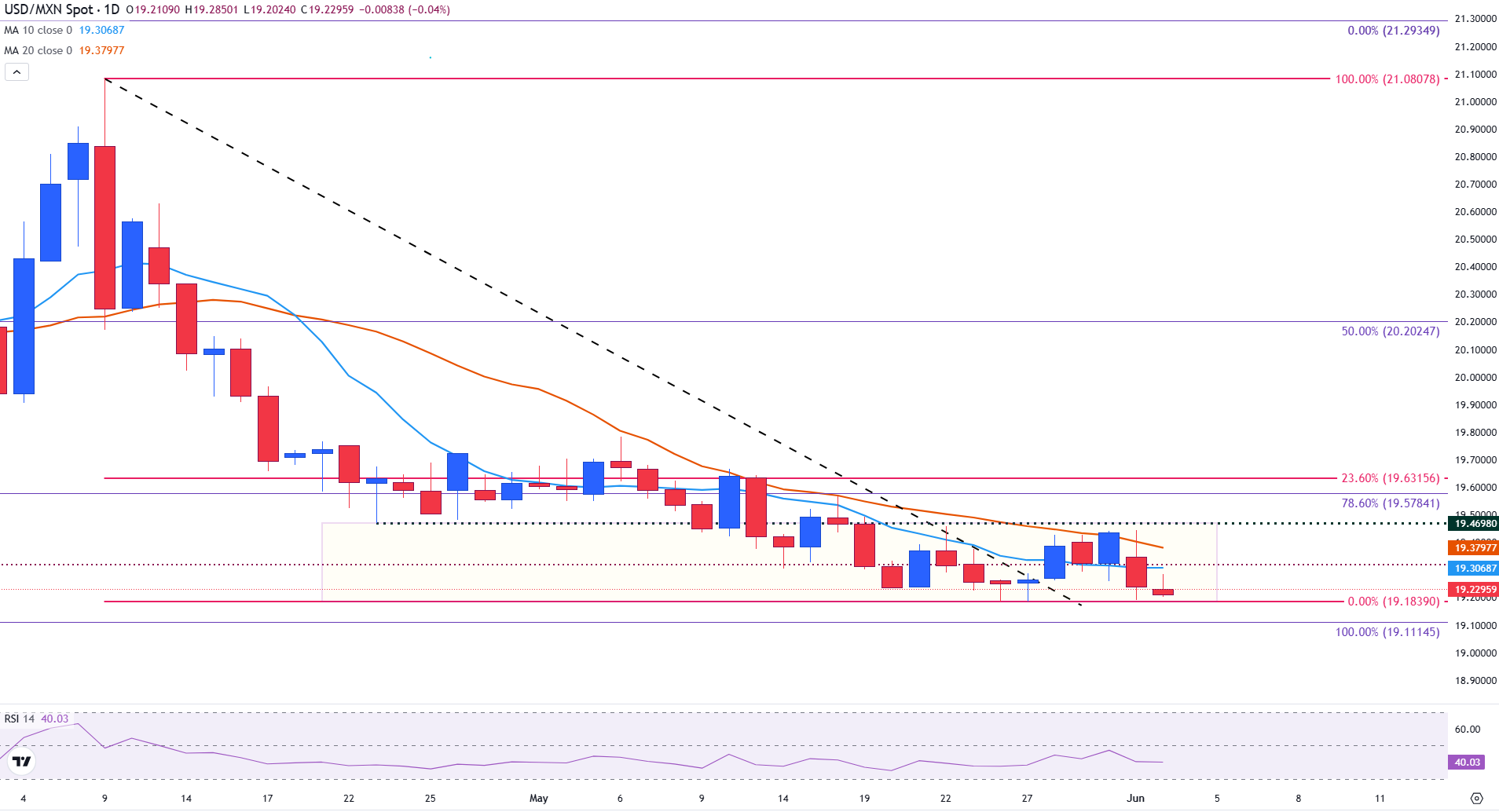
On the downside, a break below the 10-day SMA and psychological support at 19.30 would reassert bearish control, potentially pushing prices down to prior resistance at 19.28 and the May low at 19.18. This makes the current range a critical battleground for short-term direction.
Mexican Peso FAQs
The Mexican Peso (MXN) is the most traded currency among its Latin American peers. Its value is broadly determined by the performance of the Mexican economy, the country’s central bank’s policy, the amount of foreign investment in the country and even the levels of remittances sent by Mexicans who live abroad, particularly in the United States. Geopolitical trends can also move MXN: for example, the process of nearshoring – or the decision by some firms to relocate manufacturing capacity and supply chains closer to their home countries – is also seen as a catalyst for the Mexican currency as the country is considered a key manufacturing hub in the American continent. Another catalyst for MXN is Oil prices as Mexico is a key exporter of the commodity.
The main objective of Mexico’s central bank, also known as Banxico, is to maintain inflation at low and stable levels (at or close to its target of 3%, the midpoint in a tolerance band of between 2% and 4%). To this end, the bank sets an appropriate level of interest rates. When inflation is too high, Banxico will attempt to tame it by raising interest rates, making it more expensive for households and businesses to borrow money, thus cooling demand and the overall economy. Higher interest rates are generally positive for the Mexican Peso (MXN) as they lead to higher yields, making the country a more attractive place for investors. On the contrary, lower interest rates tend to weaken MXN.
Macroeconomic data releases are key to assess the state of the economy and can have an impact on the Mexican Peso (MXN) valuation. A strong Mexican economy, based on high economic growth, low unemployment and high confidence is good for MXN. Not only does it attract more foreign investment but it may encourage the Bank of Mexico (Banxico) to increase interest rates, particularly if this strength comes together with elevated inflation. However, if economic data is weak, MXN is likely to depreciate.
As an emerging-market currency, the Mexican Peso (MXN) tends to strive during risk-on periods, or when investors perceive that broader market risks are low and thus are eager to engage with investments that carry a higher risk. Conversely, MXN tends to weaken at times of market turbulence or economic uncertainty as investors tend to sell higher-risk assets and flee to the more-stable safe havens.
Author

Tammy Da Costa, CFTe®
FXStreet
Tammy is an economist and market analyst with a deep passion for financial markets, particularly commodities and geopolitics.