Mexican Peso weakens after meeting resistance as Trump trade persists
- The Mexican Peso trades lower in key pairs, reversing its recovery on Thursday.
- The Fed’s decision to cut interest rates in the US weighed on the US Dollar whilst uncertainty over tariffs is still a threat to the Peso.
- USD/MXN finds support at the 50-day SMA and remains in a broader uptrend.

The Mexican Peso (MXN) trades lower in its key pairs on Friday after rising up and meeting resistance near the top of a falling channel it has been steadily declining in since Mexico’s June elections.
The Peso dips further against the US Dollar (USD) during the Us session after the preliminary release of the Michigan Consumer Sentiment Survey, which rose to 73 in November from 70.5 in October, and above expectations of 71.
Whilst the Peso initially weakened on Wednesday because of President elect Donald Trump’s victory in the US presidential election, it quickly bounced back. MXN's initial depreciation came on the back of concerns about the impact of Trump’s tariff-heavy agenda on Mexican exports to the US.
Pressure on the Peso eased, however, after the release of higher-than-expected Mexican headline inflation data for October suggested the Bank of Mexico (Banxico) might not be as aggressive in cutting interest rates as had previously been expected. This came to the Peso’s aid since elevated interest rates tend to attract greater inflows of foreign capital.
The Peso recovered further following the Federal Reserve’s (Fed) November policy meeting – which had an overall negative impact on the US Dollar (USD), as reflected by the three-quarter percent decline in the US Dollar Index (DXY) on the day. The Fed decided to cut the Fed Funds Target Range (FFTR) by 25 basis points (bps) (0.25%) to 4.50%-4.75% as expected, largely ignoring the market’s assessment of Trumponomics as likely to spur higher inflation.
The Fed’s accompanying statement made no direct reference to the potential impact of Trump’s economic agenda on the economy and the wording was little changed from the previous meeting. During his press conference, Fed Chairman Jerome Powell said he could not comment on the impact of Trump’s policies since he did not know the “timing, (or) substance of policy changes.” He also dismissed the rise in US Treasury bond yields as resulting from higher inflation expectations. Overall, it was as if the election had never happened.
Mexican Peso faces uncertainty from tariffs
The Mexican Peso is impacted by uncertainty regarding the impact of Donald Trump’s promised tariffs on Mexican goods entering the US.
Trump has threatened to place tariffs of 200% or even 300% on Chinese vehicles entering the US via Mexico. During the election campaign, Chinese investment in electric car plants in Mexico was put on hold due to uncertainty about the outcome. That said, some Mexicans remain optimistic about Chinese companies continuing to manufacture in Mexico.
“The arrival of Donald Trump to the US presidency will not discourage investments by Chinese electric vehicle manufacturers in Mexico, as they can focus on the local market and avoid exporting cars to US territory,” said Mexican financial consultant Luis Felipe Alcántara Pozos, to El Financiero.
Others have made the point that even if Trump imposes high tariffs, Mexico is still a gateway to a broader Latin America market.
Many of Trump’s tariff policies may actually be difficult to implement given the United States-Mexico-Canada Agreement (USMCA) free trade deal. This already stipulates that Mexican autos exported to the US must contain a high percentage of US components, so if tariffs were imposed on these vehicles, they would also have a detrimental impact on the US companies exporting components to Mexico.
US Congress election result could impact Peso
Trump has won the presidency and his Republican party also gained a majority in the United States (US) Senate. However, the US Congress is still up for grabs. On Friday, the Republican party had won 211 seats to the Democratic party’s 199, according to the Associated Press, with 25 still to be called. The threshold to obtain the majority of seats stands at 218.
If the Republicans win a majority in Congress, they will have a “clean sweep,” and Trump will be able to implement his policies with less friction and delay.
According to forecasts by El Financiero, a Republican majority in Congress with Trump as President could lead the Peso to weaken even further against the USD. They estimate a band of between 21.14 and 22.26 for USD/MXN in such a scenario. The pair currently trades just above 20.00.
If the Republicans fail to win a majority in Congress, the pair is likely to end up in a range between 19.70 and 21.14, says El Financiero.
Technical Analysis: USD/MXN falls to support
USD/MXN weakens to support from the 50-day Simple Moving Average (SMA) at 19.70 after forming a bearish Long-Legged Doji candlestick on Wednesday, which was followed up and confirmed by a long red down day on Thursday.
USD/MXN Daily Chart
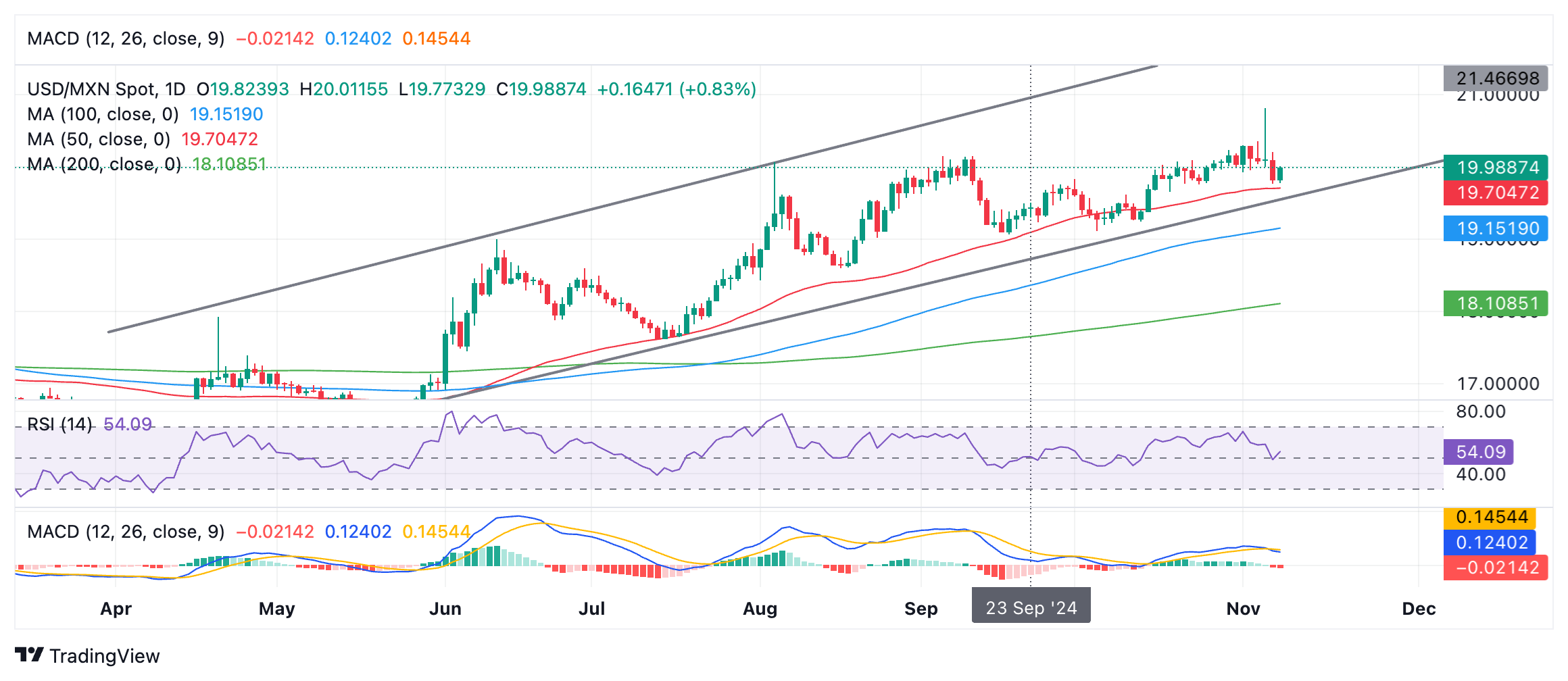
The Moving Average Convergence Divergence (MACD) momentum indicator has crossed below its signal line, giving a sell signal, another bearish indication.
However, USD/MXN remains within the guardrails of a rising channel and is still in an overall uptrend on a short, medium and long-term basis. Given the technical principle that “the trend is your friend,” the odds favor an eventual continuation higher.
A break above the 20.80 high set on Wednesday would probably confirm more gains, with 21.00 as the next key target and resistance level (round number, psychological support).
Economic Indicator
Michigan Consumer Sentiment Index
The Michigan Consumer Sentiment Index, released on a monthly basis by the University of Michigan, is a survey gauging sentiment among consumers in the United States. The questions cover three broad areas: personal finances, business conditions and buying conditions. The data shows a picture of whether or not consumers are willing to spend money, a key factor as consumer spending is a major driver of the US economy. The University of Michigan survey has proven to be an accurate indicator of the future course of the US economy. The survey publishes a preliminary, mid-month reading and a final print at the end of the month. Generally, a high reading is bullish for the US Dollar (USD), while a low reading is bearish.
Read more.Last release: Fri Nov 08, 2024 15:00 (Prel)
Frequency: Monthly
Actual: 73
Consensus: 71
Previous: 70.5
Source: University of Michigan
Consumer exuberance can translate into greater spending and faster economic growth, implying a stronger labor market and a potential pick-up in inflation, helping turn the Fed hawkish. This survey’s popularity among analysts (mentioned more frequently than CB Consumer Confidence) is justified because the data here includes interviews conducted up to a day or two before the official release, making it a timely measure of consumer mood, but foremost because it gauges consumer attitudes on financial and income situations. Actual figures beating consensus tend to be USD bullish.
Author

Joaquin Monfort
FXStreet
Joaquin Monfort is a financial writer and analyst with over 10 years experience writing about financial markets and alt data. He holds a degree in Anthropology from London University and a Diploma in Technical analysis.