Mexican Peso plunges on Trump's policies, focus shift to Banxico
- Mexican Peso weakens on fears of Trump-imposed tariffs on Mexican imports.
- Banxico expected to cut rates by 25 bps as inflation approaches 3% target.
- Upcoming US and Mexico economic data, including consumer confidence and Banxico decision, may add to Peso’s volatility.

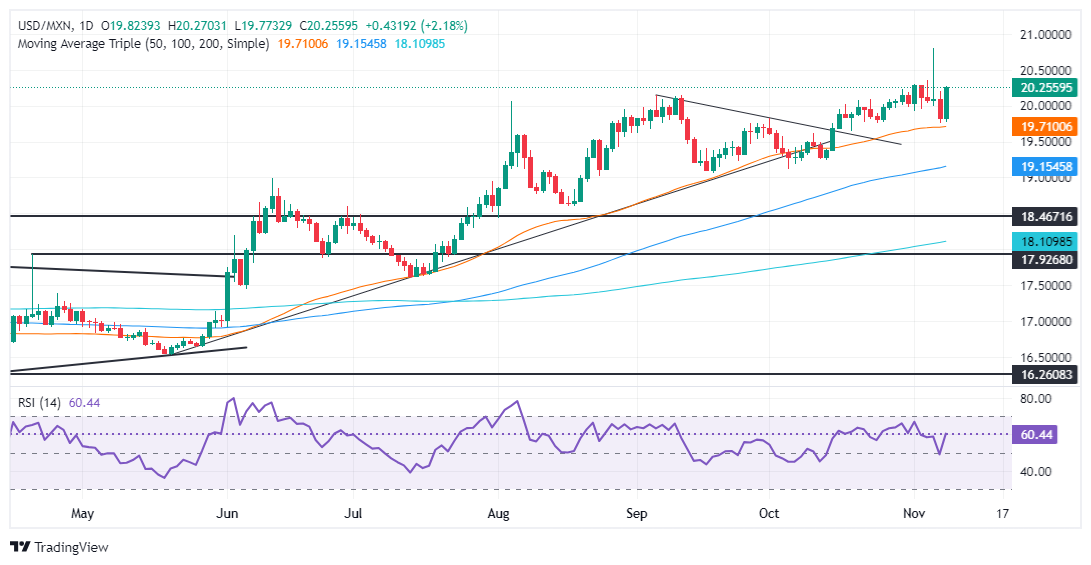
The Mexican Peso is against the ropes versus the Greenback on Friday, with the latter recovering some ground even though the US Federal Reserve (Fed) cut rates on Thursday. Risk aversion sponsored by China’s lack of clarity on its program to stimulate the economy weighed on global equities, while traders continue to digest Trump’s victory for a third day. At the time of writing, the USD/MXN trades at 20.16, up more than 1.85%.
Mexico’s economic docket remains absent on Friday, but there’s some anxiety after Americans elected Donald Trump as their next president. Fears that Trump could impose tariffs on Chinese and Mexican imports, could spark a reacceleration of inflation and disrupt supply chains.
Mexico’s Economy Secretary Marcelo Ebrard commented on Thursday that most of Mexico’s imports from China are made by around 50 companies and most of them are American. “Putting a tariff on those imports will only put those companies in danger, starting with the automotive industry,” Ebrard said.
In the meantime, the Bank of Mexico (Banxico) is expected to lower rates by 25 basis points on its monetary policy next week. The chances of adjusting policy 50 basis points (bps) are remote, though the latest report showed that underlying inflation dipped from 3.91% to 3.80% YoY, closing into the 3% goal.
Recently in the US, the Consumer Sentiment for November was revealed by the University of Michigan (UoM). The index improved sharply, but inflation expectations in the near and long term were mixed.
On Thursday, the Fed lowered rates by 25 bps but failed to provide guidance moving forward. Fed Chair Jerome Powell and the Federal Open Market Committee (FOMC) voted unanimously. In Powell’s presser he added that the economy remains solid, the labor market has cooled somewhat, and that inflation made progress toward the 2% goal. Despite this, the US central bank hasn’t declared victory on high prices.
Next week, Mexico’s schedule will feature Consumer Confidence readings, Industrial Production and the Banxico policy decision. On the US front, Fed speakers, inflation on the consumer and the producer side and Retail Sales will dictate the US Dollar’s path moving forward.
Daily digest market movers: Mexican Peso collapses on downbeat mood
- The UoM Consumer Sentiment preliminary November reading improved from 70.5 to 73.0, a 3.5% increase. Survey Director Joanne Hsu revealed that, “While current conditions were little changed, the expectations index surged across all dimensions, reaching its highest reading since July 2021.”
- Inflation expectations for one-year dipped from 2.7% to 2.6%. For a five-year period, they inched up from 3.0% to 3.1%.
- Data from the Chicago Board of Trade, via the December fed funds rate futures contract, shows investors estimate 24.5 bps of Fed easing by the end of the year.
USD/MXN technical outlook: Mexican Peso tumbles again as USD/MXN rises above 20.00
As mentioned throughout the whole week, the USD/MXN bias is upwards, and the correction post-November 5 seems to be reversed. Sellers had lost steam, and buyers re-emerged at around 19.70, pushing the exotic pair above 20.00.
If buyers reclaim 20.50, the two-year peak hit at 20.80 would be exposed. Once those two levels are surpassed, 21.00 would be up next, followed by the March 8 peak at 21.46.
Economic Indicator
Central Bank Interest Rate
The Bank of Mexico announces a key interest rate which affects the whole range of interest rates set by commercial banks, building societies and other institutions for their own savers and borrowers. Generally speaking, if the central bank is hawkish about the inflationary outlook of the economy and rises the interest rates it is positive, or bullish, for the Mexican Peso.
Read more.Next release: Thu Nov 14, 2024 19:00
Frequency: Irregular
Consensus: -
Previous: 10.5%
Source: Banxico
Mexican Peso FAQs
The Mexican Peso (MXN) is the most traded currency among its Latin American peers. Its value is broadly determined by the performance of the Mexican economy, the country’s central bank’s policy, the amount of foreign investment in the country and even the levels of remittances sent by Mexicans who live abroad, particularly in the United States. Geopolitical trends can also move MXN: for example, the process of nearshoring – or the decision by some firms to relocate manufacturing capacity and supply chains closer to their home countries – is also seen as a catalyst for the Mexican currency as the country is considered a key manufacturing hub in the American continent. Another catalyst for MXN is Oil prices as Mexico is a key exporter of the commodity.
The main objective of Mexico’s central bank, also known as Banxico, is to maintain inflation at low and stable levels (at or close to its target of 3%, the midpoint in a tolerance band of between 2% and 4%). To this end, the bank sets an appropriate level of interest rates. When inflation is too high, Banxico will attempt to tame it by raising interest rates, making it more expensive for households and businesses to borrow money, thus cooling demand and the overall economy. Higher interest rates are generally positive for the Mexican Peso (MXN) as they lead to higher yields, making the country a more attractive place for investors. On the contrary, lower interest rates tend to weaken MXN.
Macroeconomic data releases are key to assess the state of the economy and can have an impact on the Mexican Peso (MXN) valuation. A strong Mexican economy, based on high economic growth, low unemployment and high confidence is good for MXN. Not only does it attract more foreign investment but it may encourage the Bank of Mexico (Banxico) to increase interest rates, particularly if this strength comes together with elevated inflation. However, if economic data is weak, MXN is likely to depreciate.
As an emerging-market currency, the Mexican Peso (MXN) tends to strive during risk-on periods, or when investors perceive that broader market risks are low and thus are eager to engage with investments that carry a higher risk. Conversely, MXN tends to weaken at times of market turbulence or economic uncertainty as investors tend to sell higher-risk assets and flee to the more-stable safe havens.
Author

Christian Borjon Valencia
FXStreet
Markets analyst, news editor, and trading instructor with over 14 years of experience across FX, commodities, US equity indices, and global macro markets.