Mexican Peso sinks as Trump's imposes auto tariffs on all countries
- The Mexican Peso falls as traders brace for a 50-basis-point rate cut amid signs of cooling inflation and weak economic activity.
- Banxico expected to slash rates by 50 bps as economy shows signs of fatigue.
- Economic activity remains in contraction despite solid retail sales and marginal January improvement.

The Mexican Peso (MXN) depreciates against the US Dollar (USD) during the North American session on Wednesday following the release of economic data during the week, which highlighted the evolution of the disinflation process as well as an economy that is weakening. The USD/MXN trades at 20.22, up 0.60%.
Recently, US President Donald Trump announced plans for long promised tariffs of up to 25% on automotive imports. He said "What we're going to be doing is a 25% tariff for all cars that are not made in the United States," at an event in the Oval Office. "We start off with a 2.5% base, which is what we're at, and go to 25%."
Aside from this, traders are bracing for Banco de Mexico’s (Banxico) monetary policy decision on Thursday. The central bank is expected to reduce rates by 50 basis points (bps) from 9.50% to 9% due to the evolution of the disinflation process and signs that the economy is slowing down.
This week, Mexico’s economic schedule revealed that Economic Activity in January improved compared to December but remained in contractionary territory for the second consecutive month. Meanwhile, inflation data was positive as the first-half inflation in March dropped in both headline and core readings, an indication of the evolution of the disinflation process.
Other data showed that Retail Sales in January were solid, exceeding the previous month's reading and forecasts, but it is the first solid reading since April 2024, as sales shrank during the last eight straight months.
Given the backdrop, further upside is seen in USD/MXN. However, if US President Donald Trump makes tariff exemptions to Mexico, the outlook for the economy could improve. Hence, the Peso could strengthen and exert downward pressure on the exotic pair.
Ahead this week, Mexico’s docket will feature the Balance of Trade and Banxico’s interest rate decision. Across the border, the US schedule will feature the release of the Fed’s preferred inflation gauge, the core Personal Consumption Expenditures (PCE) Price Index.
Daily digest market movers: Mexican Peso drops ahead of Banxico’s meeting
- The Citi Expectations Survey revealed that most private economists expect Banxico to reduce rates by 50 basis points. According to the survey, Mexico’s primary reference rate is expected to end 2025 at 8%, down from 8.25%.
- The same survey projects the USD/MXN to end at 20.98, down from 21.00 in the last poll.
- Inflation expectations remained anchored in the high 3% range, while GDP is foreseen expanding by 0.6%, down from 0.8% in the last survey.
- Traders had priced the Fed to ease policy by 64 basis points (bps) throughout the year, according to data from the Chicago Board of Trade.
USD/MXN technical outlook: Mexican Peso loses traction as USD/MXN rises past 20.10
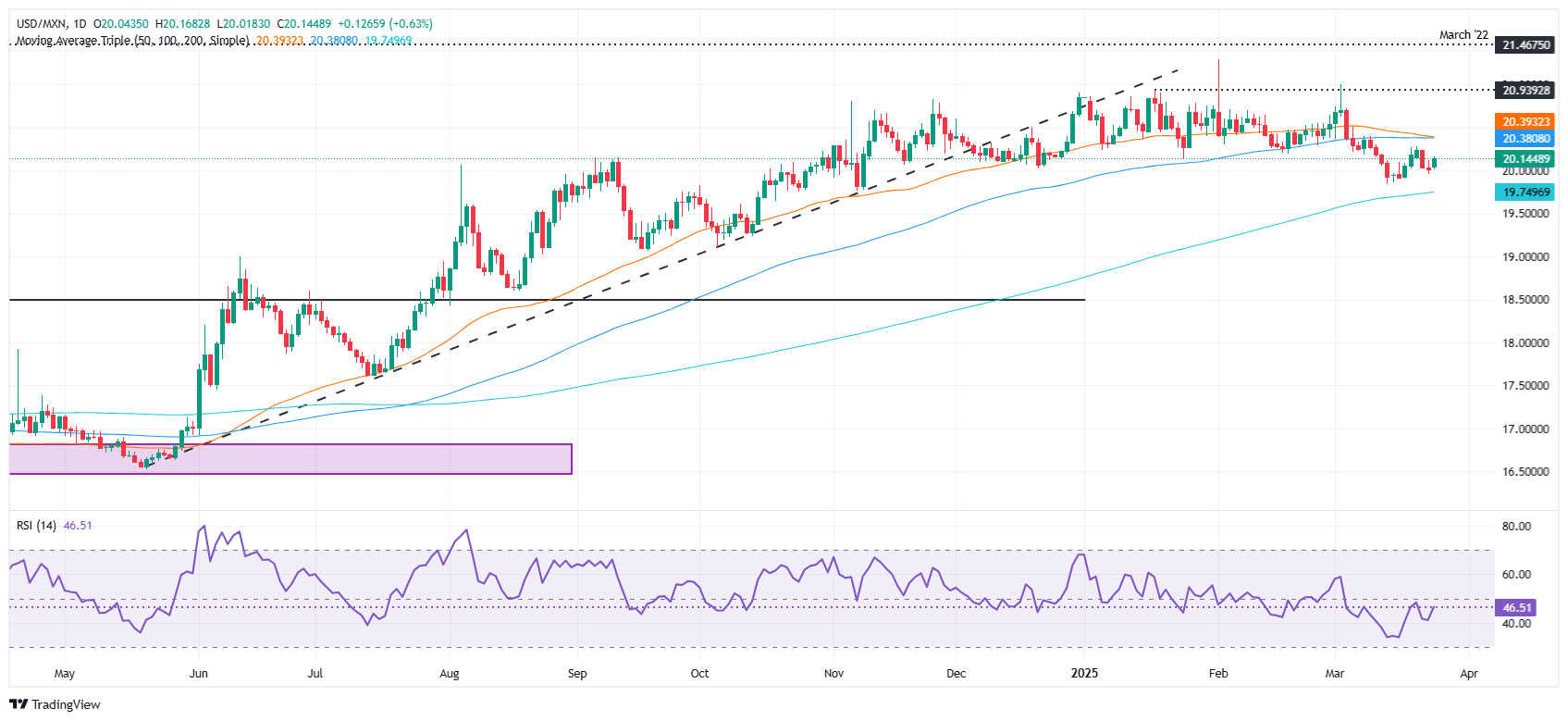
USD/MXN remains upwardly biased. Although it has refreshed a two-day high at 20.16, it fell below 20.10, paving the way for further downside. The Relative Strength Index (RSI) shows that momentum does not support either buyers or sellers, hinting at choppy trading conditions.
That said, the first key support would be the 20.00 figure. If hurdled, the next support would be the 200-day Simple Moving Average (SMA) at 19.71, followed by the September 18 swing low of 19.06. On the other hand, if USD/MXN bulls clear the 20.20 mark, the exotic pair would be poised to test the confluence of the 100-day and 50-day SMAs at 20.22 and 20.38 each, ahead of the 20.50 area.
Mexican Peso FAQs
The Mexican Peso (MXN) is the most traded currency among its Latin American peers. Its value is broadly determined by the performance of the Mexican economy, the country’s central bank’s policy, the amount of foreign investment in the country and even the levels of remittances sent by Mexicans who live abroad, particularly in the United States. Geopolitical trends can also move MXN: for example, the process of nearshoring – or the decision by some firms to relocate manufacturing capacity and supply chains closer to their home countries – is also seen as a catalyst for the Mexican currency as the country is considered a key manufacturing hub in the American continent. Another catalyst for MXN is Oil prices as Mexico is a key exporter of the commodity.
The main objective of Mexico’s central bank, also known as Banxico, is to maintain inflation at low and stable levels (at or close to its target of 3%, the midpoint in a tolerance band of between 2% and 4%). To this end, the bank sets an appropriate level of interest rates. When inflation is too high, Banxico will attempt to tame it by raising interest rates, making it more expensive for households and businesses to borrow money, thus cooling demand and the overall economy. Higher interest rates are generally positive for the Mexican Peso (MXN) as they lead to higher yields, making the country a more attractive place for investors. On the contrary, lower interest rates tend to weaken MXN.
Macroeconomic data releases are key to assess the state of the economy and can have an impact on the Mexican Peso (MXN) valuation. A strong Mexican economy, based on high economic growth, low unemployment and high confidence is good for MXN. Not only does it attract more foreign investment but it may encourage the Bank of Mexico (Banxico) to increase interest rates, particularly if this strength comes together with elevated inflation. However, if economic data is weak, MXN is likely to depreciate.
As an emerging-market currency, the Mexican Peso (MXN) tends to strive during risk-on periods, or when investors perceive that broader market risks are low and thus are eager to engage with investments that carry a higher risk. Conversely, MXN tends to weaken at times of market turbulence or economic uncertainty as investors tend to sell higher-risk assets and flee to the more-stable safe havens.
Author

Christian Borjon Valencia
FXStreet
Markets analyst, news editor, and trading instructor with over 14 years of experience across FX, commodities, US equity indices, and global macro markets.