Mexican Peso firms as USD/MXN slips from resistance ahead of Fed
- Mexican Peso recovers after failing to retest 19.80.
- Traders trim USD positions ahead of the Federal Reserve’s rate decision
- Technical resistance holds, with 19.80 capping the upside in USD/MXN for now

Mexican peso recovers modestly ahead of the Fed decision
The Mexican Peso (MXN) is rising against the US Dollar (USD) on Tuesday, reversing earlier losses as traders reduced Dollar exposure ahead of Wednesday’s highly anticipated Federal Reserve (Fed) policy decision.
At the time of writing, USD/MXN is down 0.16%, trading around 19.665, after briefly testing and rejecting resistance near 19.78.
The intraday reversal reflects a shift in short-term positioning, as investors prepare for new policy guidance from the Fed and reassess the extent of recent Dollar gains. Risk-sensitive assets, including the Mexican Peso, are stabilising modestly despite lingering global uncertainty and cautious market sentiment.
Diverging US data keeps outlook uncertain
The recent move in USD/MXN has been heavily influenced by Monday’s conflicting US services data. The Institute for Supply Management (ISM) Services PMI beat expectations, rising to 51.6 in April from 50.8, pointing to strength in business activity. However, the S&P Global US Services PMI dropped to 50.8, missing its flash estimate and highlighting a broader deceleration in service sector growth.
The divergence underscores mixed economic signals in the US, which has complicated the outlook for interest rate cuts. Treasury yields rose modestly following the ISM release, but follow-through has been limited, allowing the Mexican Peso to regain some ground.
Political backdrop remains a secondary market driver
Meanwhile, political tensions between Mexico and the United States remain in the background.
Over the weekend, Mexican President Claudia Sheinbaum publicly rejected an offer by US President Donald Trump to deploy American troops in Mexico to fight drug cartels. Sheinbaum reaffirmed Mexico’s sovereignty, stating: “We can work together, but you in your territory and us in ours.”
Although the development has drawn diplomatic attention, markets have treated it as a background risk with limited direct impact on USD/MXN price action.
All eyes are on the Fed and Banxico policy divergence
- The Federal Open Market Committee (FOMC) is expected to keep the benchmark interest rate steady in the 4.25%-4.50% range on Wednesday. However, market focus will be on the tone of Chair Jerome Powell’s press conference for any signal on the timing of rate cuts.
- According to the CME FedWatch Tool, traders are pricing in a 25 basis-point (bps) rate cut in July, though expectations have eased slightly following Monday’s ISM beat. A dovish tone from Powell could weaken the US Dollar and lift the Peso.
- The Bank of Mexico (Banxico) is expected to deliver another 50 bps cut at its next meeting on May 15. Mexican Q1 Gross Domestic Product (GDP) rose just 0.2%, narrowly avoiding recession, while inflation continues to cool. Banxico has maintained a cautious, data-driven approach.
- Recent US tariffs on key Mexican exports – including metals and autos – have added pressure to the external sector, weighing on trade and investment outlooks.
- Uncertainty surrounding global demand, commodity prices, and future US trade or immigration policy continues to cloud the outlook for emerging market assets like the Mexican Peso.
Technical analysis – USD/MXN fails to reclaim 19.800
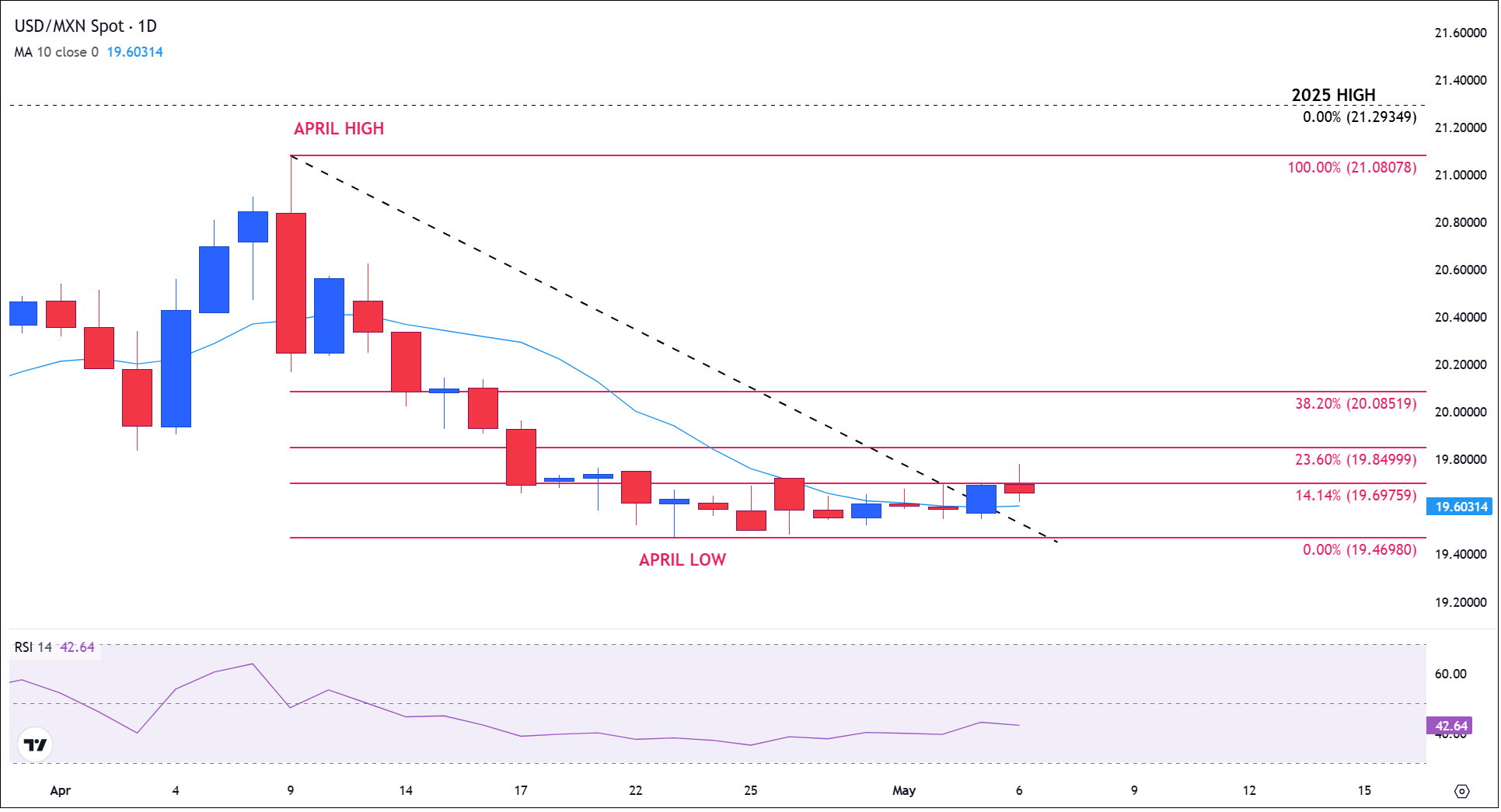
USD/MXN reversed lower on Tuesday after failing to reclaim the 19.800 level, a key confluence area just below the descending trendline of the April decline. The intraday high at 19.7819 marked the session peak before the pair lost momentum and fell back below the 10-day Simple Moving Average (SMA) at 19.6031.
The 14.14% Fibonacci retracement of the April move, located at 19.6975, has now shifted back to resistance following the rejection.
The Relative Strength Index (RSI) remains below neutral at 42.64, indicating softening bullish momentum without entering oversold territory. A decisive close below 19.60 would expose deeper support toward the April low of 19.4698, while resistance is likely to re-emerge on any recovery toward the 19.70–19.78 zone.
USD/MXN daily chart
Banxico FAQs
The Bank of Mexico, also known as Banxico, is the country’s central bank. Its mission is to preserve the value of Mexico’s currency, the Mexican Peso (MXN), and to set the monetary policy. To this end, its main objective is to maintain low and stable inflation within target levels – at or close to its target of 3%, the midpoint in a tolerance band of between 2% and 4%.
The main tool of the Banxico to guide monetary policy is by setting interest rates. When inflation is above target, the bank will attempt to tame it by raising rates, making it more expensive for households and businesses to borrow money and thus cooling the economy. Higher interest rates are generally positive for the Mexican Peso (MXN) as they lead to higher yields, making the country a more attractive place for investors. On the contrary, lower interest rates tend to weaken MXN. The rate differential with the USD, or how the Banxico is expected to set interest rates compared with the US Federal Reserve (Fed), is a key factor.
Banxico meets eight times a year, and its monetary policy is greatly influenced by decisions of the US Federal Reserve (Fed). Therefore, the central bank’s decision-making committee usually gathers a week after the Fed. In doing so, Banxico reacts and sometimes anticipates monetary policy measures set by the Federal Reserve. For example, after the Covid-19 pandemic, before the Fed raised rates, Banxico did it first in an attempt to diminish the chances of a substantial depreciation of the Mexican Peso (MXN) and to prevent capital outflows that could destabilize the country.
Author

Tammy Da Costa, CFTe®
FXStreet
Tammy is an economist and market analyst with a deep passion for financial markets, particularly commodities and geopolitics.