Mexican Peso recovers due to reduced risk of trade war
- The Mexican Peso is rebounding on Thursday as the threat of trade between the US and Mexico recedes.
- Reportedly positive conversations between the two country’s leaders, resulting in upbeat messages on social media, are calming investor nerves.
- Technically, USD/MXN pushes back from the top of a mini range and begins to cycle lower.

The Mexican Peso (MXN) rebounds by almost one and a half percentage points in its most-traded pairs on Thursday as markets price in less chance of a United States (US) – Mexico trade war.
The Peso makes back the losses it suffered on Tuesday. These came after President-elect Donald Trump said he would place 25% tariffs on Mexican and Canadian imports unless they put a stop to illegal immigration and the cross-border traffic of narcotics into the US. The MXN declined due to the expected hit such tariffs would have on Mexican exports.
In response, Mexican President Claudia Sheinbaum said Mexico would counter any US levies with its own tariffs. Sheinbaum said Mexico was already doing a lot to reduce illegal immigration, which had come down by 75% in 2024 so far. Further, she said Mexico was also cracking down on drug cartels smuggling Fentanyl into the US but that these gangs were being armed with guns from the US. A trade war would do substantial harm to business in both countries' economies, she added.
The Mexican Peso stabilized on Wednesday, however, after Trump appeared to soften his rhetoric towards Mexico. Late on Wednesday, the former president posted a message on Truth Social that he had just had “a wonderful conversation” with Sheinbaum and that she had agreed to stop migration through Mexico, according to Lallalit Srijandorn, editor at FXStreet. His comments suggested the 25% tariffs might be averted.
Mexican Peso rallies as Trump softens his rhetoric towards Mexico
The Mexican Peso edges higher after President-elect Donald Trump characterized his conversation with President Sheinbaum as “wonderful” late on Wednesday.
“She has agreed to stop migration through Mexico, and into the United States, effectively closing our southern border,” Trump wrote on Truth Social.
“We also talked about what can be done to stop the massive drug inflow into the United States, and also, US consumption of these drugs. It was very productive,” Trump continued.
At the start of this week, the Mexican Peso dropped like a lead balloon after Trump announced that he planned to impose a 25% tariff on Mexican imports in an effort to get the country to crack down on illegal immigration and drug smuggling.
For her part, President Sheinbaum initially appeared to echo Trump’s assessment of their talk, posting on X that she had had “an excellent conversation” with Trump, in which “we discussed Mexico's strategy on the migration phenomenon and I shared that [migrant] caravans are not arriving at the northern border because they are being taken care of in Mexico.”
Later, Sheinbaum tweeted that during their conversation, she had “reiterated Mexico's position was not to close borders, but to address migration while respecting human rights.”
When the Levee Breaks
Trump’s initial threat to whack 25% tariffs on US neighbors’ imports into the country drew criticism from both Mexico and Canada and institutional analysts.
Barclays said that imposing a 25% tariff against Canadian and Mexican imports “could wipe out effectively all profits” from the three Detroit automakers, according to Christian Borjon Valencia, editor at FXStreet.
On Wednesday, Mexico’s Economy Minister Marcelo Ebrard said tariffs could cost the US 400,000 jobs, describing them as "a shot in the foot" for the American economy.
Mexico was particularly vulnerable after the Morena-led government made reforms to Mexican autonomous bodies that crossed clauses in the US, Mexico, and Canada Free Trade Agreement (USMCA), annulling the deal.
However, Mexico’s Congress has since proposed adjustments to the details of the reforms – which abolished several regulatory bodies – to ensure compliance with the USMCA.
“The fact that MORENA is taking a more cautious approach with two of the most important regulators, antitrust and telecoms, is a positive sign,” said Rodolfo Ramos, a strategist at Brazilian bank Bradesco BBI.
Technical Analysis: USD/MXN pushing down from range ceiling
USD/MXN pushes down after touching the ceiling of a mini range (green dashed line on the chart below) that it formed during November.
USD/MXN 4-hour Chart
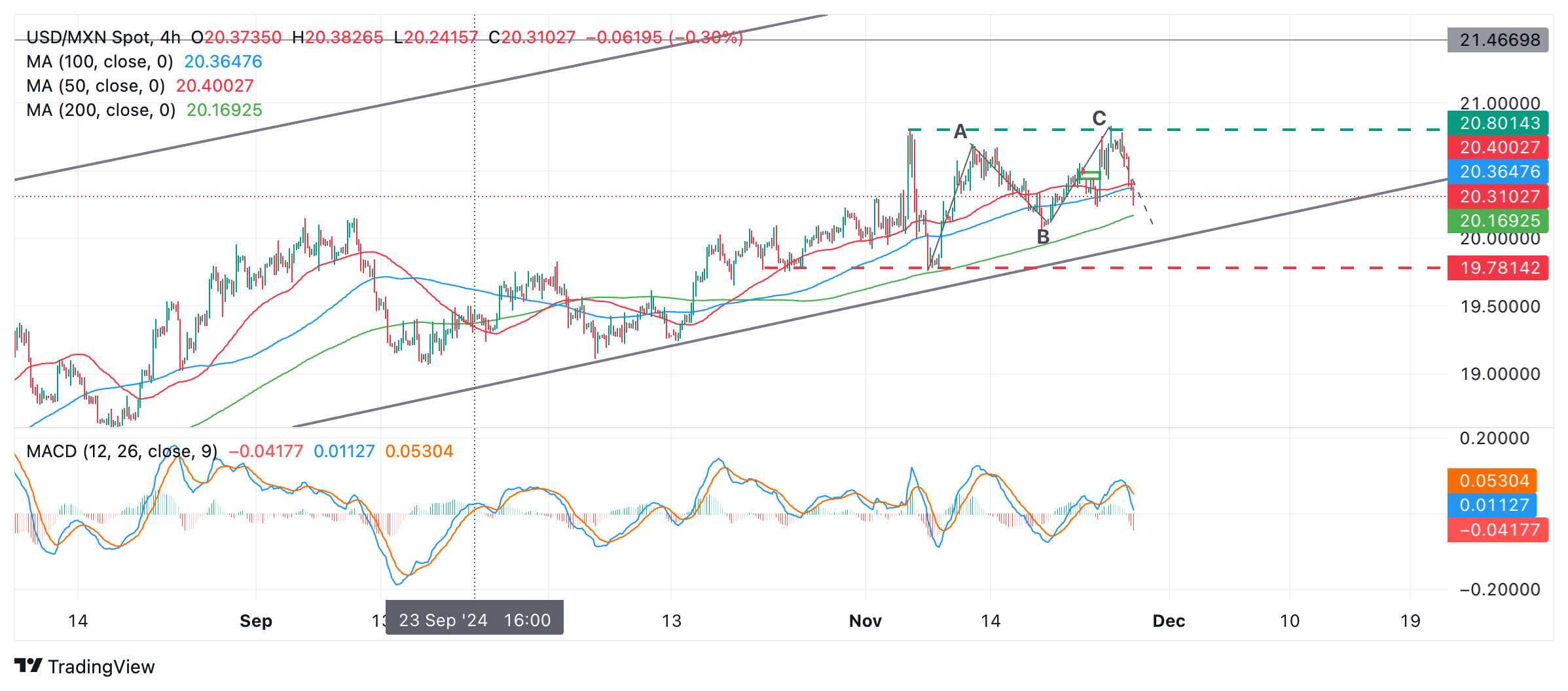
USD/MXN is probably range-bound in the short term as it oscillates within this mini range. In the medium and long term, however, it is still in an uptrend within a rising channel.
The pair is likely to continue trading up and down within the parameters of its range. The current move looks like it is taking prices back down towards support at either the 20.06 lows of wave B, the major trendline in the 19.90s, or support in the 19.70s (red dashed line).
The move is supported by a sell signal from the (blue) Moving Average Divergence Convergence (MACD) momentum indicator, which has crossed below its red signal line. The MACD is particularly reliable in sideways markets.
A decisive break above the top of the range at 20.80 would be required to signal the start of a more bullish short-term trend in line with longer-term up cycles.
US Dollar FAQs
The US Dollar (USD) is the official currency of the United States of America, and the ‘de facto’ currency of a significant number of other countries where it is found in circulation alongside local notes. It is the most heavily traded currency in the world, accounting for over 88% of all global foreign exchange turnover, or an average of $6.6 trillion in transactions per day, according to data from 2022. Following the second world war, the USD took over from the British Pound as the world’s reserve currency. For most of its history, the US Dollar was backed by Gold, until the Bretton Woods Agreement in 1971 when the Gold Standard went away.
The most important single factor impacting on the value of the US Dollar is monetary policy, which is shaped by the Federal Reserve (Fed). The Fed has two mandates: to achieve price stability (control inflation) and foster full employment. Its primary tool to achieve these two goals is by adjusting interest rates. When prices are rising too quickly and inflation is above the Fed’s 2% target, the Fed will raise rates, which helps the USD value. When inflation falls below 2% or the Unemployment Rate is too high, the Fed may lower interest rates, which weighs on the Greenback.
In extreme situations, the Federal Reserve can also print more Dollars and enact quantitative easing (QE). QE is the process by which the Fed substantially increases the flow of credit in a stuck financial system. It is a non-standard policy measure used when credit has dried up because banks will not lend to each other (out of the fear of counterparty default). It is a last resort when simply lowering interest rates is unlikely to achieve the necessary result. It was the Fed’s weapon of choice to combat the credit crunch that occurred during the Great Financial Crisis in 2008. It involves the Fed printing more Dollars and using them to buy US government bonds predominantly from financial institutions. QE usually leads to a weaker US Dollar.
Quantitative tightening (QT) is the reverse process whereby the Federal Reserve stops buying bonds from financial institutions and does not reinvest the principal from the bonds it holds maturing in new purchases. It is usually positive for the US Dollar.
Author

Joaquin Monfort
FXStreet
Joaquin Monfort is a financial writer and analyst with over 10 years experience writing about financial markets and alt data. He holds a degree in Anthropology from London University and a Diploma in Technical analysis.