|

Markets flip risk-off as Ukraine's President Zelensky cites 16 Feb. as day of Russia attack

Ukraine's President Zelensky said that the Ukraine “has been informed” that Wednesday, February 16 “will be the day of the attack”, according to comments attributed to Zelensky accompanying a Facebook update to the nation.

He does not say who or what agency provided the information. 

Nevertheless, the market is paying attention to each and every update. The 16th was a date US President Joe Biden told Western leaders about last week as a potential time when Russia will start a physical assault on Ukraine.

In an update, Russia has moved some long-range artillery and rocket launchers into firing position, threatening Ukraine, according to a US official. A bumper-to-bumper formation is seen in satellite photos — and are beginning to move into "attack positions," according to the official who said that the US believes Russia will attack Ukraine by the end of the week, although it's not yet certain what form it will take, the official said. 

The US benchmarks are printing fresh lows with the S&P 500 now moving to 4,371 the low while AIUD/JPY drops from the corrective highs and challenges what may otherwise have been regarded as the formation of an inverse head and shoulders:

AUD/JPY technical analysis, H1 chart
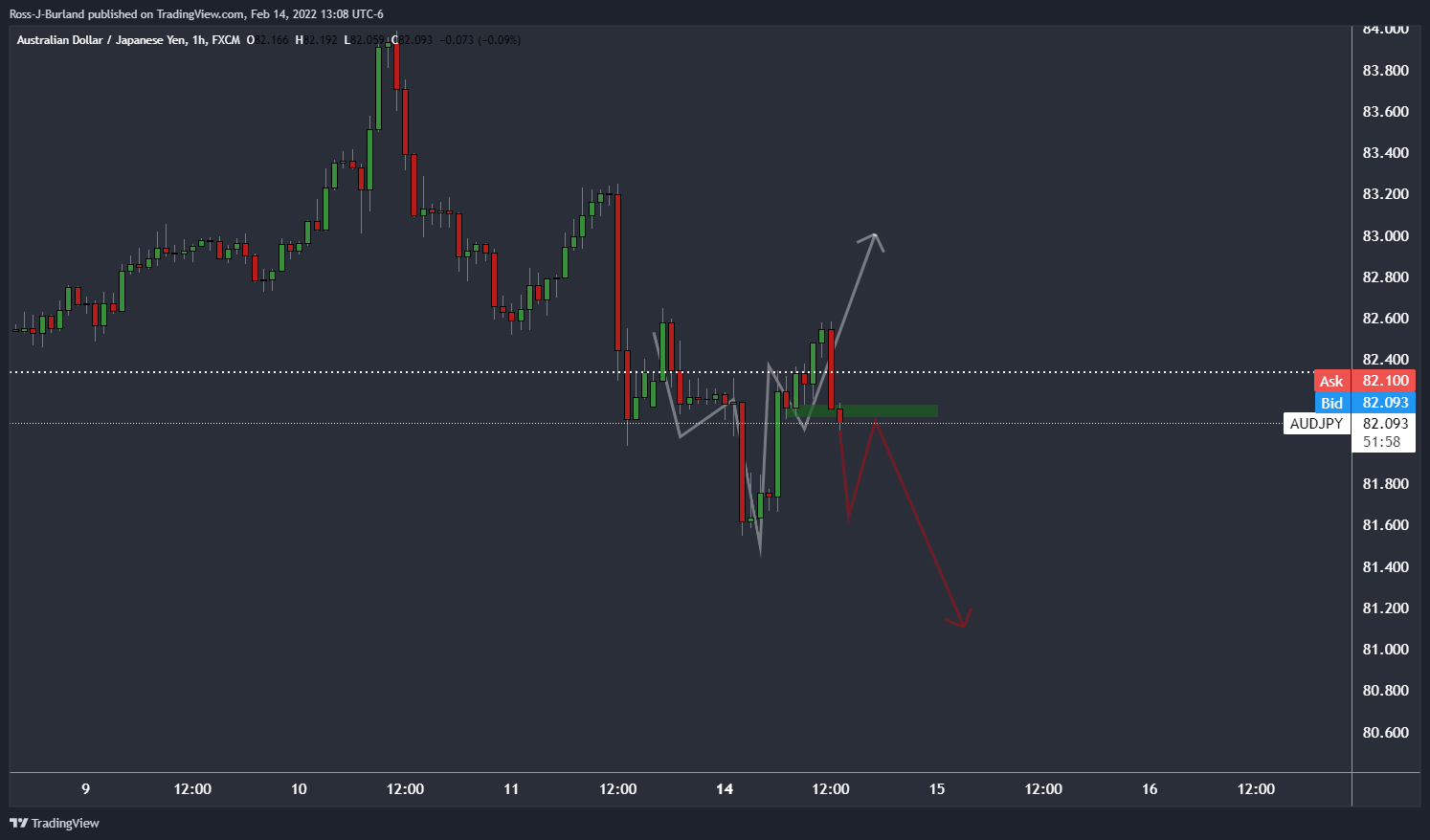
As for the forex market's risk barometer, AUD/JPY,  the price is breaking the right-hand shoulder to the downside and finding so, invalidates the inverse head and shoulders, putting the focus on the downside once again. 81.11 could become a strong level of resistance on a retest with 81.66 the next level of potential support. 

Author

Ross J Burland

Ross J Burland, born in England, UK, is a sportsman at heart. He played Rugby and Judo for his county, Kent and the South East of England Rugby team.


More from Ross J Burland
Share:

Editor's Picks

GBP/USD keeps the vacillating tone near 1.3650

GBP/USD struggles to extend its ongoimg recovery on Monday, this time flirting with the 1.3650 zone. Indeed, Cable trades without clear direction, although it manages well to maintain its business in the upper end of the recent range, challenging multi-week tops despite the decent recovery in the Greenback.

EUR/USD drifts lower to the 1.1670 zone

EUR/USD navigates a tight range at the beginning of the week, hovering around the 1.1670 region amid humble losses. The pair’s decline follows a decent advance in the US Dollar while investors continue to closely follow developments from the US money market.

Gold pushes harder; focus is now on $4,700

Gold keeps its bullish pace well and sound and approaches the $4,700 mark per troy ounce for the first time since early May. The precious metal’s move higher comes despite slight gains in the US Dollar and a modest pullback in US Treasury yields across the curve.

Here's what I learned trading meme coins
I’ve been trading cryptocurrencies for the past seven years, with meme coins becoming one of the most exciting and implacable parts of my experience. I love them because they represent internet culture and community sentiment, and, let’s be honest, extreme speculation. Newly launched meme coins were especially tempting: get in early enough, I thought, and a small bet could turn into a huge return.
Bessent’s presser in focus
Preview: Busy week ahead, with Bessent kicking this off today, with things wrapping up with Warsh at Jackson Hole. For a month that should have been a temporary period of ‘quiet’, we had anything but last week, with the bond market and tariffs front and centre.
$20 billion offered, $2 billion taken: Why Treasury doubled its buyback cap

The US Treasury moved off its own calendar on Wednesday, and that is the part worth sitting with. At 12:32 GMT, the department said it would at least double the size of liquidity support buyback operations in the 10-year to 20-year and 20-year to 30-year sectors, lifting the maximum from $2 billion per operation to at least $4 billion, effective September 9 and running to November 4.